Were DA's threats to leave just leverage, not ultimatums?
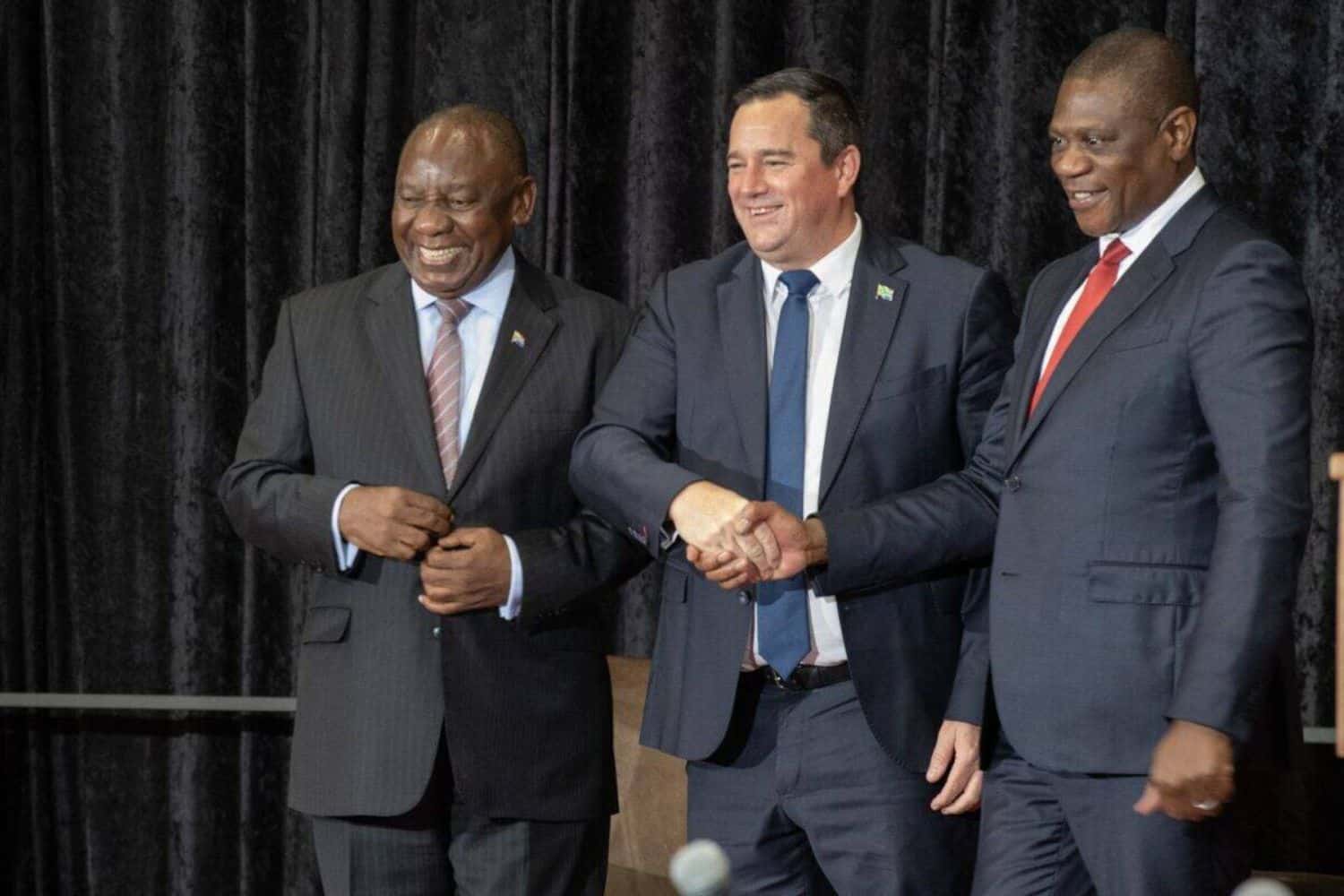
President Cyril Ramaphosa smiles as Minister of Agriculture John Steenhuisen shakes hands with Deputy President Paul Mashatile at the swearing in of ministers, on 3 July 2024, in Cape Town. Picture: RODGER BOSCH / AFP


The DA threatened to withdraw from South Africa’s government of national unity (GNU) approximately six times since its formation in June 2024.
It used the prospect of withdrawal as political leverage against what it characterised as the ANC’s unilateral actions and its protection of corrupt officials.
Despite the dramatic ultimatums and red lines, the party never actually left. Each time, DA leader John Steenhuisen ultimately chose to remain in the coalition, arguing that the alternative — a government including the EFF and MK Party — would be worse for the country.
“We do not believe that it is in the best interests of South Africa for the current GNU to collapse and for a coalition of chaos or corruption to follow because the feeding frenzy that would then result from MK or the EFF getting into office and other parties will be significant,” he explained.
2024 threats
Threat 1: Initial GNU negotiations (June 2024)
The first threat came during the very formation of the GNU.
The DA warned it would walk out when President Cyril Ramaphosa altered the terms of the agreement and withdrew an offer for the crucial Trade and Industry portfolio.
The party demanded more Cabinet positions commensurate with their electoral support before ultimately agreeing to join.
Threat 2: The BELA Bill
By September 2024, the DA threatened to leave if Ramaphosa signed the Basic education Laws Amendment Bill into law without addressing their constitutional objections related to school governing body autonomy.
Ramaphosa signed it anyway. The DA stayed.
The act was signed into law by Ramaphosa on 13 September 2024, with certain clauses, specifically sections 4 and 5, initially withheld for further consultation.
These clauses relate to school admission and language policies.
ALSO READ: Full implementation of Bela Act bruises DA’s ego
Threat 3: Protecting DA ministers
In December 2024, Steenhuisen declared that any attempt by ANC factions to influence the firing of performing DA ministers, such as Basic Education Minister Siviwe Gwarube, would “signal an end” to the coalition.
The alleged effort to remove Gwarube occurred amidst controversy and misinformation surrounding the BELA Act.
No such attempts succeeded.
DA’s threats in 2025
Threat 4: Legislation disputes
The DA declared a formal dispute with the GNU in January 2025 after Ramaphosa signed the Expropriation Bill into law without consultation.
The party also opposed the National Health Insurance Act, calling both “economy-wrecking” policies.
Steenhuisen demanded an urgent dialogue and “reset” of the GNU relationship, warning that pushing these policies without consensus could lead to their exit.
“The DA believes that the Expropriation Act is strongly unconstitutional. We will continue to use the GNU structures to mount opposition to the law,” he said, announcing plans to challenge it in court.
Threat 5: The VAT hike saga
The DA threatened to leave over a proposed Value Added Tax (VAT) increase in February 2025.
On 19 February, the original Budget Speech was postponed for the first time in democratic history due to the internal GNU conflict, with the DA claiming its “resolute opposition” to the VAT plan had forced the delay and warning that the tax increase would put the coalition’s future at risk.
When Finance Minister Enoch Godongwana finally delivered his rescheduled budget speech on 12 March, he proposed a two-step VAT increase: to 15.5% on 1 May 2025, and to 16% by April 2026.
Steenhuisen immediately rejected what he called the “tax and chaos budget,” announcing the DA would not provide the necessary majority support and again warning of the GNU’s vulnerability.
By early April, talks between the ANC and DA had hit what insiders described as a “brick wall,” with the DA refusing to agree to the budget’s fiscal framework without significant economic reforms.
ANC bosses warned their caucus that if the DA voted against the budget proposals in Parliament, the party would have effectively removed itself from the GNU.
The DA escalated the fight on 3 April, filing an urgent court application to legally challenge the fiscal framework and stop the VAT hike from being implemented.
The Presidency responded sharply. Spokesperson Vincent Magwenya reportedly stated: “You can’t be part of a government whose Budget you opposed.”
Godongwana was equally blunt: “You can’t vote against the Budget, and the next day, you want to implement that Budget. We have to draw the line.”
Finance minister gives in
Facing a court challenge and significant political pressure, Godongwana blinked.
On 24 April, he announced the withdrawal of the proposed VAT increase. The DA hailed it as a major victory, claiming their legal action had forced the government’s reversal.
A Western Cape High Court order on 27 April legally confirmed the suspension, ensuring the rate remained at 15%.
Threat 6: The Whitfield ultimatum
The most dramatic confrontation came in late June 2025 when Ramaphosa dismissed DA Deputy Minister Andrew Whitfield for travelling to Washington without approval.
Steenhuisen accused Ramaphosa of applying “flagrant double standards,” claiming Whitfield had requested permission but received no response, then apologised — again receiving silence — before being sacked without consultation.
Addressing the National Assembly, Steenhuisen issued a 48-hour ultimatum demanding the removal of corruption-accused ANC ministers, including Human Settlements Minister Thembi Simelane, implicated in VBS bank looting, Higher Education Minister Nobuhle Nkabane, who allegedly misled Parliament, and David Mahlobo, implicated by the state capture commission.
“DA members of the executive are now being fired for fighting corruption, not for committing corruption,” Steenhuisen declared.
He warned that failure to meet the ultimatum would mean “all bets are off and the consequences will be theirs to bear.”
When the deadline passed without action, the party withdrew from the National Dialogue, calling the R740 million initiative “an electioneering ploy, at taxpayer expense, to gloss over the serious crises that the ANC has plunged South Africa into.”
They resolved to vote against departmental budgets for ministers they deemed corrupt and warned that tabling a motion of no confidence in Ramaphosa remained under consideration.
“If the ANC fails to course-correct, the FedEx will seriously consider exercising our constitutional prerogative by tabling a motion of no confidence,” Steenhuisen stated.
As the GNU teetered on the brink, both the ANC and DA reportedly explored options for new partnerships. However, neither party ultimately pursued them.
ALSO READ: DA threatens to exit GNU over Whitfield’s firing
Were DA’s threats to leave just leverage, not ultimatums?
Throughout these six major instances, the DA consistently used exit threats as leverage rather than genuine intentions to collapse the government.
Helen Zille, who led the DA’s negotiating team, claimed the ANC showed bad faith from the beginning, changing draft agreements the night before the parliamentary sitting that elected Ramaphosa.
Despite agreeing to decision-making by “sufficient consensus,” Zille noted that the ANC ignored the agreement’s clauses.
“That signature isn’t worth the paper it’s written on,” she said of ANC secretary-general Fikile Mbalula’s commitment.
Steenhuisen defended the strategy of remaining in government despite frustrations.
Speaking at a media briefing in Cape Town, he insisted the arrangement served the national interest.
“I believe fundamentally that no matter how difficult the going has been and no matter how tough the analysis that has been shared, it is undeniable that South Africa is better off now for having the DA in government,” he said.
The DA leader claimed his party’s ministers set new governance standards and achieved significant reforms in portfolios including Agriculture, Home Affairs, and Communications.
He suggested ANC hostility stemmed from recognition that “DA ministers put their party to shame” and that “opportunities for looting and corruption are shrinking wherever DA reforms are implemented.”
In the end, the DA’s six exit threats proved to be precisely that: threats.
The party remained in government, continuing what Steenhuisen called the fight “within this government for more growth for more jobs and to block dangerous things and to block the ANC when it seeks to do serious lasting damage”.
READ NEXT: ‘Stop discussing my exit in dark corners’ – Ramaphosa asks ANC NEC for resignation date [VIDEO]