


Karp made history at the Soweto Marathon over the weekend, becoming the first person from Africa to reach a remarkable milestone.
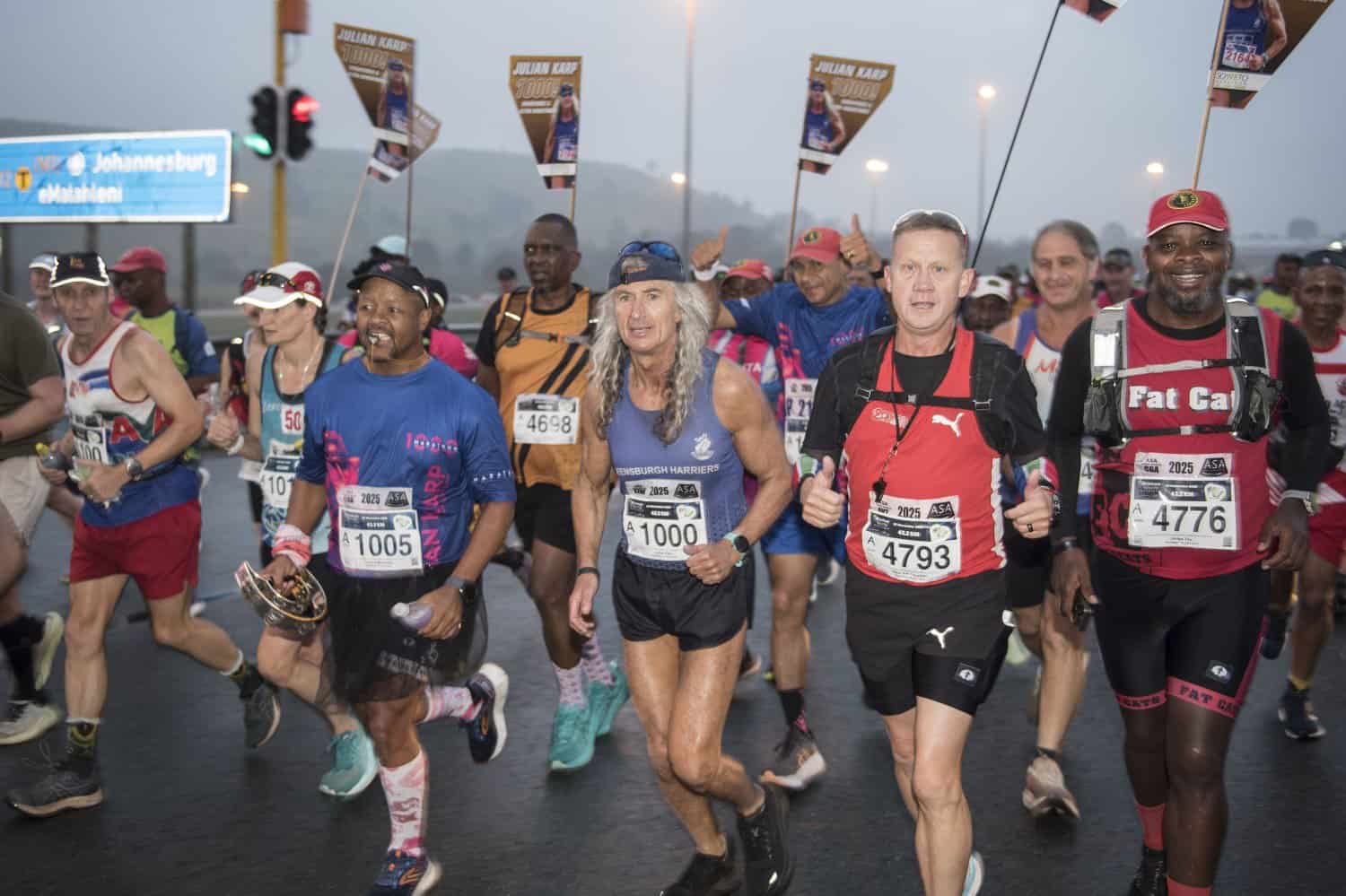
Long-distance runner Julian Karp (number 1,000) participating in the Soweto Marathon at the weekend. Picture: Michel Bega


In a country with a road running community that is obsessed with marathon and ultra-marathon races, Julian Karp has left an indelible mark.
And though he is now winding things down at the back end of his amateur career, he will always be remembered as a legend of the sport.
Karp made history on Saturday, finishing the Soweto Marathon in 5:21:35 to become the first runner from Africa to complete 1,000 marathon races.
Paced by close friends who travelled from around South Africa to join him, he was surrounded by dozens of people when he crossed the finish line.
“I never imagined it would be like this. It was absolutely brilliant,” Karp said on Sunday after a memorable day in Soweto, with organisers having given him race number 1000 to mark the occasion.
At the age of 65, Karp said he had struggled with a back injury in recent years, and he hadn’t run a marathon since May, focusing instead on shorter distance races.
So he was grateful to be able to run his 1,000th race (including 720 standard 42km marathons and 280 ultra-marathons) in the historical township.
“Every South African must run the Soweto Marathon, even if they do the 10km event. It’s a historic race filled with tradition and every time I run it I have goosebumps with every step I take,” he said.
Long journey
Reaching the milestone was a long journey for Karp, and with his marathon career potentially nearing its end, it’s ironic that his journey might conclude for the same reason it started: an injury.
As a teenager at Greenside High School in Joburg, he was passionate about playing football and tennis, and he went on to compete for the Wits U-21 football team while studying for a Bachelor of Accounting degree.
After tearing a ligament in his knee, however, Karp was told he could no longer participate in contact sport.
A friend who was a doctor suggested he start running, and it opened a new door in his life which would result in him building a legacy.
Initially focused on running fast times, he decided his knee wouldn’t hold up if he didn’t slow down, and he began concentrating on longer distance running.
“I ran the Washie 100 miler (a 169km race in the Eastern Cape) and that worked out, so I started running back-to-back marathons on weekends.”
Cutting back
Decades later, Karp said he still enjoyed running, but he was likely to do no more than a handful of marathons per year in future (far fewer than his personal record of 62) while focusing on some events he had never run, including the Great Wall of China Marathon.
Aside from his back injury and his age, which played parts in his decision, Karp had spent around R1.5 million on travel, accommodation and entry fees and it was not feasible for him to continue investing in expanding on his African record much further.
“I’ve never had to motivate myself to get out of bed and run, but my body’s tired, so I’ve started running more 21km races,” he said.
“I also can’t travel as much, so even if my back holds up, I don’t think I’ll do more than five marathons a year.”
Having done something nobody else on the continent has managed, he was in two minds about his achievement. Though he was pleased to have reached his long-term goal, he admitted it was bitter-sweet.
“It’s the end of a journey, which is quite traumatic because it’s the end of a chapter in my life, but hopefully this is also the start of a new chapter.”
Support Local Journalism
Add The Citizen as a Preferred Source on Google and follow us on Google News to see more of our trusted reporting in Google News and Top Stories.

