
Vanderbijlpark Rotarians rally for World Polio Day
Polio immunisations are provided free of charge at most public health clinics nationwide.
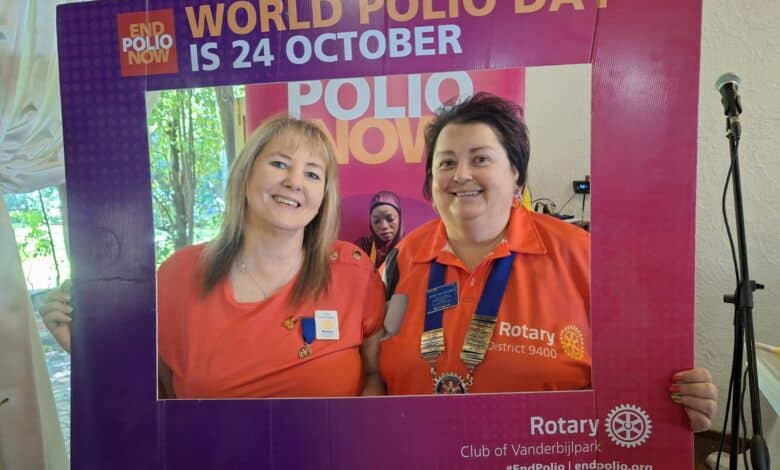
VANDERBIJLPARK – On October 24, the Rotary Club of Vanderbijlpark hosted its annual End Polio Now Breakfast at Stonehaven-on-Vaal, marking World Polio Day with a mix of education, community support, and spirited fundraising.
Past President Zander Lintvelt served as Master of Ceremonies, guiding a programme focused on the global push to eradicate polio.
Rotarian Preloshni Naidoo delivered an insightful presentation detailing the nature of the virus, its remaining strongholds, and why wiping out the final 0.1% of global cases remains the greatest challenge.
Adding an international touch to the morning, another Past President, Rita Benecke, shared the journey of the symbolic “Polio Doll,” which she brought from Mexico to Vanderbijlpark to support local awareness efforts.
The local business sector also showed strong backing. Rotarian Alice de Jager, representing the Golden Triangle Chamber of Commerce (GTCOC), presented the club with a R2 500 donation toward Rotary’s polio fund.
Fundraising efforts continued with a friendly raffle, where the lucky winner pledged to return the prize for re-auction at the next polio event to generate additional funds.
Understanding the disease
For most South Africans under 40, polio feels like a distant memory. The highly contagious virus spreads primarily through contaminated food and water, targeting children under five.
While many cases remain mild, roughly one in 200 infections attacks the central nervous system, causing irreversible paralysis within hours and potentially fatal respiratory failure.
While no cure exists, safe vaccines offer complete protection.
A global battle
Rotary International co-founded the Global Polio Eradication Initiative alongside the World Health Organisation in 1988. At the time, an estimated 350 000 cases were reported annually across 125 countries. Today, wild polio cases have plummeted by over 99.9%.
However, the threat persists. Wild poliovirus remains endemic in Pakistan and Afghanistan, which reported 52 combined cases in 2025.
With cases ticking upward in Afghanistan, health experts emphasise that as long as the virus exists anywhere, global travel leaves every unvaccinated community vulnerable.
South Africa’s vigilance
South Africa recorded its last case of wild poliovirus in 1989. In 1996, former President Nelson Mandela spearheaded the regional “Kick Polio Out of Africa” campaign, leading to the country’s official polio-free certification in 2006.
That status was temporarily revoked in 2017 due to lapses in routine immunisation coverage and disease surveillance.
Following a dedicated two-year effort by healthcare workers, South Africa regained its polio-free status in 2019, paving the way for the entire African continent to be declared free of wild poliovirus in 2020.
Health officials stress that maintaining a polio-free environment requires high routine vaccination coverage.

