Say all the recent procurement irregularities happened 'under his watch'.
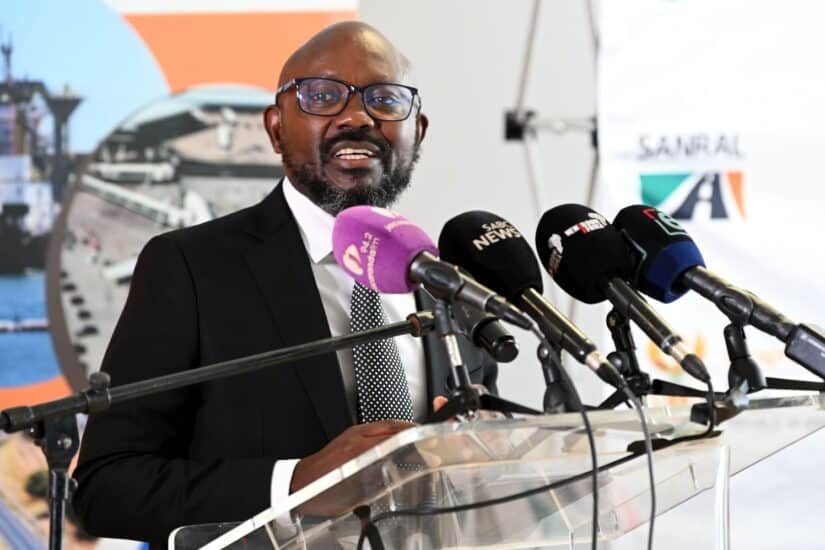
CEO Reginald Demana was placed in a ‘toxic’ environment and should explain ‘why he did not take a stand on certain issues’ or may become a scapegoat. Picture: Gallo Images/Lee Warren


Construction industry sources and analysts say they are not surprised by the decision of South African National Roads Agency (Sanral) CEO Reginald Demana to resign, arguing that the recent procurement irregularities happened under his watch.
An analyst who did not want to be named said he was astonished that Sanral had sung Demana’s praises in a Sens announcement on Thursday confirming his resignation.
“I can’t say I’m too surprised. I don’t think it’s going to reflect well when all the irregularities come out because [they] happened under his watch,” he said.
Sanral CEO steps down
Demana joined Sanral as CEO in January 2023 and will step down on 31 August 2026 to take up “a new opportunity that aligns with his long-term career ambitions”, according to the Sens announcement.
A construction company executive said he has been told that Demana had turned a blind eye to procurement irregularities but “he is not a beneficiary of it, and the rot comes from the previous board”.
“I’m not sure how true that is, but he is still an accomplice in my opinion.”
‘Toxic’ environment
Organisation Undoing Tax Abuse (Outa) CEO Wayne Duvenage also said he was not surprised by Demana’s resignation, although he believes he was capable of leading Sanral.
Duvenage said Demana’s decision to step down was likely related to the actions and overreach of the previous Sanral board, which made structural changes and interfered in the agency’s operations through executive appointments – decisions that were questioned by Outa.
“Although I do think he could have been a bit more assertive to address a lot of these issues, how do you do that while having to have look over your shoulder all the time and being set up to fail when you have people working in the oversight entity that may not like you doing your job and performing good governance role as a CEO?
“For me, it’s an issue of a toxic environment that he was in, which probably was the catalyst to him saying ‘I need to get out of here’.
“And that is the problem that we are seeing with many executives and chief financial officers in many government positions where oversight is compromising their good governance.”
Board interference
Duvenage said that as CEO Demana may still have to answer some of the questions, such as why he did not take a stand on certain issues.
He believes Demana would be able to justify his actions – “because there is so much evidence of the board’s overreach and interference” – and that he should, because by leaving he opens a bit of a door for the current people who were put there by the previous board to blame him.
“He is going to have to defend himself or possibly be the scapegoat.
“But he has probably weighed all that up and [decided] his sanity is more important than being around here and defending himself.”
Duvenage hopes Demana writes a full report “and raises his concerns around the interference and the governance” and gives it to the minister of transport “and makes it public”.
Challenge facing the next CEO
Duvenage also hopes the new Sanral board uses this opportunity to find somebody with strong leadership and governance credentials, as well as a deep understanding of the road construction, finance and maintenance sectors, in order to get Sanral back to where it was.
He warned however that whoever succeeds Demana will be taking on “a poisoned chalice”.
“There is a lot of work to be done to get the structures back so there is accountability in the various roles.”
Duvenage suggests the new board consider approaching Sanral’s former chief financial officer, who left the roads agency under a cloud in July 2024 after alleged interference by the previous board.
Demana’s impact
According to Sanral’s Sens announcement, Demana’s mandate on joining the agency was, among other things, to accelerate the development of key national road corridor infrastructure projects and stabilise Sanral’s toll portfolio.
It said Demana played a key role in several achievements during his tenure, including:
- Advancing major strategic infrastructure projects, including the R573 Moloto Road, the N2 Wild Coast Road, upgrades to the N2 and N3 in KwaZulu-Natal, the N2 Corridor in Mpumalanga and the N1 South Corridor. These projects traverse both toll and non-toll road portfolios.
- Helping resolve the Gauteng Freeway Improvement Project (GFIP) e-toll issue, which significantly strengthened Sanral’s balance sheet, largely due to the government’s decision to absorb all the related debt.
- Securing approval for an increase in Sanral’s borrowing limit to R16.5 billion until 31 March 2028, including a R7 billion government-guaranteed facility from the New Development Bank. This was key to unlocking funding capacity for toll portfolio capital investment and previously constrained capital projects.
Road ahead for Sanral
Sanral said its board has started the recruitment process for a new CEO and will appoint an acting CEO in the interim.
It said a further announcement will be made once the acting CEO has been appointed, which will be no later than 17 July 2026 to ensure a smooth handover ahead of Demana’s departure.
The board thanked Demana for his service and contribution to Sanral and wished him well in his future endeavours.
This article was republished from Moneyweb. Read the original here.