


The union says its demands are a compromise.
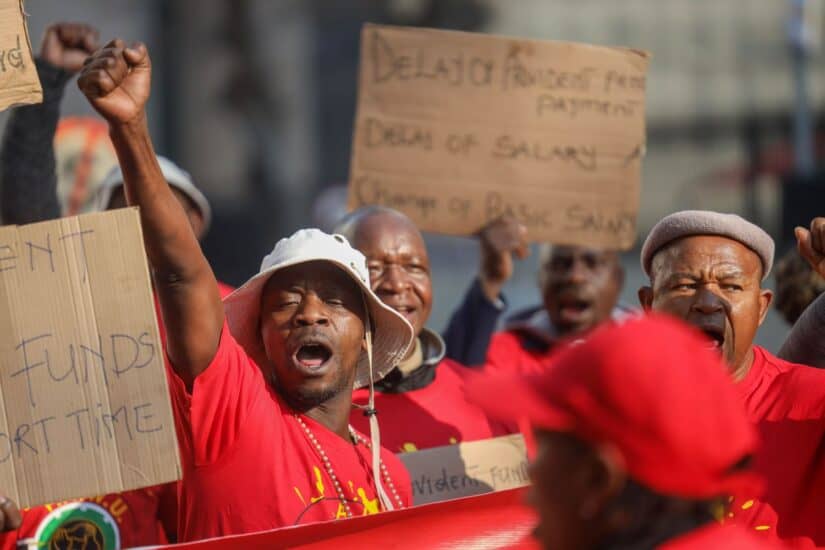
Workers affiliated with The Food and Allied Workers’ Union (FAWU) participate in a strike action at the Parktonian Hotel on July 22, 2026 in Johannesburg, South Africa. Picture: Gallo Images/Sharon Seretlo


The Food and Allied Workers’ Union (Fawu) is pushing for a better wage increase for Heineken workers, with the South African Federation of Trade Unions (Saftu) throwing its full support behind the union’s demands.
This follows a week-long protected strike action at Heineken Beverages South Africa’s operations across the country due to deadlock in wage negotiations.
“This strike is a legitimate exercise of workers’ constitutional and labour rights after all the prescribed legal processes were exhausted, including conciliation at the CCMA, where the parties remained deadlocked, leading to the issuing of a Certificate of Outcome and paving the way for protected industrial action,” said Fawu.
Demands for Heineken workers
The union is demanding a 7% across-the-board wage increase, backdated to 1 February 2026 for the legacy Sedibeng Brewery and 1 April 2026 for the legacy Distell operations. An increase in the meal allowance from R74 to R80 for shift workers and employees working overtime.
Saftu general secretary Zwelinzima Vavi told Newzroom Afrika that workers already spend most of their wages on transport and food only, so the increase must make a difference to employees’ lives.
“Inflation for workers is way above the normal rate of inflation, relating to the rest of the economy, because workers spend 60% of their wages on two things: transport and food.
“Now, when you increase the wage, you can’t want to give them something that will effectively mean no improvement in the living standards, no improvement in the wages in real terms.”
Unions to meet with Heineken
Vavi added that the solution is for the organisation to agree to the demand that employees have. It is understood that Fawu and Heineken will meet again to reach an agreement that will benefit the workers.
“There will be an S150 meeting facilitated through the CCMA called by Heineken. We hope that they will improve their offer and meet the demands.” An S150 meeting is a dispute intervention invoked during critical deadlock situations like wage negotiations or ongoing strikes.
The general secretary said the strike may be called off depending on whether the company is willing to make a reasonable offer.
Compromises
Other demands made by Fawu included that Heineken must provide transport for workers working weekend shifts and expand employee access to company liquor outlets. But these were dropped, including a R500 monthly housing allowance. The union said this was done in good faith.
“Fawu dropped the housing allowance demand, withdrew the demand relating to liquor outlets, reduced its meal allowance demand from R100 to R79/R80, and proposed that the transport issue be deferred to the National Negotiating Forum rather than be insisted upon during the wage negotiations.
“Ultimately, the union remained with only its principal demand of a 7% wage increase and the revised meal allowance demand.”
Despite these compromises, Heineken still won’t move from its original 5% wage increase.
Increase implemented in line with remuneration policies
Heineken told The Citizen the final offer of a 5% increase was implemented following appropriate procedures, which include “independent remuneration benchmarking, comparisons with relevant FMCG industry employers, employees’ total remuneration and benefits, prevailing economic conditions, affordability considerations, and the need to support the long-term sustainability of the business and future employment opportunities”.
“The Company believes remuneration should be assessed holistically and not solely through annual salary increases. In determining its position, Heineken Beverages considered employee remuneration on a total-cost-to-company basis, benchmarked against recognised external market surveys and relevant FMCG industry comparisons.”
The organisation said it remains committed to resolving the dispute through the established collective bargaining process and believes that sustainable solutions are best achieved through direct engagement between the parties within the recognised labour relations framework.
“Business continuity measures are in place to minimise disruption to customers and stakeholders, and operations will continue where it is safe and practical to do so.”



