Eskom boldly contradicts president on unbundling.
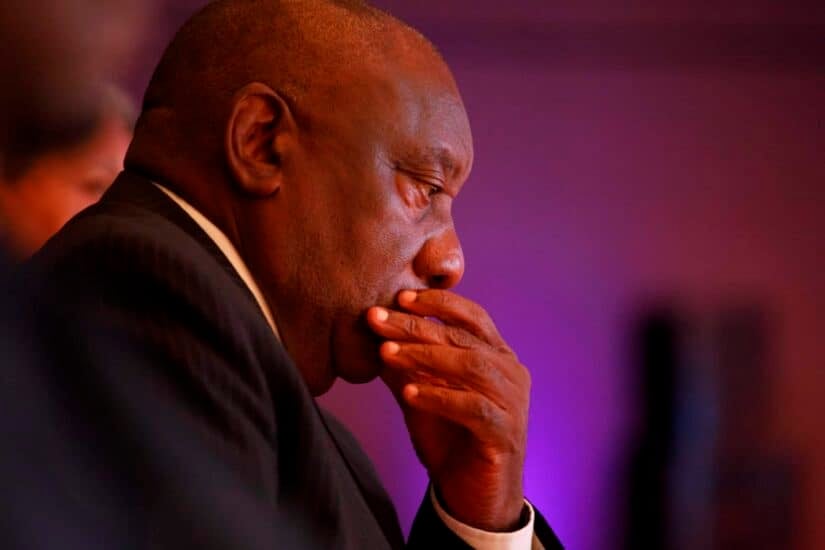
President Cyril Ramaphosa. Picture: Gallo Images/ER Lombard


South Africa has made tremendous progress towards establishing a competitive electricity market, but unless President Cyril Ramaphosa now cracks down on those resisting Eskom’s unbundling, that progress could be undone once he leaves the country’s highest office.
This is the opinion of Professor Piet Croucamp, a political scientist at North-West University – and several experts agree.
Since 2011, the government’s programme to procure electricity from independent power producers (IPPs) has attracted almost R300 billion in investment, nearly a fifth of it from foreign investors.
In addition to 12 500MW of generation capacity procured through the programme, the energy regulator has registered more than 10 000MW of large-scale private generation projects.
If the unbundling does not happen, that flow of investment will dry up, and the country will be left with Eskom’s monopoly, high electricity tariffs and polluting coal-fired power stations that will undermine the competitiveness of South African manufacturers in international markets. This is the warning from Tommy Garner, a South African Independent Power Producers Association (Saippa) board member.
The reform of South Africa’s electricity market is arguably the greatest legacy of Ramaphosa’s presidency.
Although the government’s renewable energy procurement programme began under the Zuma administration, it was Ramaphosa who, in 2021, removed the restrictions on private electricity generation despite resistance from his then energy minister, Gwede Mantashe.
Since then, Eskom’s unbundling and the transition to a competitive electricity market has been enshrined in legislation, with a deadline of the end of 2029 to separate the transmission network and system operation from Eskom so that they can function as an independent state-owned entity.
Eskom versus the president
In December, however, Eskom threw a spanner in the works by announcing that, with the backing of Minister of Electricity and Energy Kgosientsho Ramokgopa, it intended to retain ownership of the transmission assets after the unbundling.
The announcement caused considerable alarm among business leaders.
The whole point is that the transmission system must be managed independently so that Eskom and IPPs can compete on an equal footing.
An independent system operator can hardly be expected to go cap in hand to Eskom every time decisions need to be taken on matters such as expanding the grid. Without ownership of the transmission assets, it can in any event forget about raising finance for such expansions, which are already overdue and urgently needed.
In his State of the Nation Address in February, Ramaphosa put his foot down and made it abundantly clear that Eskom could forget about retaining the transmission assets.
He also appointed a task team to oversee the establishment of an independent system operator, reporting directly to him.
Since then, Ramokgopa has been noticeably quiet.
Promise of ‘political protection’
However, at the launch of Eskom Green, the power utility’s new renewable energy subsidiary, Ramokgopa made it clear that he would provide political protection for Eskom.
At the same event, Eskom chair Mteto Nyati made it equally clear that Eskom’s envisioned end state includes the National Transmission Company South Africa (NTCSA), despite Ramaphosa’s directive.
This has now sparked a public spat between Nyati and Busisiwe Mavuso, CEO of Business Leadership South Africa (BLSA), which, together with Business Unity South Africa (Busa), supports the government’s policy of fully unbundling the transmission business.
Moneyweb has learnt that Eskom also refused to support a report by Ramaphosa’s task team that proposes bringing forward the deadline for the unbundling by two years, to the end of 2027. That date coincides with the end of Ramaphosa’s term as ANC president.
Although his term as president of South Africa only ends two years later, the election of a new ANC leader could significantly weaken his authority.
There is also the possibility that this, together with the lingering Phala Phala controversy, could shorten his tenure in the Union Buildings.
It is against this backdrop, says Croucamp, that Eskom has become bold enough to openly challenge the president.
The move towards a competitive electricity market and Eskom’s unbundling does not enjoy universal support within the ANC.
Many party veterans regard it as privatisation – a dirty word in their eyes.
Croucamp believes Ramokgopa, who has presidential ambitions of his own, is likely backed by senior ANC figures such as national chair Gwede Mantashe, first deputy secretary-general Nomvula Mokonyane and deputy president of both the ANC and the country, Paul Mashatile (who is widely regarded as Ramaphosa’s likely successor in both positions).
Officials feeling ‘undermined’
Moreover, Ramaphosa did not rely on the normal machinery of government to implement his market-friendly economic reforms, including those in the electricity sector.
Instead, he bypassed government departments and relied on Operation Vulindlela, a partnership with National Treasury housed within The Presidency.
According to Croucamp, officials who believe their authority has been undermined by this parallel structure are becoming increasingly resistant.
“Until now, Operation Vulindlela could even hold ministers to account, but it is no longer as influential in shaping policy as it once was,” he says.
“There is growing tension between Operation Vulindlela and government departments. The departments are beginning to assert themselves.”
An Operation Vulindlela plan to reform the electricity distribution industry, which is currently dominated by dysfunctional municipalities, has in fact been gathering dust on Ramokgopa’s desk for more than a year.
Croucamp warns that in a post-Ramaphosa era, Operation Vulindlela could be captured by empowerment interests.
“Operation Vulindlela and The Presidency – where Ramaphosa has centralised power – in the wrong hands could be very dangerous.”
Professor Anton Eberhard, emeritus professor in the Power Futures Lab at the University of Cape Town’s Graduate School of Business, says transferring the transmission network to an independent operator is fundamental to electricity market reform.
“If that does not happen, there is a real danger that the entire unbundling process could be reversed,” he says, adding that Eskom is currently slowing the process down.
Money the ultimate decider?
Peter Attard Montalto, MD of consultancy Krutham, says Eskom’s unbundling is politically and practically difficult, but it can be done and has been done many times elsewhere in the world.
Negotiations will have to be held with holders of Eskom’s bonds to obtain their consent for transferring the transmission assets, which currently underpin Eskom’s debt of more than R300 billion.
He describes this as “a credit event of international significance” that must be handled correctly and will require better communication and decisive action in particular to ensure the holding company is not worse off.
One approach would be to ensure that every aspect of policy around Eskom is perfectly in place before unbundling transmission.
The other would be to proceed with the separation and provide support for Eskom through residual uncertainty.
According to Attard Montalto, “structures-and-processes best practice exist to allow this to happen, and a recent press release by The Presidency makes it clear they also understand this”.
Critical deadline
Discussions with several experts make it clear that the end of 2027 is a critical deadline to ensure that the process has at least reached the point where it is irreversible.
The question is how far Ramaphosa is prepared to go to ensure that happens.
Will he revert to his customary hands-off approach, or will he be prepared to exercise the nuclear option by removing Ramokgopa and the Eskom board if necessary?
This article was republished from Moneyweb. Read the original here.