
The more pertinent question is what conditions national government will impose before asking taxpayers elsewhere in the country to finance its rescue.
City of Johannesburg. Picture: iStock


The City of Johannesburg’s budget looks respectable on the surface – but its self-proclaimed solvency is an accounting mirage.
The city reported an accounting surplus of R1.2 billion for the financial year to June 2025 and a cash surplus of R1.8 billion.
That cash surplus was made possible by more than R3 billion in net borrowing just before the books were closed for the year. Without it, the city would have recorded a cash deficit of about R1.7 billion.
A new report from the Centre for Development and Enterprise (CDE) shows how the city maintains the façade of financial stability by recognising billions of rands in municipal bills as revenue, even though 15-17% of annual billings go uncollected.
It has become increasingly likely that national government will eventually have to step in and rescue SA’s pre-eminent city from itself. Joburg may be too big to fail, but it is becoming too badly governed to finance itself.
Most of the metrics are headed the wrong way.
The workforce increased 40% over the decade to 2025, while employee costs more than doubled from R9.9 billion to R20.7 billion.
Average remuneration increased from R400 000 to R602 000 per annum over the same period.
Employee-related costs have grown by an average of roughly 9% a year over the past decade and now absorb about 40% of the cash collected from customers.
There’s some confusion over employee numbers: the 2025 budget puts the number of city employees at 34 453, while the integrated annual report records 37 229 employees.
While employee costs are soaring, infrastructure spending has gone the other way.
In inflation-adjusted terms, investment in infrastructure has fallen by roughly 50% since 2015 and by close to 70% per resident.
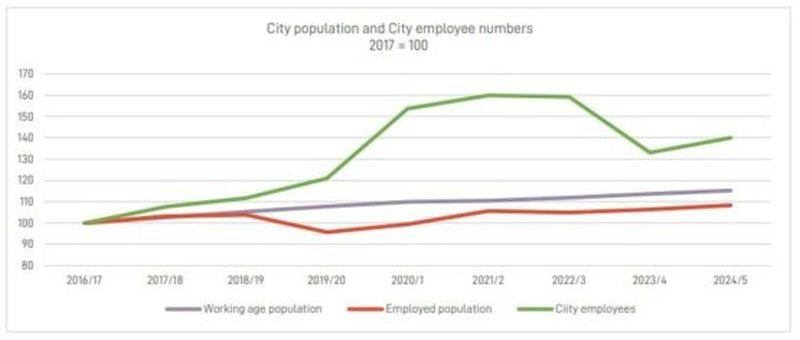
This widening gap between personnel costs and infrastructure spending adds substance to the charge that Joburg is prioritising the machinery of government over the delivery of basic services.
Since 2016, Joburg has had nine different mayors and eight coalition administrations, with no mayor completing a full five-year term.
Political control has repeatedly shifted through resignations, deaths in office, motions of no confidence, court rulings and renegotiated coalition agreements.
The resulting political churn has brought frequent changes in appointments and policy, making sustained planning and reform virtually impossible.
Joburg does not need another budget filled with optimistic projections – it needs a reckoning, and the November election is a good place to start, the CDE says.
Compliant residents carry the burden
The proportion of residents paying their municipal accounts is declining, leaving compliant customers to carry a growing burden – and even they are deserting city services where they can.
Electricity accounted for 34% of city revenue a decade ago, but now accounts for 28%, as the amount of power sold to customers has declined. About 30% of the electricity City Power buys is lost through technical losses, theft, illegal connections and unbilled consumption – roughly double Cape Town’s rate.
Those who can afford it are installing solar panels and batteries to reduce their reliance on a city in accelerating decline – feeding what CDE executive director Ann Bernstein calls a “doom loop”.
Deteriorating services weaken customers’ willingness to pay.
Declining collections reduce the money available for maintenance. Services deteriorate further, and the city responds by increasing tariffs on those who still pay.
Water is the biggest risk
Water poses an even greater risk than electricity, with outstanding water debt growing by about 20% a year over the past decade.
Dry taps, burst pipes, leaking infrastructure and failing reservoirs have become part of daily life across Johannesburg.
Businesses in Park Central, Selby, reported going almost nine months without a reliable permanent water supply, forcing them to rely on tankers.
“Johannesburg’s financial crisis is much more serious than an annual budget deficit,” says Bernstein.
“The City has become dangerously disconnected from financial reality.
“It bills residents and businesses, records those bills as revenue and spends on the assumption that the money will arrive. Increasingly, it doesn’t.”
Amounts owed to suppliers climbed to more than R28 billion, from roughly R12 billion a decade ago. Last Friday, Joburg announced that it had settled R5.25 billion owed to Eskom, with another instalment due this week.
What’s not clear is where this money came from, and whether other budget items were pilfered to pull off a Hail Mary of this scale.
The parlous state of Joburg’s finances prompted Finance Minister Enoch Godongwana to issue a rare reprimand after the city struck an agreement with the South African Municipal Workers Union that could add R10.3 billion to personnel costs over three years.
“You are hereby directed to stop proceeding with the implementation of this illegally signed agreement that has the potential to destroy the sustainability of the City of Johannesburg,” wrote the minister.
Most worryingly, city spending has been barrelling along at an average 7.7% a year over the past decade, while inflation averaged 4.8%. Meanwhile, the Joburg economy limped along at about 1% a year.
This cannot continue, says Antony Altbeker, the public finance specialist who authored the research commissioned by CDE.
Johannesburg is unlikely to be allowed to fail outright.
The more difficult question is what conditions national government will impose before asking taxpayers elsewhere in the country to finance its rescue.
The private sector may be willing to assist, but only once the city provides credible evidence that its governance, budgeting and revenue-collection failures are being addressed.
This article was republished from Moneyweb. Read the original here.