'Millionaire VIP protectors' also questioned.
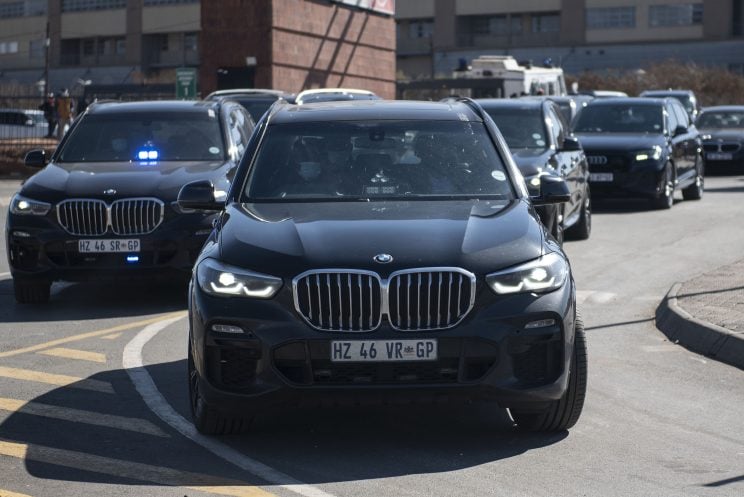
Tshwane mayor Dr Nasiphi Moya has six bodyguards allocated to her despite only being entitled to two bodyguards per shift in a two-shift system. Picture: Michel Bega/The Citizen


A pensioner from Bronkhorstspruit is challenging the 2024/25 salary increase of 5% for councillors in the City of Tshwane in court, arguing that they were only entitled to half of it.
Cecilia Knox is also asking the High Court in Pretoria to set aside council decisions providing for what she describes as an excessive and unauthorised number of VIP protectors for the mayor, Dr Nasiphi Moya, and members of her mayoral committee.
R35k for Tshwane Mayor’s protector
An allowance of R35 000 per month granted to each protector in lieu of overtime is also on her chopping block.
Moneyweb earlier reported that this controversial allowance, which municipal union Imatu also opposed, would push the protectors’ annual income to more than R1 million.
Imatu’s counterpart, Samwu, however, wants the allowance extended beyond the mobile protectors currently receiving it, a move that could double the number of eligible officers. It has officially declared a dispute with the employer in this regard.
The metro has indicated that it will oppose Knox’s court application.
Tshwane’s special council meeting
Knox says in her affidavit to the court that news articles about these matters prompted her to conduct her own research. She then searched for a legal team prepared to defer its fees until the case was concluded, and only after securing that, did she launch the application.
Knox refers to a special council meeting on 12 September 2025.
The agenda only had one item: “Annual Adjustment of Councillor Remuneration in terms of the Determination of Upper Limits of Salaries, Allowances and Benefits of different members of Municipal Councils for the 2024/2025 Municipal Financial Year.”
A report before the council proposed a 5% increase in annual remuneration, which would have set it at the following amounts:
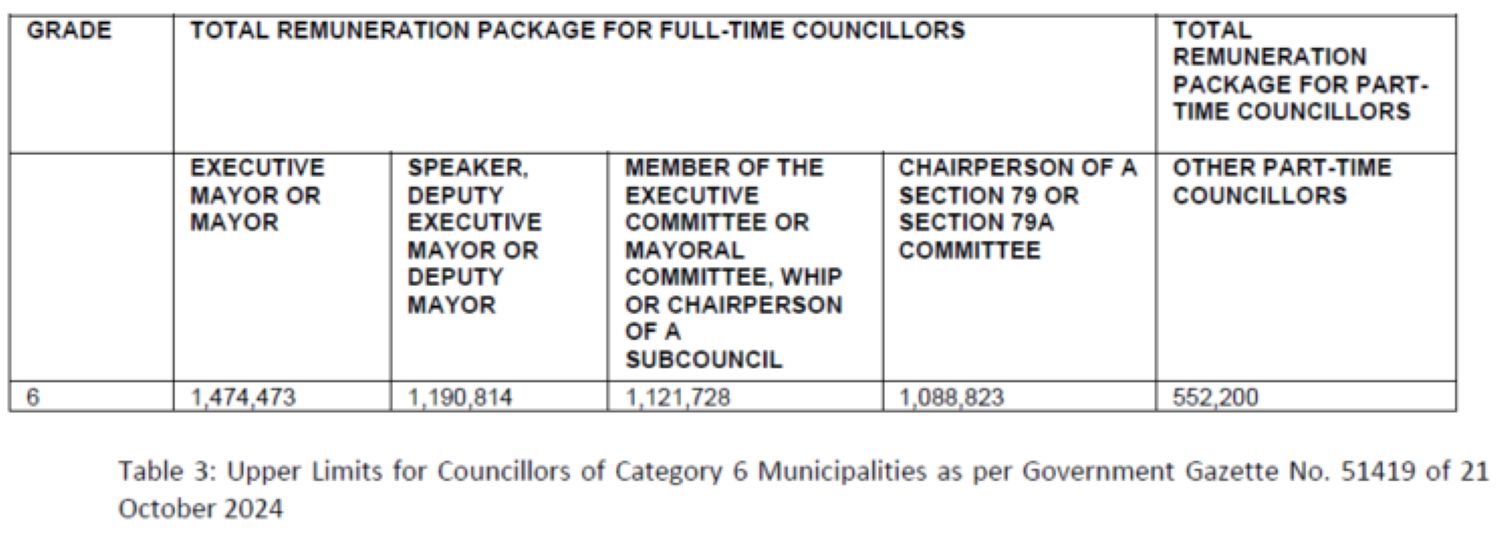
This excludes certain allowances, including a R3 600 monthly cellphone allowance, a R317 monthly data allowance, and a basic tools-of-trade allowance.
Protectors for deputy mayor, speaker, chief whip
The report makes it clear that only the mayor, deputy mayor, speaker, and chief whip are entitled to personal protection, with a limit of two protectors per shift in a two-shift system.
“Deviation from the norm may only be based on the recommendations of the South African Police Service,” the report states.
Council approved the 5% increase as well as the cellphone and data allowances with effect from 1 July 2025. Regarding personal protection, it decided to maintain the status quo pending a risk assessment by the police.
According to Knox, no such risk assessment has been done to date.
Council did not, in its decision, spell out that a previous council decision, taken on 28 August, authorised a R35 000 monthly allowance for 63 VIP protectors from 1 July 2025 – “paid for by taxpayers like me!” says Knox.
Over and above the four functionaries entitled to two protectors per shift – a total of 16 – Tshwane is also providing VIP protectors for the municipal manager, Johann Mettler, the chief of the metro police, Yolande Faro, and each member of the mayoral committee.
Flawed process
What makes it worse is that the R35 000 monthly allowance is calculated on the premise that all the protectors are at the rank of Sergeant, while most of them are at the lower rank of warrant officer, Knox adds.
The upper limits for the remuneration of council members are set at a national level each year and require a council decision that the Member of the Executive Committee (MEC) for Cooperative Governance and Traditional Affairs must concur with.
Knox points out that MEC Jacob Mamabolo informed the council’s chief whip, Ald Molatelo Mashola, on 26 September 2025, only 14 days after the council’s decision, that the 5% increase is a no-go.
In the letter that Moneyweb has seen, he says: “This percentage increase is inconsistent with the 2.5% increase applicable for the 2024/25 financial year. Both council and my office have no legal powers to approve a 5% salary increase, as this is not the applicable percentage for the 2024/25 financial year.”
He further addresses Moya’s bodyguards: “Furthermore, I have noted that six (6) bodyguards are allocated to the Executive Mayor in contravention of the aforementioned (Government) Gazettes.
“The municipality must comply with the prescript of two (2) bodyguards per shift of a two-shift system as prescribed by the above Gazettes.”
Knox tells the court: “To date, however, the above-mentioned untenable situation with the bodyguards and a 5% increase have not been rectified or brought in line with the Regulations.”
No date has been set for the court hearing yet.
Bargaining Council ruling
Imatu earlier took the council’s unilateral implementation of its decision on the bodyguards to the Local Government Bargaining Council, on the grounds of insufficient consultation, because the employer failed to provide the documentation Imatu requested. This includes the risk assessments.
The Bargaining Council ruled in Imatu’s favour and referred the matter back to the local labour forum.
The 5% salary increase for councillors followed their salaries being frozen since 2020.
This article was republished from Moneyweb. Read the original here.