Inside South Africa's baby savers that government wants to get rid of.
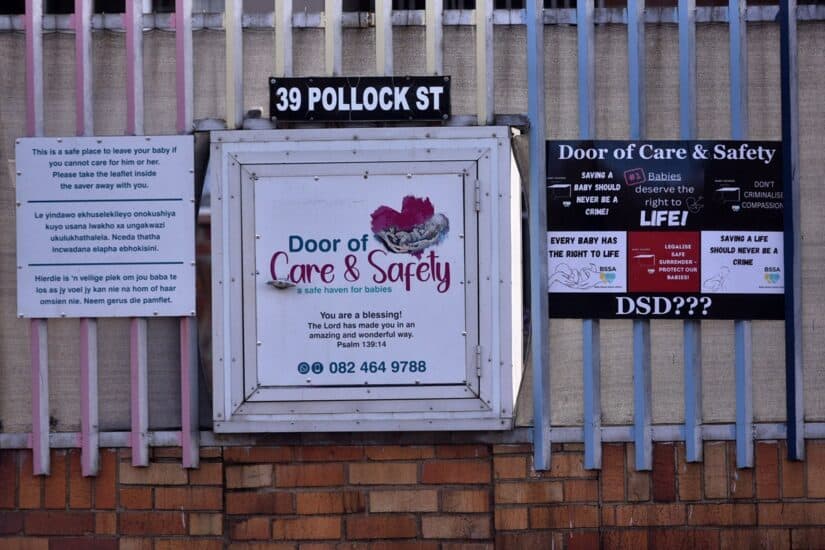
Founder of the Door of Care and Safety, Ramona van der Heever’s non-profit organization focused on rescuing and caring for abandoned, abused, orphaned children in Randfontein, 6 May 2026. A baby bin (drop box)which she established in 2016 to provide a safe, anonymous place for mothers to leave unwanted babies, aiming to prevent infanticide and provide love and a future for these children. Picture: Nigel Sibanda/ The Citizen


A desperate mother slips down a side street, carrying a bundle wrapped in a blanket. She presses a latch and a stainless-steel hatch swings open. She places the baby inside, on a soft pressure plate and leaves behind a letter reading: “I love you, my child. I am really broken, but I cannot give you the life that you deserve.”
“I plead for your forgiveness. I chose not to abort and you really fought your way to be here, and God will turn your life story into a testimony. You will be the subject of my daily prayer that God will shower you with so much love. I may not physically be a part of your life, but I will be a part in other ways. I love you, my child,” reads part of the message left for the baby boy, who has since been adopted.
The door clicks shut. A silent alarm fires. Within minutes, footsteps hurry from inside the building. A responder unlocks the hatch, lifts the infant, and carries the child into a new life.
Court battle
This scenario formed part of a three-day hearing before a full bench in the Pretoria High Court in May in a landmark case (judgment reserved) that could shape the future of safe baby relinquishment in South Africa.
Built into the wall of a registered place of safety or children’s home, the box offers a secure, anonymous drop-off for newborns whose mothers see no other way out.
Baby savers don’t encourage abandonment.
They are a last-resort alternative to unsafe dumping in velds, rivers, plastic bags, or pit latrines – a practice that kills two out of every three abandoned babies, according to Baby Savers South Africa (BSSA).
The people behind the boxes
Behind each box stands a small team that runs on adrenaline, faith and paperwork.
At Door of Hope in Glenvista, Nadene Grabham, Operations Director and co-founder of BSSA, says the mission has received 301 babies through its saver since 1999 – part of the 1940 infants the home has welcomed through its doors.
“As the baby saver is on our property, the baby is removed within minutes, the baby is checked for any medical conditions, abuse, injuries, etc,” she says.
If stable, the infant gets a medical check-up within 24 hours, is bathed, fed, while the arrival is referred to the Department of Social Development (DSD) and a child protection organisation (CPO) to start statutory processes.
In Pretoria, Wouter and Mientjie Prozesky run Rock of Hope, a registered place of safety that activated its baby saver in June 2023.
Since then, eight newborns have arrived via the box.
In Magalieskruin, Sharon Rushton oversees Jeremiah’s Hope, which opened its saver in 2022 and has received 10 babies to date.
In Tshwane, Tahiyya Hassim runs New BeginningZ, which operates two savers and has received 15 babies in the past five years.
Her team layers alarms – inside the house, on eight cell phones, and at the security company – then checks the online camera before unlocking the box.
One same challenge
Every operator names the same antagonist: the state.
Prozesky says, “Our biggest challenge would be the Department of Social Development, trying their utmost to criminalise the Savers.”
Rushton echoes, “The challenges we face are generally from the Department of Social Development, who deemed the Baby Savers illegal in 2023.”
She adds that DSD “have not been referring babies to shelters with Baby Savers and they have even closed smaller shelters”.
Hassim says the problems are not retrieving the baby but placing the child afterwards.
“The problems arise when we are full and unable to place the Baby with us so finding suitable, registered and accredited Baby Homes is difficult as everyone is always full and so many have closed down in recent years,” she says.
She notes that Child and Youth Care Centres (CYCCs) cannot take children under three, and Places of Safety are scarce.
When a mother is a foreigner
Hassim also flags nationality disputes.
“The other problem is also CPOs and DSD offices questioning the nationality of a child and mother,” she says.
“No one wants to touch a referral if the mother is a foreigner, even if the baby was born in South Africa.”
She argues that DSD often wants to prosecute these mothers for abandonment or attempted murder – “which is ridiculous as the mom made the effort to safely relinquish the child in a safe, registered place instead of just dumping the child in a veld or plastic bag or river or pit latrine or leaving them to die in a park or taxi rank somewhere.”
‘Sharing a common purpose of making a difference in the lives of babies’
For Prozesky, the highlight of being part of BSSA is the shared mission.
“Sharing a common purpose of making a difference in the lives of babies and saving the lives of those little ones,” he says.
Rushton says BSSA has given Jeremiah’s Hope “the opportunity to be part of a broader network, speaking with one voice for those who cannot speak for themselves.”
“It provides us with the platform to pursue the legalisation of Baby Savers as another option for desperate mothers who often have been let down by the system,” she adds.
It is truly the last resort for desperate mothers.