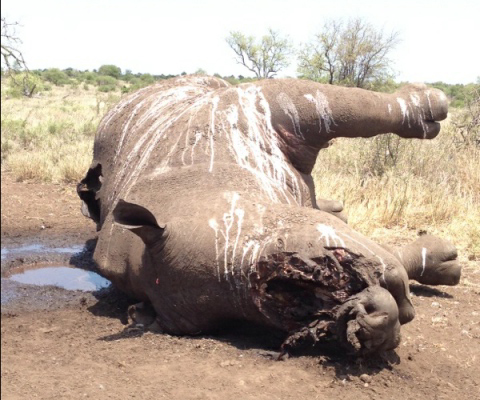
LETABA – Last week I was invited by SANParks to accompany the international media on a four-day visit to Letaba Rest Camp in Kruger National Park (KNP). The objective was to expose these correspondents to the war on rhino poachers.
Newsrooms from across the world were given insight into the crisis when they were taken to two recently killed rhino in the Letaba region and witnessed an autopsy being performed by Mr Kobus de Wet, head of criminal investigation in the park.
We were driven for 40 minutes from Letaba and walked the last three kilometres to the carcasses. Accompanied by several anti-poaching rangers, we walked in eerie silence in single file for roughly 30 minutes.
Ahead we could see about two dozen vultures circling in the sky. We knew we were close when the nauseating stench of the carcasses, scorching for three days in the sun, assailed our senses.
Only one of the two rhino was dehorned – the anti-poaching unit found the horn early Monday morning while in pursuit of the poachers who had discarded the evidence when they fled back to Mozambique.
De Wet explained that an autopsy was always performed to extract the bullet from the carcass for forensic evidence. The autopsy lasted about two hours and it was found that a bullet from a .458 rifle had penetrated the rhino’s lungs. One female ranger emotionally mentioned that she had been on duty when about 50 rhino were savagely killed this year alone.
Most of the poachers caught were in their late twenties, which proved that they were opportunists and not necessarily old Renamo soldiers who downed their weapons 21 years ago when a peace accord was struck with the Frelimo government.
The next day we attended the handover of a Gazelle military helicopter to SANParks by the Ichikowitz Family Foundation in association with Paramount, a leading African aerospace and defence group. The Gazelle had been configured by Paramount’s Advanced Technology Division to increase areas that could be traversed and also facilitate air support at night. Critical parts of this helicopter’s capabilities are its speed (up to 310km/h) and night-vision-capable cockpit. SANParks promptly held a demonstration of a poaching-gang arrest, using helicopters, automatic rifles and sniffer dogs.
The Rangers Corp, led by Maj Gen (ret) Johan Jooste is now fully trained in fighting a war on all fronts against the poaching insurgents, who infiltrate KNP mainly from Mozambique. Both full-time and reserve forces have been deployed in KNP as part of the border protection initiative.
CEO of SANParks, Dr David Mabunda, said in a statement that he was grateful to have patriotic partners like the Ichikowitz Family Foundation supporting the fight against rhino poaching. He outlined the results of a recent census that estimated there were from 8 400 to 9 600 white rhino in KNP. To date this year nearly 900 have been killed countrywide, with estimates that the figure of 668 poached rhino in 2012 will increase yet again by 50% to about 1 000.
Other private sector partners that are raising money to help in the fight are the Honorary Rangers (who raised R39 million for SANParks in 2012), The Bavaria Initiative and Unitrans.
KNP is the largest game reserve in South Africa, covering an area of 19 633 square kilometres and extends 360 kilometres from north to south and 65 from east to west. Ichikowitz mentioned that the strategic advantage in wartime belongs to the force that has superior airpower. With the onslaught against the rhino since 2007, perhaps the government should look at supplying additional helicopters to SANParks to eradicate the infiltration by poachers from Mozambique.
From a taxpayer’s perspective, it is gratifying to know that the SANDF, SAPS and SANParks have joined forces in Operation Rhino. (For a short overview, readers can go to https://www.touchinglives.co.za/?p=407). In addition, the customs and excise department of SARS has deployed more than 140 sniffer dogs at various airports in the country, trained to identify rhino horn, lion bone, ivory, narcotics, firearms and other contraband.