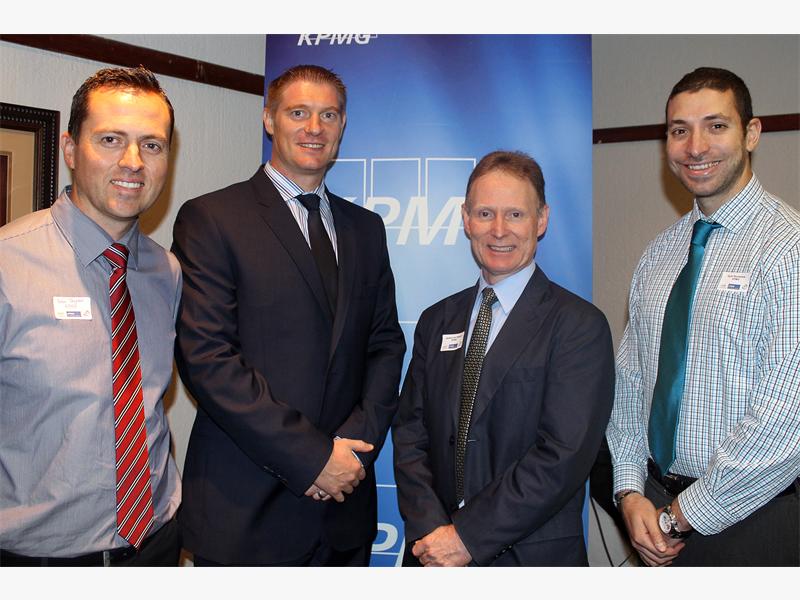
NELSPRUIT – The Kruger Lowveld Chamber of Business and Tourism (KLCBT) again hosted auditing firm, KPMG, at its annual budget breakfast last week.
The auditors sent four representatives to the city on February 27, the day after finance minister, Mr Pravin Gordhan made his budget speech, to break it down for members of the chamber.
Taxation
Mr Joubert Botha, director of tax-management services at KPMG, explained that 69 per cent of taxpayers contributed only 17 per cent to the country’s total tax bill, while only two per cent contributed as much as 30 per cent of the state’s total income from taxation.
In his speech, Gordhan said the individual tax register had increased over the past five years to include more than 15 million people – all known economically active individuals. According to the minister, who said they expected the economy to grow by 2,7 per cent, tax revenues have been buoyant over the past year despite the moderate economic growth. “In 2013/14, we will collect R899 billion – R1 billion more than we projected last February,” he said.
As a result, taxpayers will see relief amounting to R9,3 billion this year, with about 40 per cent of it going to South Africans earning below R250 000 per year.
Botha noted that with a maximum income tax rate of 40 per cent, South Africa is slightly above that of the 32 per cent global average, or 28 per cent African average.
Africa
Gordhan said the government was also looking at ways to improve trade with Africa by making it easier and looking at non-confidential information sharing to enhance this, as well as a simplified tax- and foreign-exchange framework for companies that trade on the continent.
“Increasing these inflows will be crucial for closing the current account deficit. Foreign assets owned by local firms are an important source of income, and reduce our vulnerability to future domestic downturns,” he said.
Border-management cooperation has also deepened. Lebombo Border is being prepared as a pilot for seamless organisation, which will lead to enhanced control and trade facilitation and will become operational shortly, with only the remaining formalities having to be concluded.
Economy
Incentives to grow the local economy have also been introduced for agriculture, manufacturing and industry. Botha said experts agreed that private businesses must partner with government to create jobs.
According to Gordhan, government will expand its employment programmes during the next three years and will continue to support employment possibilities by the private sector to create six million jobs over the next five years.
Government spending
Gordhan said the expansion of the social wage (currently standing at 57 per cent of consolidated expenditure) must be sustained, but the curbing of wasteful expenditure and cracking down on corruption would diminish unnecessary government spending.
Spending reviews by National Treasury were underway to examine programme performance and value for money, the Auditor General stepped up efforts to strengthen the financial control environment and cost-containment instructions were issued in January to combat waste.
Budgets for consultants, travel, accommodation and venue hire have been curtailed. Forthcoming regulations would also strengthen treasury’s oversight of public entities.