Alliances to help protect Kruger’s rhino
In this third article in a series about Kruger’s Rhino War, a brief description of the role of the major alliance partners is given.
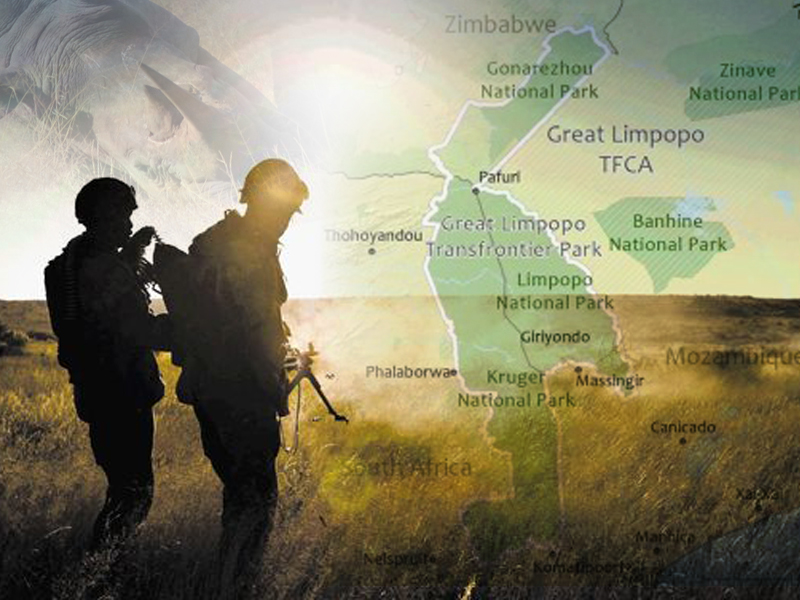
SKUKUZA – The enormity and nature of rhino poaching in the Kruger National Park (KNP) has necessitated the forming of alliances with other conservancies and institutions in an effort to protect the animals in the bush and the integrity of the South African border. In addition, international syndicates need to be investigated and arrests made with the support of the international community.
Information about poachers and the various categories of criminals involved in this wildlife crime can be found in the first instalments.
The Lowveld Lebombo Environmental Asset Protection Alliance (LLEAPA) concept
The idea of LLEAPA is a government initiative, says the Department to Environmental Affairs and consists of a joint operating committee with representatives of SANParks, the South African National Defence Force (SANDF), the SAPS, Mozambique and South Africa.
Law enforcement in the KNP
Protection of environmental assets within the borders of the two-million hectare national park is done by a ranger corps of around 650. They have air support provided by SANParks.
SANDF for border security
It is mandated to execute border-safeguarding operations and to secure border integrity. According to Gen Xolani Mabanga, spokesman for the military, currently One Infantry Company plus support elements are deployed in the eastern KNP. A separate coordination element is also attached to the base at Sandriver, specifically to organise the reaction capability and an intelligence troop for additional surveillance. This element is from time to time, normally during full-moon periods, augmented with a mobile air-operations team with resources such as an Augusta A107 helicopter and Cessna Caravan with various surveillance equipment for both day and night operations. All these elements are under the command of Joint Tactical Headquarters Mpumalanga, based in Nelspruit.
The SANDF does not have formal military agreements with the armed forces of Mozambique in terms of anti-poaching. However, quarterly meetings take place to discuss border violations in general and which include poaching activities.
How effective the deployment of the 300-odd troops has been, is a question that has been raised in the public forum, especially via social media.
Lowvelder spoke to ex-military staff that were deployed in this region in the 1980s to track insurgents from Mozambique, in order to determine the kind of operation required to successfully secure a border of this nature.
According to a staff member, during that time, there had been military bases located every 50km along the border with excellent logistical support. Troops were deployed in the bush for a month at a time, and had excellent discipline – not making use of fire or torches in order to remain undetected. Also, training of trackers was of an excellent standard and trackers could, for example, find a spoor that was 11 hours old and locate the insurgents within three. This was possible due to sufficient air and and support provided by the defence force. “But remember, we also really wanted to be there,” he remarked.
Erstwhile operators like him questioned the current strategy of a single base at Sandriver from where troops were taken by vehicle to patrol the fence, intimating that this was “aimless”. “Poachers know exactly where these troops are at any given time,” the source explained. Another question raised was whether the military had any intelligence officers operational in Mozambique, and if they were as according to Mabanga’s statement, how effective were they?
There are no separate statistics for arrests or anti-poaching operation involving SANParks rangers and SANDF members.
The Greater Limpopo Transfrontier Park (GLTP) – Eastern neighbour
The fence between the Kruger and its eastern neighbours was removed in 2002 to create a transfrontier conservation area. There had been criticism of this move, with allusion that this had made it easier for poachers to cross into South Africa. Only a third of the length of the fence was removed. The remaining bit was unfortunately in no state to act as an effective deterrent to people wanting to enter the KNP.
Working closely with SANParks is a newly deployed specially trained anti-poaching corps of 30 rangers in the conservancy. They are deployed on the Mozambican side along the park’s border. Among the successes in the GLTP have been 57 arrests of poachers and the confiscation of 26 rifles.
Game Reserves United (GRU) – Western neighbour
GRU is an alliance of private game reserves on the western border of the KNP. It states its main purpose as establishing a reliable and unified intelligence to thwart poaching. Over the past three years, their efforts have resulted in a decline of 50 per cent per annum in rhino poaching in this area. It has an memorandum of understanding (MoU) with SANParks to manage operations.
Inkomati Interest Group – Southern neighbour
A collaboration between private landowners to the south, working with SANParks anti-poaching operations, hopes to curb insurgencies from this direction.
All anti-poaching activities involving the military and rangers are coordinated by the Operation Rhino joint operational centre, chaired by Maj Gen Johan Jooste of SANPArks.
Recent international interventions
• In late December 2012 South Africa signed an MoU with Vietnam on tackling wildlife trafficking between the two nations and later developed a joint rhino action plan. South Africa signed a similar one with China in 2013 and is developing others with Thailand, Laos, Cambodia and Hong Kong.
• In 2013 the Joaquim Chissano Wildlife Preservation Initiaitve was established involving this former Mozambican president and the Peace Parks Foundation which is responsible for the development of the GLTP.
• In March 2013 the Convention on International Trade in Endangered Species of Wild Flora and Fauna (CITES) singled out certain countries heavily implicated in trade which could be subject to sanctions if identified actions were not taken.
• By the end of January the Vietnamese government reported to CITES on its progress in making seizures, arrests, prosecutions and convictions for rhino-horn trafficking and use offences, as well as implementation of a robust tracking system for preventing imported horn trophies from going into illegal trade. The country has also been instructed to develop and implement measures to reduce demand.
• Similarly, Mozambique, a transit point for horn exiting Africa, submitted a report (late) in March.
• On February 12 and 13 the London conference on illegal wildlife trade received commitments from key priority governments to combat the growing global threat posed by illegal wildlife trade. Heads of state and foreign ministers from around 46 countries attended, South Africa not among them.
• An MoU between South Africa and Mozambique was signed on April 17 on measures to address the scourge.
• Last week the Mozambican government announced dramatic increases in the penalties for poaching, particularly of endangered species.