Eco-warrior says goodbye after 44 years in the veld
Early in his career in conservation Nick Zambatis worked out of a small tent in a frontier town. This year, he said goodbye from a management office in the Kruger National Park (KNP) after 44 years in conservation. And his one regret?There is no old-age home in the KNP!
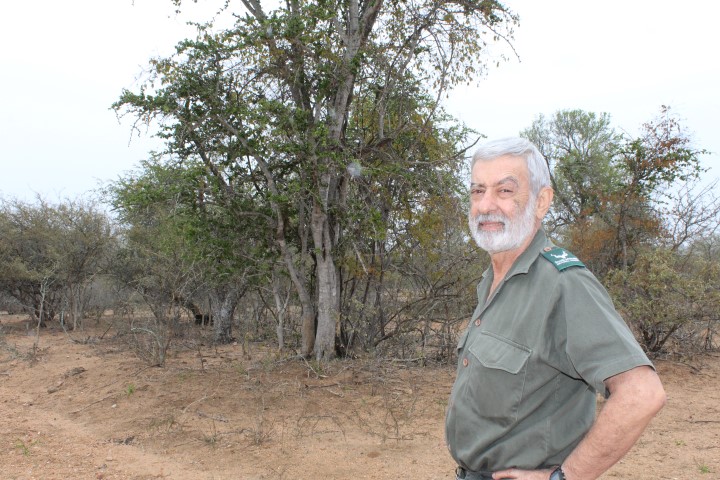
SKUKUZA – Retiring Kruger National Park (KNP) biodiversity and conservation manager, Mr Nick Zambatis, started out in conservation 44 years ago because he hated city life.
His dream was to work in the KNP, a dream that was realised in 1987 and crowned by receiving a lifetime achievement award at the KNP Achievement Awards Ceremony on May 13.
In the early days when Zambatis started his career there was not the conservation awareness there is today.
“As conservationists we were seen by some as extremists. Today society has seen the light. Lots of people are still just very excited about the big hairies like lions and leopards in the beginning, but that can instil a love of what else matters in conservation.”He has a lot of respect for the veld after spending much of his time studying the savanna plains and the relationship of man and animals with the veld. His best times in the Kruger were days spent in the veld undertaking a variety of tasks.
“There is no better classroom than the veld to get to know nature well,” said Zambatis. “For this you need to be able to read the veld.”
He started out as a research technician in the ’70s doing vegetation surveys, game censuses, fish capture, waterfowl census and game capture. It was still “rough and ready” to be working in conservation.
He was stationed in what was then a real frontier town, Hoedspruit. He compiled topographic maps of Klaserie and Timbavati and undertook projects on water provision in Klaserie.
“This taught me early in my career that drought is a natural phenomenon. Nature needs changes.”
This remained an ongoing interest and for 21 years it was his responsibility to manage the climate monitoring programme of the KNP.
As a bachelor he started studying for a three-year diploma in nature conservation in the ’80s. This often entailed sitting in a small tent in the middle of the Lowveld summer with a paraffin lamp. In the mid-1980s he managed the Hans Hoheisen Research Station for three years.
“It was where I came to love dead silence or at night the distant call of a hyena or an owlet. It was music to my ears,” he explained.
Just at the stage when Zambatis was facing the nightmare of perhaps being transferred back to Pretoria in 1987, he started his job as a research technician based in Skukuza. He was mostly involved with fire research on experimental burning plots, vegetation surveys and collecting biological material.
According to him, there would not be any orders this year to the rangers to do any burning because of the poor grass production.
“Burning changes the savanna and the drought has already taken its toll with all the changes it brought about this year,” Zambatis said.
Another change that he felt is needed is how the elephant population in the KNP should be managed.
“We are losing large trees because of the elephant population escalating quite drastically. This impacts the tree population severely. Our mixed woodland is fast beginning to change into a shrubveld. We need tall trees for the birds like vultures,” he said regretfully.
A special interest in the vegetation of the Lowveld was Zambatis’ passion. “I wanted to be able to identify as many of the plant species as I could find during my regular veld expeditions.”
Not much was available on “veld flowers” when he started out collecting specimens. He set out to rectify this. To date he has collected about 7 500 specimens, mostly in the Lowveld.
In recognition of his contribution to exploration, an aquatic herb was named after him in 1991, Nesea zambatidis.
Zambatis did succeed through it all to obtain an MSC with distinction from the University of KwaZulu-Natal.
At the end of his career he was employed in conservation management, a fitting end to a long chapter as he has always been interested in the applied side of conservation. Various protocols had to be written and Zambatis became a specialist in putting these together.
He is happy to be retiring but saddened not to be part of the management team in the KNP any longer.
“It was a privilege to be allowed to take care of the country’s natural resources,” said Zambatis.