Officials clamp down on illegal number plates
Other than the font size, there are quite a few requirements it has to meet, like the markings, attachment, positioning and design.
MBOMBELA – You might be driving around with a number plate that does not comply with the National Road Traffic Act and not even know it.
Wynand Labuschagne, traffic law-enforcement deputy director in the Mpumalanga Department of Community Safety, Security and Liaison, issued another stern warning. Labuschagne warned that officials are busy cracking down on motorists whose vehicles do not have correct number plates. But how do you know if the number plates on your vehicle, motorcycle, trailer or caravan are legal? Other than the font size, there are quite a few requirements it has to meet, like the markings, attachment, positioning and design.
Apart from an SABS sticker, a number plate must also bear a certification mark, which contains the name or trademark and batch number of the supplier. Embossers must use the font that was specifically designed for the local number plate industry. The use of any other font is illegal.
Labuschagne explained that there are only three legal number plate sizes, and each must be embossed with alphanumerics of a specific size.
• 520mm x 113mm – embossed with 75mm-high alphanumerics
• 250mm x 205mm – embossed with 75mm-high alphanumerics
• 250mm x 165mm – embossed with 60mm-high alphanumerics
Because there are vehicles on which the front and rear number plate apertures are not the same size, two different-sized number plates can be used on the same vehicle.
The Automobile Association of South Africa (AA) explained that the attachment is also of utmost importance. Attaching a number plate with double-sided tape is illegal. By law, number plates must be attached to the vehicle with four-millimetre rivets or one-way self-tapping screws.
If you prefer not to rivet the plate directly onto your car, there is also the option of a number plate carrier or holding bracket. Such holders must comply with legal requirements and be approved by the National Department of Transport.
“The best advice would be to check with your local licensing/traffic authority to ensure that your vehicle is cleared as being roadworthy,” said Labuschagne.
Remember that all vehicles must have a number plate both in the front and rear but motorcycles, however, require only one at the back.
It is important to note that on regular passenger cars and SUVs the number plates must not be higher than 1,5 metres from ground level. According to the AA, if the front design of the vehicle is such that it cannot accommodate a number plate right in the middle, as is the norm, it can be mounted to one side.
The rear number plate may not be obscured by a permanent fixture such as a tow bar. If the obstruction is considered to be temporary – as with a removable bicycle rack for instance – a second number plate must be attached to the rack to ensure that it is clearly visible. Such racks must be removed when not in use. Each province of South Africa has a different background design for number plates. Labuschagne said the background design is determined by the MEC of the province.
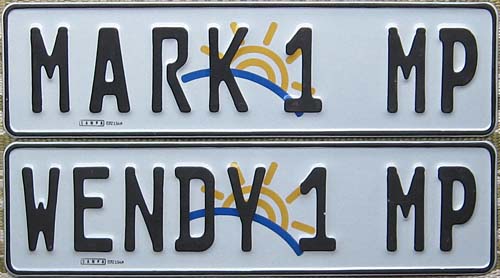
“Though the majority of the number plates have the rising sun logo, it is also legal without it,” said Labuschagne. Once your vehicle has been registered with the licensing department you will receive a printout of the registration paper. You will need to produce this document, as well as your ID document, before an embosser will make your number plates.
According to the South African Number Plate Association, any embosser who does not request this documentation should be avoided.
To ensure you are dealing with a reputable embosser, you should also enquire whether they are approved by the SABS.
Personalised number plates are legal, but only letters and numbers are allowed. Any symbols such as %, &, @ or $ are illegal. Vulgar language is not allowed and blatantly vulgar or offensive numbers will not be allocated.
Although no roll-out date has been confirmed, new laws on number plates are on the cards, aimed at standardising number plates across the country. The proposed changes include the national flag in the top left corner, with the name of the province underneath it.
Different coloured letters and figures will identify different types of vehicles; black for public transport, red for government vehicles, green for diplomatic vehicles and blue for personal vehicles.
Also read: The illegality of LED lights explained
Stern warning issued: No LED lights allowed