World Water Day – A 10 Step Guide to save water at home
World Water Day 2021, on 22 March is about water and climate change- and how the two are inextricably linked.

Adapting to the water effects of climate change will protect health and save lives.

Using water more efficiently will reduce greenhouse gases. We cannot afford to wait,. Everyone has a role to play.

We simply have to use less water. In fact, according to our National Water Resource Strategy, by fixing leaks in the municipal water supply system, and people using less water, a whopping 571 billion litre drop in South Africans are renowned heavy water users. In Gauteng people reportedly clock an astounding average of 305 litres per person per day.

Through the news of rain has recently replaced stories of drought on many front pages South Africa’s water crisis is far from over. We are largely a dry country. An average of only about 464mm grace our lands, in comparison to a world average of about 860mm.

Yet, even the water that we have available in a good year of rain is not enough. According to forecasts by the Institute of Security Studies, the combined demand for water by municipalities, agriculture and industries are already more than what we have available, but this gap between demand and supply is set to grow. By 2030 South Africans are set to demand 17% more than what is available.
10 step guide to save water at home
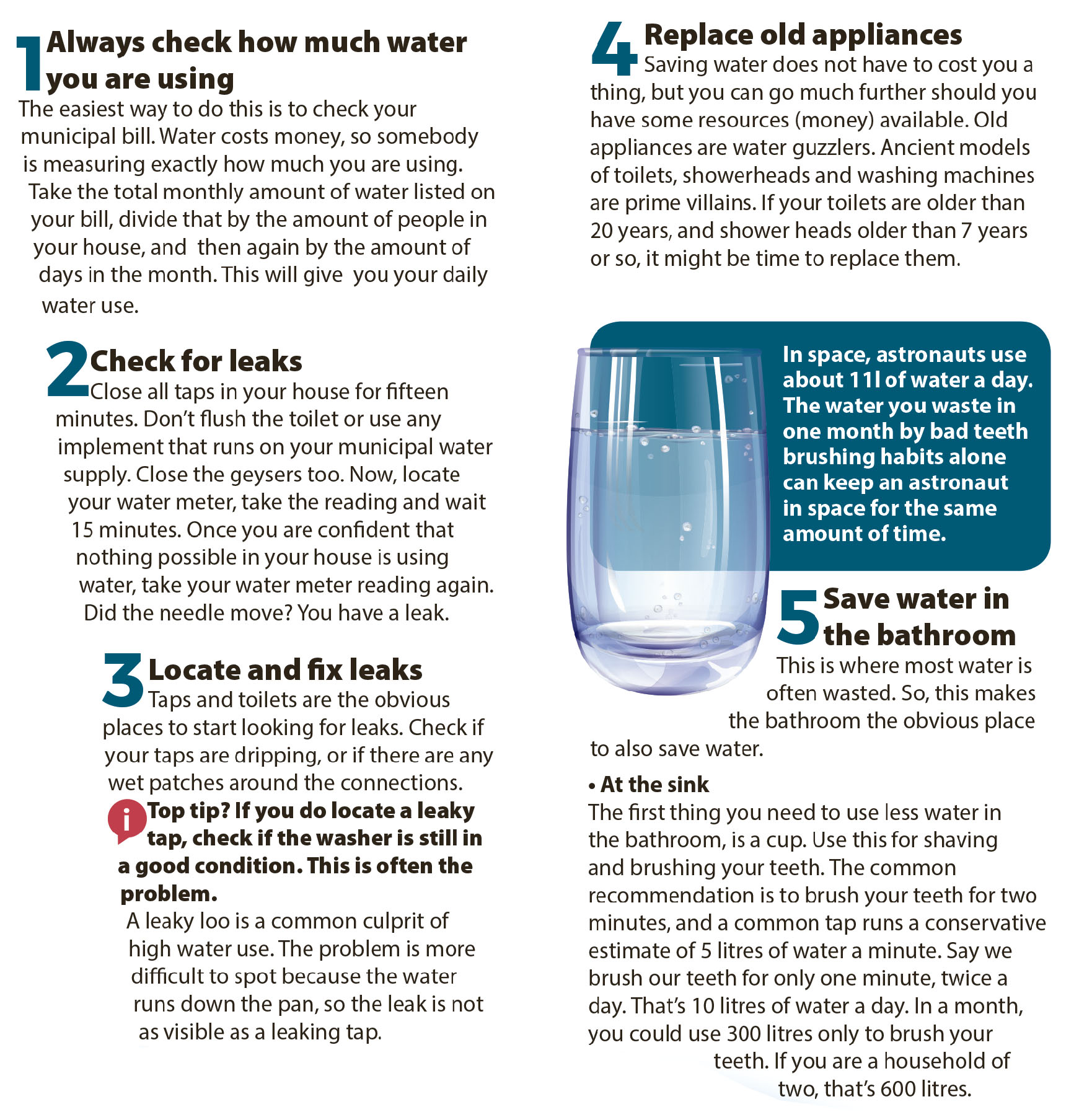
- Always check how much water you are using.
- Check for leaks.
- Locate and fix leaks.
- Replace old appliances.
- Save water in the bathroom.
- Streamline your toilet.
- Save water in the kitchen.
- Use less water for laundry.
- Track your progress.
- Change your mindset about using water.



Where does our water come from though?

If you think it’s from your tap, think again. Instead the simple act of turning the
faucet to get running water is only the small end result of an intricate water delivery system, far removed from the rain that falls outside your window.
Where your water comes from, and how it gets to you, depends on the place where you live and the systems that the people that manage it put in place. In many parts of Central Asia, for example,
water is captured in permanent glaciers, and in the summer season, the melting ice fills the
main rivers.
In Saudi Arabia about 50% of drinking water is from the sea (desalination).
We depend mainly on surface water, says media liaison for the Department of Water and
Sanitation, Sputnik Ratau.
In South Africa, we are heavily dependent on rainfall to replenish these rivers and das,
as well as groundwater. This has had vast consequences to our country, the places we call home, and our ability to make a living there.

Water supply in South Africa
South Africa has an arid to semi-arid climate, with an average rainfall of 465 mm each year (about half the world average). This number paints only a small part of the picture of water availability in the country.
When, and where that rain falls varies greatly. All but the south-western and southern regions of South Africa rely on summer rainfall. The rainfall is also heaviest in the east and decreases as you go west. In fact, about 50% of South Africa’s water resources originate from only 10% of our land. These ‘high water yield’ areas are like water factories, and contribute significantly to the overall water supply of the country, supporting the growth and development of places far away.
Not only is the rain distributed unevenly over the landscape and through the year, but it can
also fluctuate over the long term. Droughts don’t often occur over the whole country at once but there are years when the entire summer rainfall region is affected.
Because of this, we are a country that stores, and moves water to where and when it is necessary. Our large dams can store up to two thirds of the country’s total annual runoff, and most of our
large rivers are now heavily used and regulated in order to secure a water supply.
By moving water from catchments where there is a lot of water, to those where there are not enough, we can mine, farm and build cities, where it would otherwise not have been possible.
In this way, many of our major cities and industrial developments are actually located far away from the water necessary for it to function. Gauteng, and the Nelson Mandela Bay Municipality and surrounds, are two good examples.
South Africa’s high water yield areas
High water yield areas are places where the mean annual runoff is at least three times more than the average for the catchment that it is located in. Mean annual run-off is the amount of water on the surface of the land that can be used in a year, which is calculated as an average (or mean) over several years.
Deterioration of water quantity and quality in our water factories can have a disproportionately large effect on ecosystems and regions downstream. Keeping the high water yield areas clean, and in good condition, should be a national priority. This means that thirsty activities like forestry should be minimized there, as should activities that would pollute or degrade the quality of the water, like timer mills, mining or over-grazing.
About 45% of the water in South Africa comes from rivers shared with neighbouring countries. We share seven rivers with our immediate neighbours, and South Africa is a member of a number of transboundary water agreements as prescribed by the SADC Protocol on Trans-Boundary Waters. These agreements allow South Africa and its neighbours to share common waters for mutual development and benefits.
Where will water come from in future?
According to the Department of Water and Sanitation’s National Water and Sanitation Master Plan, South Africa’s dependence on surface water will proportionately decrease over the coming decades. The plan states that by 2040, treated acid mine drainage and desalinated seawater will make a significant contribution to South Africa’s water mix. In the future, we will make more use of groundwater, in an effort to reduce our reliance on the water above ground.
In future, if you open your tap, your water might perhaps come from a different place. Perhaps some of it could be recycled water from your shower or even, from a tank filled with rainwater that just fell outside your window.