An increasing number of Facebook users have splashed outdated, false legal jargon all over their profiles in an attempt to keep the contents of their Facebook accounts private.
The jargon looks like this:
“Deadline tomorrow !!! Everything you’ve ever posted becomes public from tomorrow. Even messages that have been deleted or the photos not allowed. It costs nothing for a simple copy and paste, better safe than sorry. Channel 13 News talked about the change in Facebook’s privacy policy. I do not give Facebook or any entities associated with Facebook permission to use my pictures, information, messages or posts, both past and future. With this statement, I give notice to Facebook it is strictly forbidden to disclose, copy, distribute, or take any other action against me based on this profile and/or its contents. The content of this profile is private and confidential information. The violation of privacy can be punished by law (UCC 1-308- 1 1 308-103 and the Rome Statute). NOTE: Facebook is now a public entity. All members must post a note like this. If you prefer, you can copy and paste this version. If you do not publish a statement at least once it will be tactically allowing the use of your photos, as well as the information contained in the profile status updates. DO NOT SHARE. Copy and paste”
If you copied and pasted it, your behaviour was ignorant or you ill-informed. Or both.
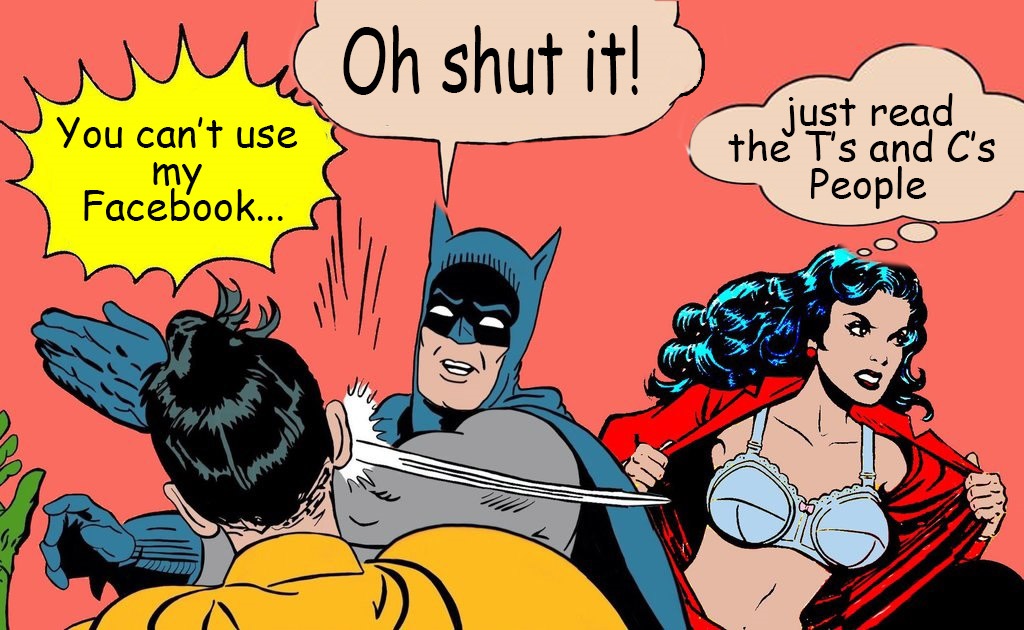
Or, in the words of a local Facebook user:

Despite the paragraph’s content not making sense, the same “privacy paragraph” keeps finding its way onto news lists world wide.
Here’s why it amounts to nothing more than nonsense:
• You agreed to parting with some privacy expectations when you joined Facebook.
If you use Facebook, you contracted with the social-media platform. As a prerequisite for your joining the website, you agreed to it’s regulations, which dictate that whatever you place on Facebook, may be used and shared by the platform.
Although it has privacy settings, its regulations state that it cannot guarantee that users’ privacy settings will be respected.
• You cannot cancel a contract by means of a status update. Think about it.
Because you entered into an agreement with Facebook and agreed to your posts being displayed and shared by it, you cannot retract your consent thereto by means of a status update. One reason is that, with 1,59 billion users updating their statuses continuously, the platform’s management will hardly take notice. Another reason is that Facebook’s regulations do not allow users to amend the agreement they concluded.
• Does a robber exclaim: “I will not be guilty of this crime!” before robbing a bank?
Likewise, you cannot simply declare that no action is to be taken against you as a result of your ramblings.
• You are not in America
UCC 11-308-308 1-103 refers to the United States’ Uniform Commercial Code (UCC). You are in South Africa and the USA’s laws won’t help you.
• If privacy is the issue, you are not dealing with genocide, crimes against humanity, war crimes or crimes of aggression
The Roman Statute is the treaty in terms of which the International Criminal Court (ICC) was established. That court currently deals with four core international crimes namely genocide, crimes against humanity, war crimes and the crime of aggression.
Facebook reacted to this in a press release on November 26, 2012. Management reiterated that those who use Facebook regulate the privacy of their profiles’ content as they agreed to in accordance with the rules and regulations.
Also read: Everything you must know about the law and social media in SA
In June, Lowvelder reported:

An increasing number of Lowvelders have recently been adding outdated and false legal jargon to their profiles in an attempt to keep the contents of their Facebook accounts private.
If you are one of them, this report aims to inform you that it might be one of the most ignorant (because this journalist should probably not call you stupid) things you have ever done. Despite the paragraph’s content not making sense, each upgrade of Facebook’s regulations leads to magnanimous sharing of the same “privacy paragraph”.
Lowvelder will explain this by quoting the “privacy paragraph” phrase by phrase, pointing out why it amounts to nothing more than nonsense.
“In response to the new Facebook guidelines I hereby declare that my copyright is attached to all of my personal details, illustrations, comics, paintings, crafts, professional photos and videos, etc. (as a result of the Berner Convention).”
There are three things wrong with this sentence:
• If you use Facebook, you contracted with the social-media platform. As a prerequisite for your joining the website, you agreed to it’s regulations, which dictate that whatever you place on Facebook, may be used and shared by the platform. Although it has privacy settings, its regulations state that it cannot guarantee that users’ privacy settings will be respected.
• You cannot create your copyrights by declaring them. Copyrights are intrinsically part of any creation.
• The statement refers to the Berner Convention, which doesn’t exist. The Berne Convention, however, regulates copyright on some of the world’s countries, but not all of them. As a citizen of South Africa, where we follow the convention, you cannot force a resident of a non-member country to comply with the regulations thereof.
The next phrase states that for commercial use, the Facebook user’s written consent is needed before his or her profile content is shared. The excerpt further states: “By the present communiqué, I notify Facebook that it is strictly forbidden to disclose, copy, distribute, disseminate, or take any other action against me on the basis of this profile and/or its contents.”
• Because you entered into an agreement with Facebook and agreed to your posts being displayed and shared by it, you cannot retract your consent thereto by means of a status update. One reason is that, with 1,59 billion users updating their statuses continuously, the platform’s management will hardly take notice. Another reason is that Facebook’s regulations do not allow users to amend the agreement they concluded.
•You cannot simply declare that no action is to be taken against you as a result of your ramblings. That would be like a bank robber storming the reserve bank after having declared that there would be no consequences to his actions.
“The aforementioned prohibited actions also apply to employees, students, agents and/or any staff under Facebook’s direction or control. The content of this profile is private and confidential information. The violation of my privacy is punished by law (UCC 1 1-308-308 1-103 and the Rome Statute).”
• Again, the “aforementioned prohibited” mentioned here has not been prohibited in a valid, legal way and can therefore not apply to anyone who works for Facebook.
• This is the really funny part: UCC 11-308-308 1-103 refers to the United States’ Uniform Commercial Code (UCC). You are in South Africa and the USA’s laws won’t help you.
• The Roman Statute is the treaty in terms of which the International Criminal Court (ICC) was established. That court currently deals with four core international crimes namely genocide, crimes against humanity, war crimes and the crime of aggression.
Lastly, the paragraph states that “Facebook is now an open capital entity. All members are recommended to publish a notice like this… If you do not publish a statement at least once, you will be tacitly allowing the use of elements such as your photos as well as the information contained in your profile status updates.”
Facebook reacted to this in a press release on November 26, 2012. Management reiterated that those who use Facebook regulate the privacy of their profiles’ content as they agreed to in accordance with the rules and regulations.
How should I approach sharing another’s Facebook content or publishing it elsewhere?
When a post is shared on Facebook, the author’s details are quoted by default. You may therefore make use of the platform’s “share” functions to your heart’s content. When a post is distributed on another platform, the fair practice rule should be your rule of thumb.
• The fair practice/dealing rule:
If you need to reproduce another’s work, do so in a limited way (the extent of the reproduction must be limited with the consideration of its purpose). The reproducer must go to all reasonable lengths to obtain the owner or creator’s permission to reproduce his or her work. If this cannot be obtained, the reproducer must nonetheless cite the source of the work (Facebook, for example).