
WATCH: Catch the Gamma Normid Meteor Shower tonight
SWAICSA shares viewing tips for the meteor shower.
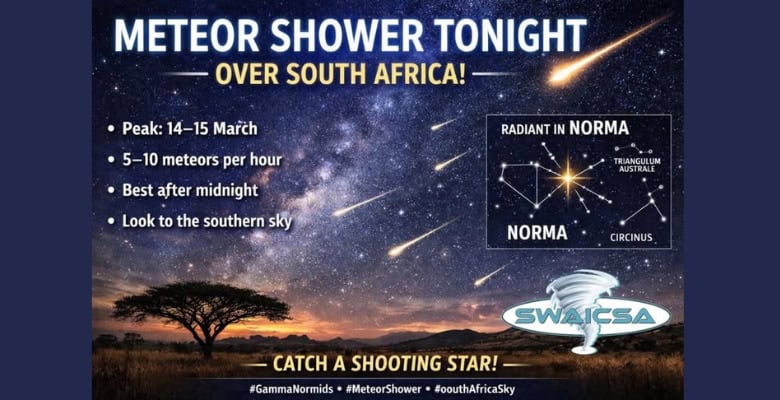
According to the Severe Weather and Information Centre SA (SWAICSA), a quiet but beautiful celestial show, also referred to as the Gamma Normid meteor shower, will reach its peak tonight, March 14.
Although The South African Weather Service (SAWS) issued a yellow level 4 warning for disruptive rain with isolated showers and scattered thundershowers in the north-eastern parts of the country, stargazers elsewhere in South Africa may experience this cosmic show.
Weather forecast for today and tomorrow, 14-15 March 2026:
Partly cloudy and cool to warm but hot in places, with isolated showers and thundershower but scattered to widespread in the north-east where it will be cloudy ⚠️Disruptive rainfall.#saws #SAWeatherService #Warning pic.twitter.com/EZgrYXtZnm— SA Weather Service (@SAWeatherServic) March 14, 2026
“This lesser-known meteor shower occurs when earth passes through a stream of tiny debris left behind by an ancient comet. As these small particles slam into our atmosphere at incredible speeds, they burn up and create bright streaks of light we call meteors or ‘shooting stars’, SWAICSA said.
According to the centre, South Africa is well positioned to experience the meteor shower, weather permitting, since the Gamma Normid meteor shower appears to originate from the constellation Norma, which is situated in the southern sky.
What you might see:
This is not one of the strongest meteor showers of the year, but under dark skies (away from city lights) observers may see around 5 to 10 meteors per hour at the peak.
Gamma Normid Meteor Shower Alert! ☄️
Skywatchers in the Southern Hemisphere, get ready! On the night of March 14–15, the mysterious Gamma Normids will light up the sky. While the meteor rate is modest—about 6 per hour—these streaks move fast at roughly 56 km/s, often leaving… pic.twitter.com/jiDhQjbHWt
— Paul White Gold Eagle (@PaulGoldEagle) March 13, 2026
They are often fast and sharp streaks of light, appearing suddenly and disappearing just as quickly – a brief flash from a grain of cosmic dust burning up high above Earth.
Best viewing tips:
* Find a dark location away from city lights
* Allow 20 to 30 minutes for your eyes to adjust to the dark
* Lie back or use a reclining chair for a wide view of the sky
* Dress warmly and enjoy the quiet night sky.
* Look up after midnight until just before dawn.
Where to look:
SWAICSA advises stargazer’s to look toward the southern sky.
“Watch a wide dark area overhead and be patient. Meteors can appear anywhere across the sky, not only near the constellation Norma. For a few hours tonight, invisible cosmic debris turns into steaks of light across the heavens – a reminder that our planet is constantly travelling through a vast and ancient universe.”
Catch a shooting star tonight. Step outside and look up!
Join the Lowveld Media WhatsApp channel and stay in the loop with breaking news, exclusive updates, and amazing deals from our local advertisers! Click here: https://shorturl.at/NznHy