
Walter Uncles arrived in the Lowveld as a young bachelor in 1927. Appointed by the Union Department of Agriculture his job was to break land and start with experimental planting at the site set for a future experimental farm that was later to become the Institute for Tropical and Subtropical Crops of the Agricultural Research Council of South Africa.
Shortly after his arrival the Afrikaans translation of his surname, Uncles, became his nickname. Until his death 50 years later he was known in the Lowveld as Oompies Uncles.
Forty years after his arrival, in 1976, Walter Uncles wrote a regular column in what was then The Lowvelder with the title “Oompies remembers”. It painted a vivid picture of early town life in old Nelspruit. Here is a third delivery in this regard:

Can you imagine Nelspruit streets with dusty gravel surfaces? The roads were maintained by an ox-drawn grader operated by one Roelf Strydom who also was in charge of the abattoir, location, cemetery, sanitary works and water reticulation. In addition Strydom also assisted with street layout and planted and cared for the beautiful flamboyants which are in summer a sight as attractive as anything anywhere in the world.
Also read Early entertainment the Lowveld way.
For obvious reasons it is a tree not quite suitable to grow on street pavements, but it is felt nevertheless that many more could still be planted in certain areas. With tarred roads and cemented pavements, insufficient rainwater is available to them now and as a result many are deteriorating. As there was no waterborne sewage system in operation then, pails with night soil had to be collected in the evening and removed by means of an ox-drawn vehicle to a certain disposal point. It was always most unpleasant to come across this wagon nicknamed “The Fire Brigade” while on its rounds in town.
The slaughtering of cattle for the butchery was also a rather primitive, cruel and inhuman act. After having roped the selected animal in the enclosure with a long catch stick, a chain would be placed on the head behind the horns with the other end being passed through a ring embedded at floor level on a large concrete slab next to the slaughter poles, with a block and tackle mounted in the centre.
The helpless animal is now slowly but surely pulled in inch by inch while struggling desperately to escape from the stench of blood from previous victims and bellowing furiously to be heard a mile away. Eventually it gave in to the might of four or six workman doing the hauling. A stab behind the horns into the head finishes the beast off. The butcher shop owned and operated by Abie Joubert, brother of Eddie, was located where Joubert Buildings stands today.

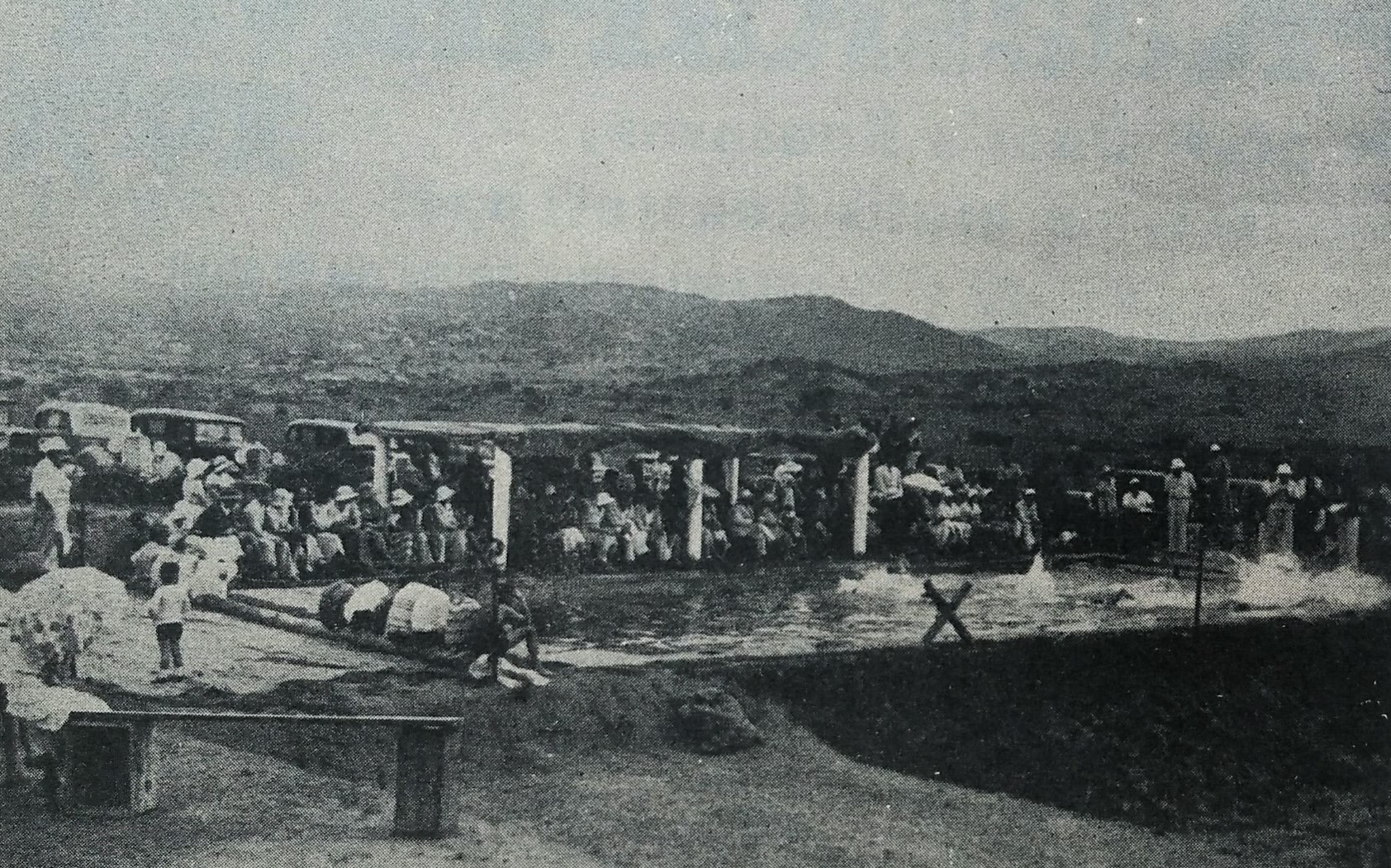
I spoke about picnic outings last week and another popular spot frequented by Nelspruiters was on a farm, Houtboschloop. Again, by each contributing one shilling to the “kitty” they would set off by hired lorry early on a Sunday morning, or on a public holiday, to spend the day under lovely shade trees just lazing about, playing gramophone records or bathing in the crystal clear, cool, bilharzia-free pools.
The midday-meal was invariable a braai which was always enjoyed by all. No liquor was consumed during these outings and not at any of the dances as is the custom today, as the youth in those days were almost all teetotallers and mostly non-smokers, especially the women folk.
Also read Lowveld always a retreat for artists.
Due to its popularity and increasing patronising of the venue, the farm owner, fearing the possibility of bush fires, erected a sign, “Beware of mambas”. This put an end to the picnicking there. The name Mamba Alley subsequently stuck to this area for a long time.
The spot was near where the Sudwala Caves are now which were known to exist at that time, but in those days only a few dared the hike of many miles across bush-covered mountain terrain. At the entrance great difficulty was experienced in gaining access through a small opening, the interior being equally rough, uneven and dangerous when guided only by torch or candlelight.



