
While just two decades ago the ability to self-shift was mostly found in big and stately sedans, and appealed to those who drove them, budget buyers now also want automatic cars.
That’s why every manufacturer now offers automatic versions of its cheaper, entry-level commuters.
This gradual move from manual to auto is probably happening because of a number of reasons. While 30-odd years ago any autobox was guaranteed to whine like Nana Mouskouri as it continuously fished for the right gear (which it seldom found), modern autos are much faster and precise in their cog selection. There’s also a lot more cars on the road today, causing peak hour pileups in all but the smallest dorpies, thus making an automatic car the better choice for everyday commuting.
And then there’s the PlayStation generation; a new breed of drivers who cannot be much bothered with the ‘silliness’ of being in total control of a vehicle by working the clutch and gear lever themselves.
Whatever your particular reason for wanting an affordable automatic car, the Honda Amaze sedan should be on your test drive list.
New identity
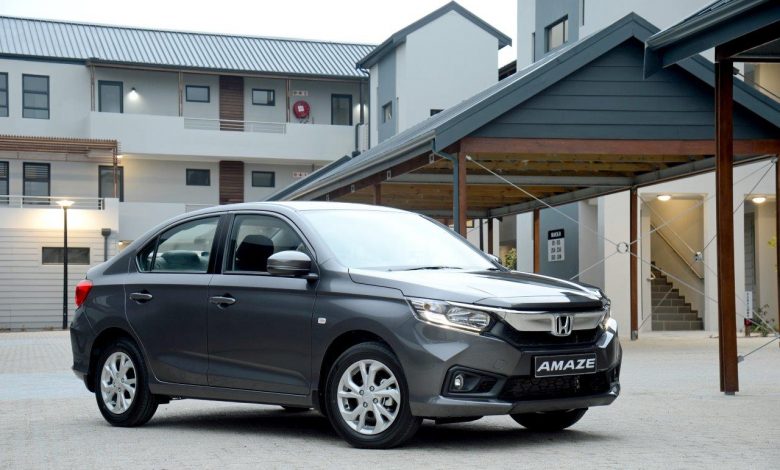
Honda recently gave the Amaze sedan its own identity, giving it a new look and removing the Brio badge. The car now has a different look from the hatch, one which is quite… let’s describe it as ‘interesting’.
In the front, the nose ends quite suddenly to give the Amaze a stubby look, and while I cannot make my mind up whether I like it or not, judging by the numbers on the road the buying public must find it attractive.
One thing is for sure; with such a stubby nose parking the Amaze is no guess work because you know there where the bonnet dissapears from sight, everything else does too.
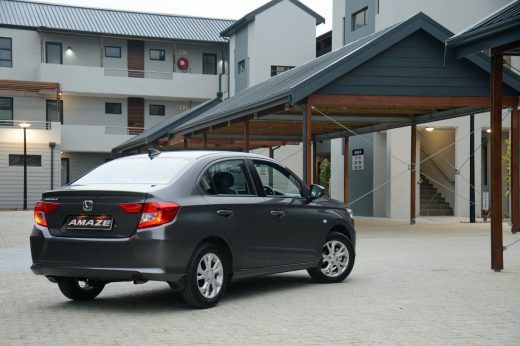
The boot also doesn’t hang too far over the rear axle, making the Amaze a really compact sedan.
However, despite its reserved dimensions, the cabin offers a lot of space and, with the front seats pushed all the way back, legroom for backseat passengers is quite generous.
Headroom in the rear is also not too shabby.
Where I did note space to be on the tight side, is in the boot. While the Amaze sedan offers more luggage space than hatches in this class, its boot space (360-litres) is less than that of the Nissan Almera (384-litres), a budget sedan with which it competes directly and also offering an automatic derivative.
Then again, also competing in this category is the Suzuki Dzire 1.2GL Auto and it offers only 288 litres of space for whatever budget sedan owners need to cart around.
Two-tone party
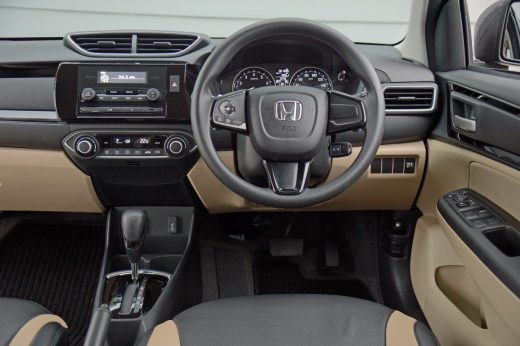
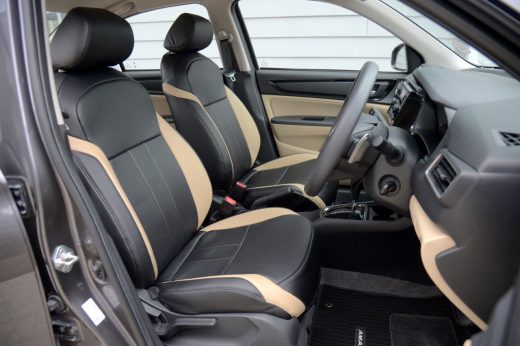
Inside the Amaze the overall interior theme is a two-tone affair with beige and black having been used side by side right through.
The subject of this test report, the 1.2 Comfort Auto, sports rather comfortable perforated leather seats which consist of black and beige panels stitched together.
Together with the hard plastics of similar hues, the Amaze’s cabin is about as child-proof as it gets because any spills and smudges can just be wiped off with a wet cloth.
While not plush in any way, the general appearance inside is modern and the overall fit of all plastics very neat.
The 1.2 Comfort Auto also sports enough convenience features to keep driver and passengers happy during daily commutes with USB and AUX sockets in the front and back.
There’s no touch screen display in the dash like some vehicles in this bottom segment have, just a normal radio with normal push buttons but it gets the job done so no complaint there.
The driver does get controls for audio and Bluetooth communication on the steering wheel, as well as a set of paddles for shifting gears if he or she should happen to suffer from Wannabe Racing Driver Syndrome.
Right application
The Honda Amaze runs on a naturally aspirated 1.2-litre, four-cylinder petrol engine.
This unit produces 66kW at 6 000rpm and 110Nm at 4 800rpm, and while those output figures don’t sound capable of much, the Amaze sits on such a light platform that it doesn’t lack motivation in town.
To shift gears Honda of course chose a CVT (Continuous Variable Transmission) box, which is basically a belt running on a tapered shaft to create ‘virtual’ gears.
Toyota and Nissan also swear by CVT boxes but many people find them frustrating.

In this application – inside a budget commuter – the CVT works perfectly and does not bother at all, no matter what it does.
Seeing the Amaze is a commuter car, you just want to get to work using as little fuel as possible, and for that CVTs are perfect because they really bring fuel consumption down considerably.
Honda says the Amaze 1.2 Auto will use as little as 5.7-litres to cover 100km if driven correctly (so leave those paddle shifters alone).
Shippy ride
Driving the automatic Amaze in heavy traffic is a breeze thanks to the CVT transmission, but on the open road it does lack a bit of punch and is affected by crosswinds to some extend.
While surely more suitable for long distance trips than some cheap hatches, extended highway driving will be tiresome as the steering asks for the driver’s undivided attention.
In Richards Bay, with its millions of humps, the Amaze’s ride is somewhat ‘shippy’ but that’s expected.
The manufacturer’s recommendation that tyres should be inflated to 2.2 bar, is questionable, because it makes for a somewhat bumpy drive.
In such a small, lightweight car, I personally cannot see why the tyres should be so hard and am of the opinion that 1.8 bar is a more suitable number and won’t affect road holding or performance.
Verdict
At around R200 000 the Honda Amaze 1.2 Auto is good value for money if you are in the market for a self-shifting everyday car.
That engine is bullet proof and the interior quite neat and comfortable.
A five-year/200 000km warranty as well as a two-year/30 000km service plan and, being light on fuel, will make for low cost of ownership, while two front airbags together with ABS brakes and EBD make it a safe commuter.
Those who can live with the Amaze’s small peculiarities, will love it.



