Sowing the seed for a greener future for pupils
Food and Trees for Africa and Konica Minolta Nelspruit planted trees at Marambane Primary School.
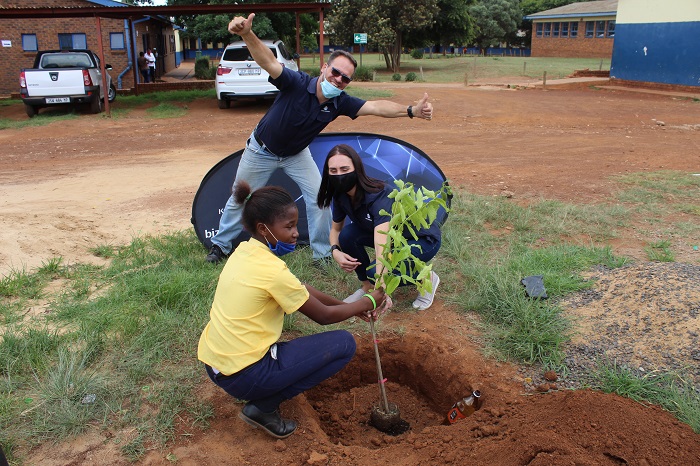
This took place last Friday. About 920 exotic, indigenous and fruit trees were distributed through the Mbombela and Lydenburg/Mashishing areas as part of the greening and carbon neutral initiative.
The trees were distributed and planted at Marifaan, Lesodi, Sizwe, Kellysville and Lydenburg primary schools, as well as Mashishing and Skhila secondary schools.
The principal of Marambane, Didi Masinga, thanked Food and Trees for Africa and Konica Minolta Nelspruit for the trees and educating their learners about their importance and benefits.
Read: New evidence shows missing boy’s remains not actually his
The project was done as a display of gratitude for Nelson Mandela’s passion for the youth and education in South Africa.
This particular tree-planting initiative has been running for the past 13 years and has seen 50 001 trees donated across Mpumalanga.
Many recent studies have demonstrated how planting trees positively affects living spaces and learning outcomes.
One study found that learners in a green environment, even if this is only viewed from a window, have lower stress levels and better attention spans.
Another pointed to improved academic performance. Simply being in a greener environment can boost learners’ memory levels, researchers discovered.
Green spaces also improve chances for social interaction, allowing pupils to better communicate with peers and teachers, and connect with nature.
Also read: Vehicle licence renewal made easy at Mpumalanga post offices
With 50 001 trees, Konica Minolta Nelspruit has impacted 1 037 beneficiary organisations, 985 of which are schools. At each planting, learners, teachers and community members learned about caring for trees and protecting the environment.
A whopping 98 per cent of studies highlight the positive impact of environmental education on learners. One notable result is increased participation and engagement and thus, improved performance in schoolwork. Green spaces also create opportunities for hands-on outdoor learning, that can inspire learners to become eco-stewards.