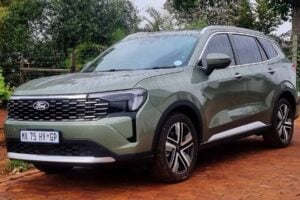
First ever Super Duty-badged Ranger will have single, Super and double cab bodystyles, but require a code 10 licence.
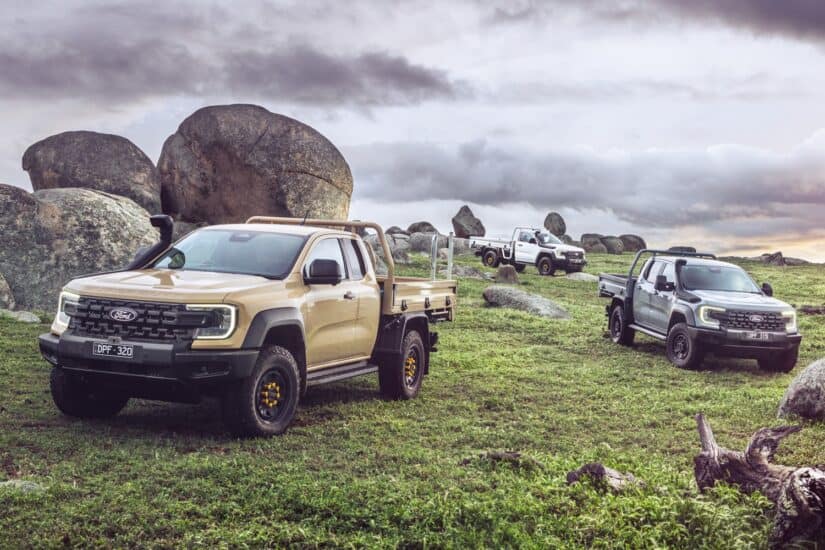
Entire family of Ford Ranger Super Duty models will come to South Africa in a gradual roll-out next year. Picture: Ford Australia


Approved for South Africa shortly before its “unveiling” as a prototype at the Nampo Agricultural Expo in Bothaville in the Free State in May, Ford has announced a preliminary price tag for the Ranger Super Duty.
Not only a double cab
The first ever Ranger to wear the Super Duty moniker, until now reserved for the F-Series in the United States, the newcomer will still only arrive in 2027 in what the Blue Oval describes as a phased approach.

Assembled in Thailand and not at the Silverton plant outside Pretoria, the imported and largely Australian-developed Super Duty won’t be restricted to a double cab bodystyle as believed until now.
As part of the roll-out, it will also be offered in double chassis cab, single chassis cab and Super Chassis Cab configurations.
Code 10
Likely to be modelled on the XLT derivative, or XL in the case of the single cab, the Super Duty, as with the Brazilian-made F-250 sold locally over two decades ago, will require a code 10 licence as a result of its 4 500 kg gross vehicle mass (GVM) rating.
Extensively muscled-up
Compared to the standard Ranger, the Super Duty’s key differences include a steel front bumper, wider mirrors, a new bonnet with Super Duty lettering, a steel front bashplate and an enlarged 130-litre long range diesel tank.

Elsewhere, special mounting points have been integrated into the bumper to accommodate Ford accessory-approved driving lights, while the wheel arches have been widened to accommodate the 33-inch all-terrain tyres.
Structurally revised
Not detailed until now, the Ranger Super Duty’s chassis changes include a reinforced frame, stronger driveshafts, a new heavy-duty rear axle, and a Ranger-first locking front and rear differentials.

In addition, Ford has also fitted eight stud wheel hubs and a thicker steel protection plate underneath the fuel tank, front differential and transfer case.
Accordingly, the Super Duty has a claimed 299 mm of ground clearance and a wading depth of 850 mm. As standard, it can still tow 3 500 kg, or up to 4 500 kg when fitted with the optional uprated tow bar.
No massive changes inside
Inside, the interior has not been changed from the standard Ranger, bar Super Duty lettering on the upper glovebox and a scale display, with readouts, within the 12-inch SYNC 4A infotainment display thanks to sensors built into the suspension.

Although no other details are known, the Super Duty is expected to have the same level of specification as the XLT.
Detuned Lion V6
Residing up front, the South African-spec Ranger Super Duty follows the Australian example by retaining the 3.0-litre Lion turbodiesel V6 engine, albeit in detuned form described by Ford as having been done for “heavy-duty emissions standards”.
As a result, power output drops from 184 kW to the same 154 kW as the discontinued 2.0-litre bi-turbodiesel Panther engine, while torque is unchanged at 600 Nm.
The General Motors (GM) co-developed 10-speed automatic gearbox is again the sole transmission option. However, while its gear set remains the same, it does benefit from an upgraded cooling system.
Price?
An official date of arrival still to be set, Ford has set out a price tag of around R1 100 000 for the single chassis cab, to R1 300 000 for the double cab.

As such, the double cab will be priced a fraction below the Raptor, which carries a sticker of R1 307 300. Ford has indicated, though, that final specification and pricing will only be announced in the new year.