
Sun halo puts on a spectacular show across Gauteng
A rare atmospheric phenomenon caused by high-altitude ice crystals caught the attention of communities across the province.
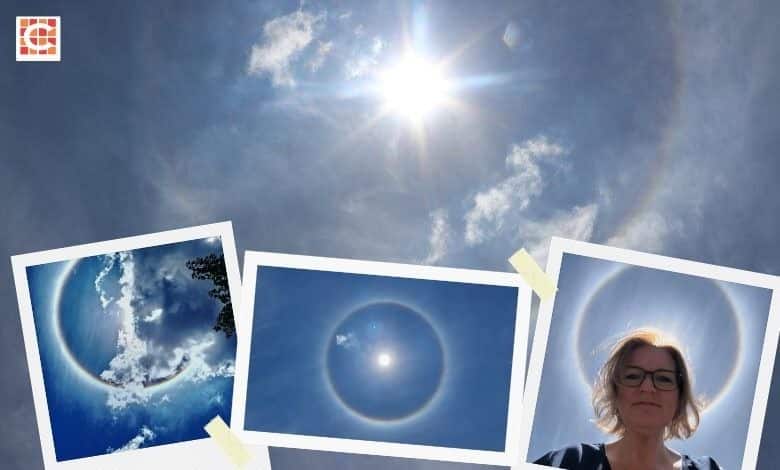
From Vanderbijlpark to Krugersdorp and Pretoria, residents were treated to the same natural spectacle today (November 16), with Caxton journalists and readers sharing photos of the glowing circle.
The phenomenon, known as a solar halo, prompted curiosity across several communities, with some residents wondering whether they were looking at a rainbow, an optical illusion or something a little more mysterious.
While it looked almost magical, there was a perfectly scientific explanation.
A rainbow around the sun
In Vanderbijlpark, residents spotted the phenomenon shortly after 11:00. Gerda Bruinette captured a photo of the display at about 11:30, with the colourful ring clearly visible around the sun.
According to Vaalweekblad, Jaco Mulder identified it as the commonly occurring 22-degree halo.
The spectacle was also captured over Johannesburg by Caxton Joburg North editor Aimee McGill, while Northcliff Melville Times reported on the striking display that transformed the city’s blue skies.
On the West Rand, Krugersdorp residents also stepped outside to investigate the unusual sight. Local weather enthusiast Juandré Vorster, better known as The Weather Hooligan, explained the science behind it, reported the Krugersdorp News.
Pretoria residents and Pretoria Rekord readers also spotted the display. A photo supplied to Rekord showed a broad ring of light with a faint reddish tint along its inner edge.
Prof Jennifer Fitchett from Wits University confirmed that it was a 22-degree halo. She explained that the ring forms when sunlight passes through tiny, six-sided ice crystals in cirrus clouds approximately 8km to 10km above the ground.
These high clouds often appear as thin streaks in the sky. As sunlight passes through the crystals, it bends, creating the circle visible from the ground. The 22 degrees refers to the angle between the sun and the ring.
Does it mean rain is coming?
Although the appearance of a halo can indicate moisture and high-level cloud associated with an approaching weather system, it is not necessarily a reliable forecast of rain.
Fitchett said the ring itself offered little indication of what Pretoria’s weather would do next. The more useful clue today was the darkening cumulus clouds moving in, which suggested further rain was likely after yesterday’s thunderstorms.
She also stressed that the phenomenon was unrelated to the recent extreme heat. The ice crystals responsible form high in the atmosphere, where temperatures are extremely low, even when conditions on the ground are warm.
According to the UK Met Office, the most common type is the 22-degree halo. The World Meteorological Organisation describes it as generally white, with a reddish inner edge. The sky inside the circle can also appear darker than the surrounding sky.
The same optical phenomenon can occur around the moon, producing a lunar halo.
How to photograph it without hurting your eyes
While the temptation to admire and photograph the spectacle is understandable, citizens should remember that looking directly at the sun can cause serious eye damage.
Fitchett advised residents to stand where the edge of a building blocks the sun itself and observe the surrounding ring.
Vorster and Krugersdorp News also shared practical tips for capturing the display safely:
- Block the sun: Use your hand, a tree, a streetlight or the edge of a building to obscure the sun.
- Look around the obstruction: The halo sits approximately 22 degrees from the sun, so blocking the sun itself allows you to see the surrounding ring.
- Don’t rely on sunglasses: They can reduce general brightness but are not a substitute for blocking the sun.
- Position your camera carefully: Hold up a finger or use the edge of a building to block the sun while photographing the surrounding sky.
- Use your phone camera: Most modern smartphones can capture the display, provided the sun is obscured.
Breaking news at your fingertips… Follow Caxton Network News on Facebook and join our WhatsApp channel.
Nuus wat saakmaak. Volg Caxton Netwerk-nuus op Facebook en sluit aan by ons WhatsApp-kanaal.
Read original story on www.citizen.co.za

