That press conference was emotionally charged, but beyond the drama, it demanded accountability.
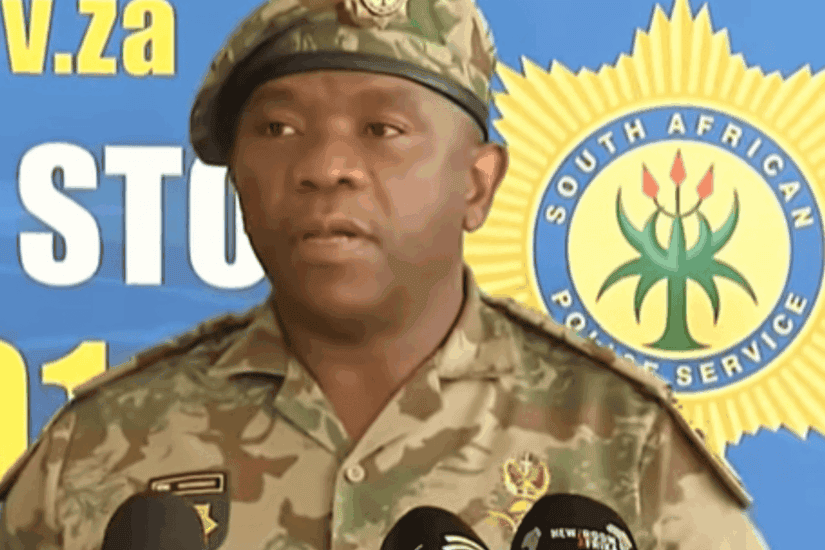
KwaZulu-Natal police commissioner Nhlanhla Mkhwanazi briefs the media on 6 July 2025. Picture: Screenshot


It has been a year since KwaZulu‑Natal (KZN) police commissioner Nhlanhla Mkhwanazi stunned the country with revelations on how politicians and criminal networks had infiltrated South Africa’s criminal justice system.
On 6 July 2025, Mkhwanazi addressed the media in Durban in full combat uniform, alleging a transnational drug syndicate – aided by politicians, senior police officers, prosecutors, and businesspeople – had deeply infiltrated the criminal justice system.
Emotionally charged
He specifically accused the now-suspended police minister, Senzo Mchunu, and deputy commissioner Shadrack Sibiya of disbanding the elite Political Killings Task Team (PKTT) to obstruct investigations into organised crime and political hits.
That press conference was emotionally charged, but beyond the drama, it demanded accountability.
Twelve months later, the investigations have yielded unprecedented disciplinary and criminal actions within the police leadership. High‑profile arrests included businessman Vusimuzi “Cat” Matlala and James Murray, who were allegedly bribing senior police to secure an R228‑million contract.
Has anything changed?
Further operations led to the charging of national police commissioner General Fannie Masemola, along with the arrest of officials, including Kagiso Lerutla and Julius Mkhwanazi, and the suspension of Major‑General Feroz Khan.
The question today is whether anything has truly changed.
Since then, the Madlanga Commission has been established, Parliament’s ad hoc committee has taken up the issue, and key suspensions have followed – including that of the national commissioner earlier this year.
Mkhwanazi’s claims that 121 dockets were abruptly removed amid alleged ministerial interference set the tone. These files were later returned, the PKTT resumed its work, and even a second task team was formed in Gauteng. Individuals named at the briefing, such as Shadrack Sibiya, were suspended, showing the allegations had real consequences.
Reforms
Political analyst and North-West University professor, André Duvenhage, said the deeper question is whether South Africans are seeing tangible benefits.
Duvenhage said commissions and committees must deliver more than headlines.
“They must reform a justice system long accused of capture,” he said.
Duvenhage describes that day as “explosive” and “shook the foundations of the South African political system and political elites”.
‘Mafia state’
He argues it verified “South Africa can be regarded as a mafia state”, and the revelations were “a fundamental test of the consolidation of our democracy and, very specifically, the supremacy of the judicial system – the oppergesag van die reg (superiority of the law) in a constitutional state”.
“In a way, it is a fundamental test to the consolidation of our democracy and, very specifically, the supremacy of the judicial system and what we call in Afrikaans, die oppergesag van die reg (the superiority of the law) and South Africa as a constitutional state.”
He added that corruption is not only systemic and endemic, but it has also become influenced and directed by criminal groupings.
“These people are influencing senior decision‑making, basically destroying the criminal justice system. And that, in a way, explains why there was no action taken specifically against ANC politicians over the years.”
Corruption
For Duvenhage, the revelations exposed corruption not only within the police but also the direct influence of criminal groupings on senior decision‑making.
“Corruption is not only systemic and endemic, but it has also become influenced and directed by criminal groupings.
“These people are influencing senior decision‑making, basically destroying the criminal justice system,” he added.
This is why, for years, no action was taken against ANC politicians despite more than 100 serious corruption cases, he said.
Scandals
Duvenhage points to scandals ranging from the Seriti Commission to Chancellor House, Oilgate, state capture, and Phala Phala.
“There are more than a hundred of them, and this puts into perspective why there was no action.”
Why did Mkwanazi survive?
What is striking, he added, is that Mkhwanazi has survived in his position.
“I ask myself who is behind him politically, because he needs to have some support. You cannot challenge this system without political support.”
At the same time, Duvenhage highlights the wave of assassinations and attempted assassinations as evidence of criminal elites’ influence.
“There are so many assassinations or attempted assassinations identifying the influence of the criminal elite on the system even today,” he said.
Remedies
The remedies are daunting, he stressed.
“Can we change this around? Or has it become so serious that the system is destroying itself in some ways and cannot be repaired? And if it is going to be repaired, then you need to put in jail properly 70 -80% of senior politicians within the framework of the ANC and involving other parties.”
Corruption, he stressed, is not confined to one party.
“We have seen over the weekend other forms of corruption identified involving Julius Malema, the old tobacco thing and what is connected to that. So, this is serious, but how are we going to take this forward?”
Politics
Duvenhage also situates these developments within South Africa’s radical political environment.
“With the radical political environment, I’m speaking about the left, the centre‑left of South African politics. At the same time, I’m referring to the ANC, not the DA in this case.”
He points to the uMkhonto weSizwe (MK) party as a key player.
“It seems to me as if there are plans going on to formulate a revolution within a revolution. And that is what the MK is doing. They are the architects and the front line of all of this.”
He warns that xenophobic rhetoric is being used as a mobilising tool.
“This is the common enemy they need to mobilise against. But I think it is to cover up many other things to keep political control; as a result of this serious corruption and state capture we are seeing.”
Looking ahead
Duvenhage said the press conference was a turning point, forcing the country to confront the reality of police capture and criminal infiltration.
But looking ahead, the challenge is whether commissions, committees, and suspensions will translate into a justice system that works for the people.
“Looking forward, the challenge is whether these inquiries will translate into a justice system that works for citizens,” he said.
“Either the revelations of a year ago become the catalyst for genuine reform, or they fade into yet another chapter in the long story of corruption without consequence.”