
The report found executive accountability concerns relating to Mchunu.
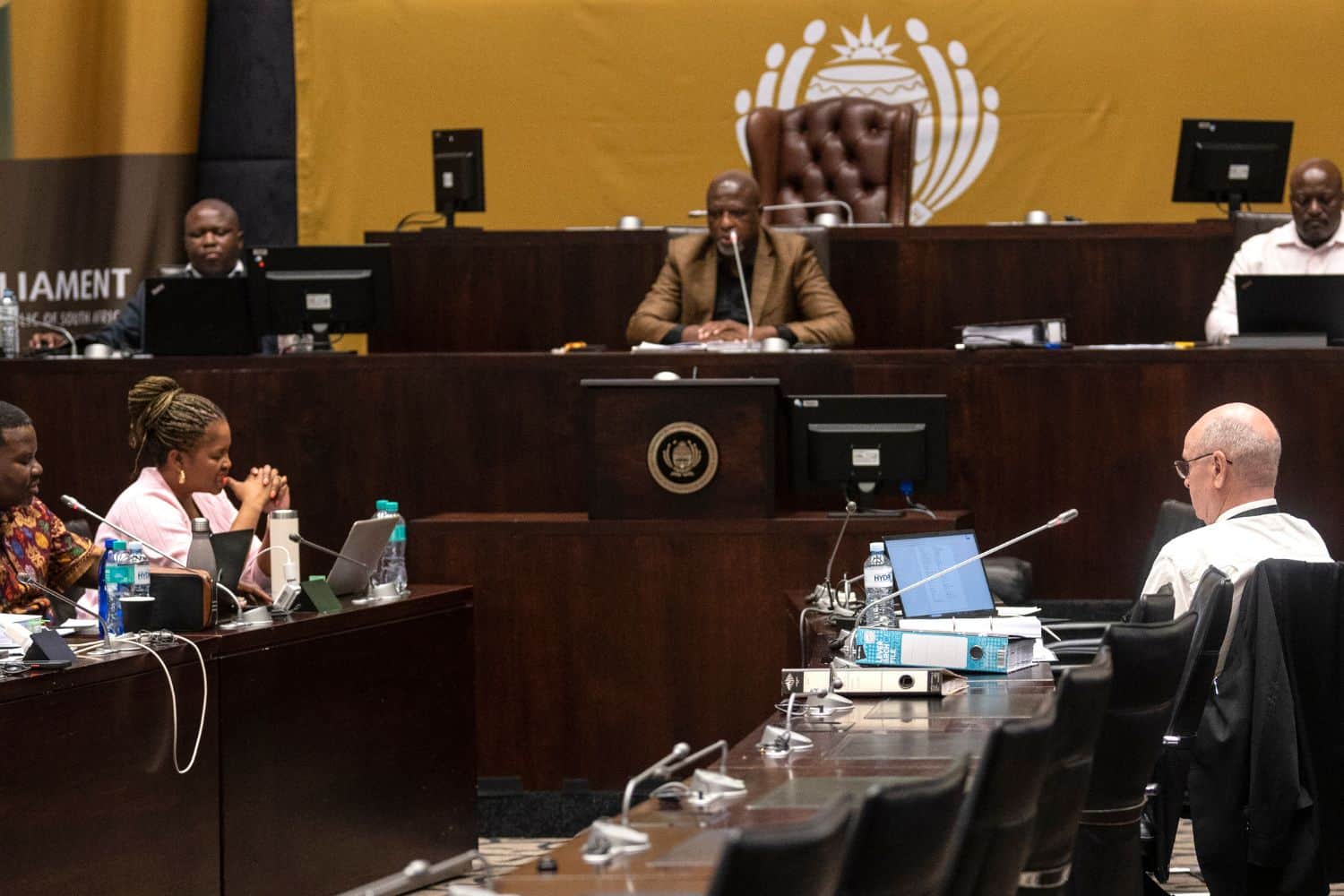
MPs during Parliament’s ad hoc committee inquiry at the Good Hope Chambers in Cape Town on 10 February 2026. Picture: Gallo Images/Brenton Geach


Parliament’s Ad Hoc Committee to investigate allegations made by KwaZulu-Natal police commissioner Lieutenant General Nhlanhla Mkhwanazi has deliberated on several issues involving individuals and state institutions.
On Tuesday, committee members met to deliberate on the draft report, with MPs agreeing on several issues it identified.
What the evidence reveals
- The evidence gathered through testimony before the committee revealed systemic governance weaknesses rather than merely an isolated administrative dispute
- The 31 December 2024 directive was issued and implemented through a materially deficient governance process
- Governance of specialised units and temporary task teams was found to be inadequate
- Docket control, case continuity, and evidentiary safeguards require strengthening
- Crime Intelligence is affected by serious structural and integrity vulnerabilities
- Crime Intelligence funding, classification, and oversight arrangements do not provide adequate assurance
- Leadership, delegation, discipline, and command-governance processes require strengthening
- The Medicare24 procurement process was affected by serious irregularities and control failures
- Improperly managed relationships and informal influence created institutional integrity risks
- Safeguards relating to the National Prosecuting Authority (NPA) and IDAC require focused assessment
- Police accountability and civilian oversight mechanisms require strengthening
- Internal reporting systems, witness protection, and whistleblower protection remain inadequate
- Parliamentary oversight, implementation follow-up, institutional culture, and public confidence all require further attention
Ad hoc committee on Mchunu, Matlala and Mogotsi
MPs agreed that further deliberations were required concerning several individuals before the report could be finalised and adopted.
These include suspended police minister Senzo Mchunu over his 31 December directive to disband the PKTT and his relationship with Brown Mogotsi, and suspended deputy national police commissioner Shadrack Sibiya’s handling of the 121 dockets, his implementation of Mchunu’s directive and relationships with Mogotsi and Vusimuzi ‘Cat’ Matlala.
The report found executive accountability concerns relating to Mchunu but did not conclude that a corrupt agreement or cartel instruction had been proven.
Suspended national police commissioner Fannie Masemola’s response to Mchunu’s directive and the warning about the Medicare24 contract, as well as Matlala’s allegations against former police minister Bheki Cele, including alleged payments, were also highlighted.
The report also found serious unresolved issues involving Sibiya, but does not conclude that he acted on behalf of Matlala, Mogotsi, or an organised crime network.
Institutions
The committee identified that, while serious vulnerabilities to organised crime exist, the evidence does not establish a single controlling cartel across all institutions.
The report identified institutional risks affecting the judiciary, prosecution services, and IDAC, but does not conclude that these institutions have been captured.
The committee recognised unmanaged personal relationships as integrity risks, but does not regard every informal relationship as evidence of corruption.
The report found limitations arising from restricted access to classified Crime Intelligence information and recommends improved mechanisms governing classified information.
‘Watered down’ findings
While MPs largely agreed on most sections of the draft report, some, including EFF MP Leigh-Ann Mathys, raised concerns about “watered down” findings.
These include findings on Mchunu’s directive, which Mathys said MPs were clear was “irrational”, and the “erosion” of the criminal justice system, which the report recorded as a “vulnerability”.
“It must be clear that the directive was irrational and that paragraph does not capture that the directive that the minister issued was irrational. It’s just very watered down.
“For the minister to make such a high-end decision on disbandment based on independent submissions from citizens was not a sound decision at all. So that needs to come out much more clearly,” she said.
Ad hoc committee on O’Sullivan’s ‘disrespect’
Other issues that were not recorded properly in the draft report, according to Mathys, concerned Paul O’Sullivan, Sarah-Jane Trent, and Robert McBride, “which are extremely watered down”.
“This must be reworded to clearly state that the relationship that was between Robert McBride, O’Sullivan, and Trent was improper, irregular, and warrants criminal investigations.
“Also, the whole matter of our engagement with Paul O’Sullivan is not properly captured in this report. From our very first engagement with Paul O’Sullivan, it must be here. And the extent that we had to go to, including his walkout.
“His name must be mentioned here clearly, including the accommodation, and all those requests that he made, how he walked out, and also how he insulted one of our Honourable Members here in the committee. That must be captured in the report, and not as an afterthought.
“It can’t be that we can let people off the hook in that regard, who showed such utter disrespect to the process of this committee.”
The report was sent back to the content team to make the necessary changes, who will then send it back to the committee. The legal team is committed to submitting the third draft by Friday, 17 July.