Amnesty International South Africa said the state must 'move beyond commitments and deliver tangible improvements'
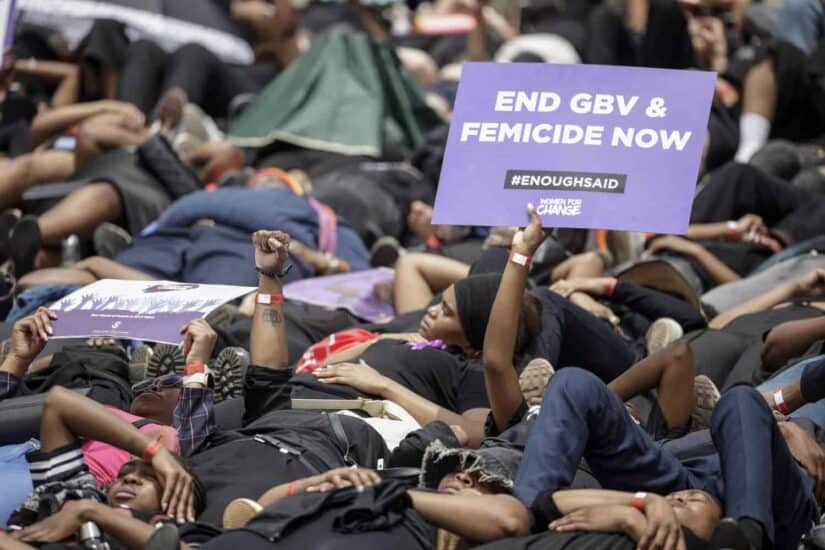
Protesters hold placards as they lie on the ground during the Women’s Nationwide Shutdown at Constitution Hill in Johannesburg on November 21, 2025. Picture: Gianluigi Guercia / AFP


Amnesty International South Africa has called on the government to move beyond promises and make meaningful improvements to women’s lives in the country.
South African women trapped
The human rights group used Women’s Day to highlight that millions of South African women and girls don’t experience their constitutional rights to dignity, safety and basic services.
“Decades after the end of apartheid, intersecting crises of gender-based violence and femicide (GBVF) and failing service delivery continue to trap women in cycles of poverty, risk, and inequality,” Amnesty International South Africa said on Sunday.
It comes after President Cyril Ramaphosa on Sunday said the high level of gender-based violence (GBV) in the country means South African women will never be truly free.
Amnesty International South Africa Executive Director Shenilla Mohamed called on government to do more.
“As South Africa marks Women’s Day, the state must move beyond commitments and deliver tangible improvements that transform the realities women face in their communities every day,” she said.
Reliable crime stats needed
Mohamed used the latest crime statistics to make her point.
“The most recent quarterly crime statistics (January 2026 – March 2026), recorded 9 782 reported rapes, while this was down by 8.5% from the same time last year, this still amounts to around 108 rapes a day. The total number of sexual offences reported were 12 590,” she said.
Mohamed also questioned the reliability of the statistics presented by the state on crimes against women and children, after the South African Police Service (Saps) suspended publication of disaggregated crime data in August 2025, including statistics on the murder and assault of women and children.
“When critical information about the killings and assaults of women is missing from official statistics, it undermines efforts to prevent violence, allocate resources effectively and hold those responsible to account,” she said.
Service delivery
Amnesty International South Africa also called on the government to improve service delivery, saying these failures place women at risk.
“Inadequate access to water, sanitation and other essential services disproportionately impacts women and girls, exposing them to heightened insecurity and limiting their ability to live with dignity.”
“Violence against women does not occur in isolation. It is exacerbated by the conditions many women are forced to endure every day, including unreliable access to water, sanitation, electricity and safe public spaces,” Mohamed said.