


The 99 933 people who left due to the anti-illegal immigration protests cost the South African government at least R3 414 per foreign national.
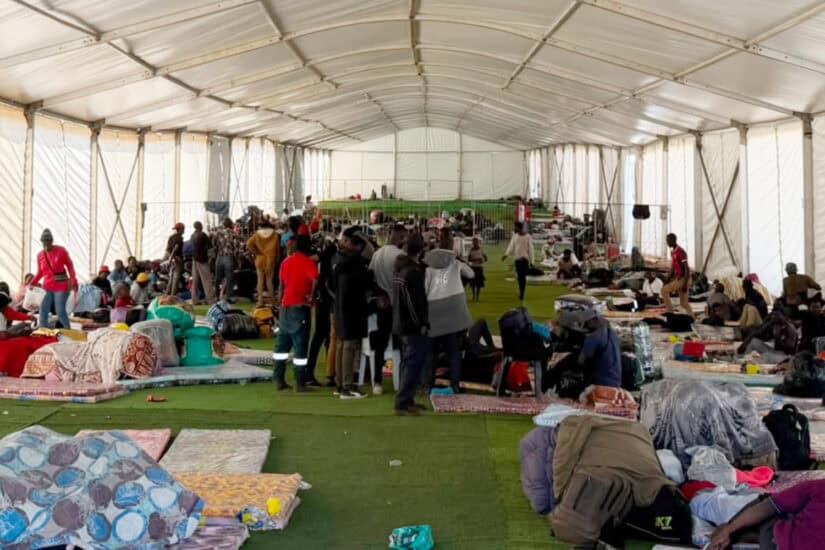
Foreign nationals awaiting repatriation at a temporary facility near the Beitbridge border post. Picture: Supplied / Department of Public Works and Infrastructure


The South African government spent hundreds of millions on the repatriation of foreign nationals, with a request for emergency funding still to be approved by National Treasury.
Between preparatory efforts prior to the mass anti-illegal immigration protests on 30 June, and 18 August, the government spent R341.2 million to facilitate the call of “abahambe”.
The Department of Home Affairs (DHA) clarified that making the repatriation operation possible relied on the overriding of governance fail-safes – and a request for funding that was still subject to approval.
“Should the request for unforeseen and unavoidable expenditure not be approved, the department will have to reprioritise funds in its baseline to cover the overspending.
“Such a reprioritisation process will require virements and forced savings,” DHA stated.
Over R30 million on home affairs officials
A detailed breakdown of the repatriation and deportation expenditure was given to the Home Affairs Portfolio Committee on Tuesday.
The repatriation operation took approximately 11 000 people from 12 local entities, including government departments, law enforcement, diplomatic missions, charity organisations and the private sector.
The R341.2 million included R48 million spent by the Department of Public Works and Infrastructure (DPWI) for the temporary repatriation facility.
Accommodation for national Home Affairs officials in Durban and Musina cost the department R9.5 million, with overtime for officials totalling R13 million.
Home Affairs’ provincial expenditure totalled R14.5 million, including R5.9 million on overtime, R6.2 million on accommodation for staff, and R80 000 on photocopier paper.
The eThekwini and Cape Town municipalities spent R10 million and R3 million, respectively, for transport to Musina and Epping.
DHA stated it provided the DPWI and the relevant municipalities with repayment commitment letters in order to secure their cooperation.
“The cities assisted the DHA with the removal of illegal foreigners concentrated in specific locations on a reimbursement basis given the urgency and scale of the humanitarian crisis.
“The DHA reimbursed the cities for the expenditure incurred by means of interdepartmental claims and based on the supporting documents provided,” DHA told the committee
Almost 55 000 Malawians gone
DHA’s figures put the number of repatriations at 89 936, with a further 9 997 being forcefully deported.
Malawians were the nationality who chose to voluntarily leave in the greatest numbers, accounting for 54 541 of repatriations.
Additionally, 27 920 Zimbabweans, 2 417 Mozambiquans and 1 145 Nigerians were among those who left South Africa.
In total, the 99 933 people who left due to the anti-illegal immigration protests cost the South African government at least R3 414 per foreign national.
The greatest cost was the spending of R232.8 million on buses for the departees, while there was also R8.7 million spent on chartered flights to Ethiopia, Nigeria, Burundi and the Democratic Republic of the Congo.
Initial budget for all transportation cost related to foreign nationals was R57 million, but that ballooned to R277 million.
As a result, the budget for travel agent fees swelled from R2 million to over R13 million.
DHA stated that is used its existing travel management contractor appointed via a 2023 tender, and fees were charged at a predetermined rate.
Procurement of transport and accommodation was done via an order submitted by DHA and facilitated by the travel management company, who spread the quotations and orders across multiple service providers.
“To reduce the risk of relying on single suppliers the department ordered busses from more than one company rather than giving one company an order,” DHA stated.



