



Although Johnson conceded that Masemola's case should have been separated from the rest, she denied that it was done to embarrass him.
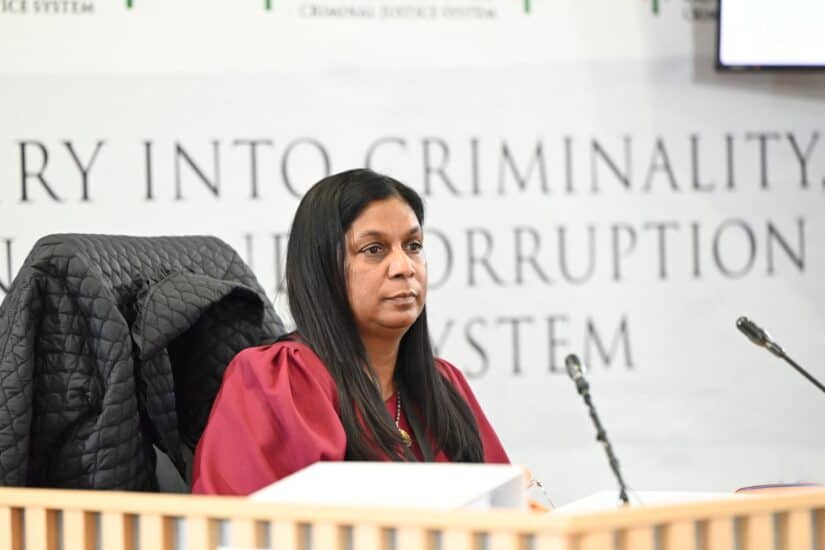
Former Independent Directorate Against Corruption Head Advocate Andrea Johnson testifies at the Madlanga Commission of Inquiry at Brigette Mabandla Judicial College on July 28, 2026 in Pretoria, South Africa. (Photo by Gallo Images/Frennie Shivambu)


It was another day of concessions for former Independent Directorate Against Corruption head Advocate Andrea Johnson, who continued with her testimony at the Madlanga Commission on Wednesday.
The commission zoomed in on the charges faced by suspended national police commissioner Fannie Masemola, who was arrested for contravention of the PFMA, relating to the irregular awarding of a R360 million Saps contract to Vusimuzi ‘Cat’ Matlala’s company, Medicare24 Tshwane District.
In March, Masemola dismissed allegations that he was caught sleeping regarding the awarding of this tender.
“Talking about dropping the ball, I wouldn’t know what you are indeed referring to. As an accounting officer, I’ve done my work. I’ve done what I was supposed to do. But I don’t think it’s an area one would want to venture into. Have I done anything wrong? No, I didn’t do anything wrong. I cancelled the contract, and I followed other processes, and yeah, that’s how far I want to take it,” he told the media at the time.
Charges against Masemola
On Wednesday, the commissioners questioned Johnson about the charges against Masemola and how Idac became involved in the case.
Commission chair Mbuyiseli Madlanga took issue with Masemola being lumped in with people charged with corruption and fraud, even though his charges were unrelated. He also questioned Johnson about what information she relied on to reach the conclusion that the charges had met the threshold for an Idac mandate.
“General Masemola’s charges cannot stand alone and must be added to others that will then meet the threshold to trigger an Idac mandate,” said Madlanga.
“If the charges Masemola is facing are only those under the PFMA, on what basis does the Idac have the mandate to charge General Masemola under the PFMA only?”
‘He took too long’
Johnson said Masemola’s charges resulted from the serious, complex corruption and commercial crimes matter, which falls under the Idac mandate.
“The Medicare24 matter relates to serious, high-profile or complex corruption and commercial crimes. That is the umbrella of the cases. The involvement of General Masemola in serious, high-profile commercial or financial matters is related to the PFMA.
“When these offences were allegedly taking place, Major-General Charity Matlala Matlou brought it to the commissioner to say there are these offences taking place, and commissioner, as the accounting officer, you need to stop the contract, which would then stop the payment.
“It took him a long time to do so, and in not acting, in terms of his duties as the accounting officer, to act promptly and diligently, funds were paid out because of these unlawful, corrupt activities in the approximate amount of R50 million. We never said he was part of the corrupt activities, but he was charged under the PFMA for the matters we say he became aware of and did not stop.”
However, Madlanga insisted Masemola’s charges should have been separated from the rest.
“General Masemola would have to be charged on his own, so what would the charges he is facing be additional to? Nothing. Your attempt to simply force the PFMA charges to be additional does not work. When you look at the charges General Masemola is facing, they’re not related to anything; they stand on their own,” he said.
‘No defending him’
Madlanga further made it clear to Johnson that the commissioners were not suggesting that Masemola did not have a case to answer, but were focused only on Idac’s mandate.
“Idac, in so far as the PFMA is concerned, on our reading, Idac’s mandate is only if there are other charges and then the PFMA charges are additional to that. That’s all we’re saying. Whether or not PFMA offences have been committed is something else altogether, but it’s not something to be pursued by Idac; that’s all we’re suggesting to you.”
‘Was Masemola willful?’
However, commissioners Sandile Khumalo and Sesi Baloyi missed Madlanga’s memo and delved into the merits of the charges.
They maintained that the provisions that Johnson relied on to charge Masemola did not describe the suspended commissioner’s actions.
“I’m going to focus on the process leading to the charges by Idac. You refer to General Matlou’s affidavit. What she says in relation to General Masemola, she advises him to consider terminating the contract to save Saps from irreparable harm. General Masemola then accepted the advice,” explained Khumalo.
“What the PFMA requires is willful and grossly negligent conduct on the part of General Masemola. If I understand this, they would kick in if, notwithstanding the advice, he does absolutely nothing, because then that would be willful.
“If upon receiving that advice, you terminate the contract, where is the willful, intentional conduct? You can only sustain the PFMA charges if, after he received advice from the head of risk, he ignores that advice and allows Saps to continue with this contract.”
Johnson maintained that Masemola was charged because he took “too long” to act on the advice.
“It is precisely because he took a long time that in that period, monies were released. That is how I understand it,” said Johnson.
“I gave the commissioner advice, and he terminated the contract; this is what General Matlou said. She is the complainant, and there is no suggestion by her that ‘General Masemola did nothing with my advice or that he took long before acting on the advice, and as a result, there was the loss’,” responded Khumalo.
‘You meant to embarrass him’
Commissioner Baloyi went for the jugular, saying Idac arrested Masemola to embarrass him. She said it was inconceivable that all the legal minds at Idac could not see that the institution had no mandate to investigate Masemola.
“This was just a scheme to get him arrested and have him appear in court, and the purpose is achieved,” said Baloyi.
“It must have been obvious to the lawyers in your office and to the prosecutor who approves those charges that you’re not making an allegation of corruption against him. How do we justify him being here? There has to be another reason why this was approved.
“It is inconceivable to me that a whole lot of lawyers who looked at these charges, none of them said, ‘we can’t do this; this is not good enough for our mandate’. The real intention was never to secure a successful prosecution for corruption; in my view, the intention was to get him arrested, with the spectacle that comes with it, and get him charged; that was its only purpose.”
No malice
Johnson denied Baloyi’s sentiments, saying although the prosecutors could not link Masemola to corruption, there was no malice in the charges brought against him.
“The only thing I accept is that they didn’t draw a link between the two [Masemola and corruption]; that in itself does not make the conduct malicious, and there was no intent to put him on show; it was to charge him as they did,” said Johnson.
“At face value, it seems to me that this must have been done to embarrass him, to taint him, to cause the public to see him as also being complicit in fraud and corruption,” said Madlanga.
“This was done to embarrass him and make him look like he too has done corruption and fraud. This was calculated.”
‘Why was I not told?’
Although Johnson accepted that Masemola’s case should have been separated from the rest and that the optics were not good for him, she insisted it was not done to embarrass him.
Johnson further questioned why her colleagues did not inform her of the many matters she only learned about at the commission. She suggested there was “something going on” at Idac that she was not aware of.
“I have to ponder why we find ourselves in this position as Idac. I don’t think there is meanness when questions are posed by the commission about ‘but why didn’t you know? You should have read’, I think the commission understands I can’t read everything, I won’t know everything, and I do have to trust and rely on my people,” said Johnson.
“I sat with a conundrum last night and asked myself why these issues were not brought to my attention. There must have been something going on that I was not aware of. I cannot tell you what the something else was; I wish I could.”



!['Joburg needs own Madlanga moment,' Zille says as she vows corruption crackdown [VIDEO]](https://media.citizen.co.za/wp-content/uploads/2026/10/Helen-Zille-1-300x200.jpg)