Groups said Hong Kong reforms fail to criminalise AI intimate image creation. Only 20% of rape prosecutions result in convictions.
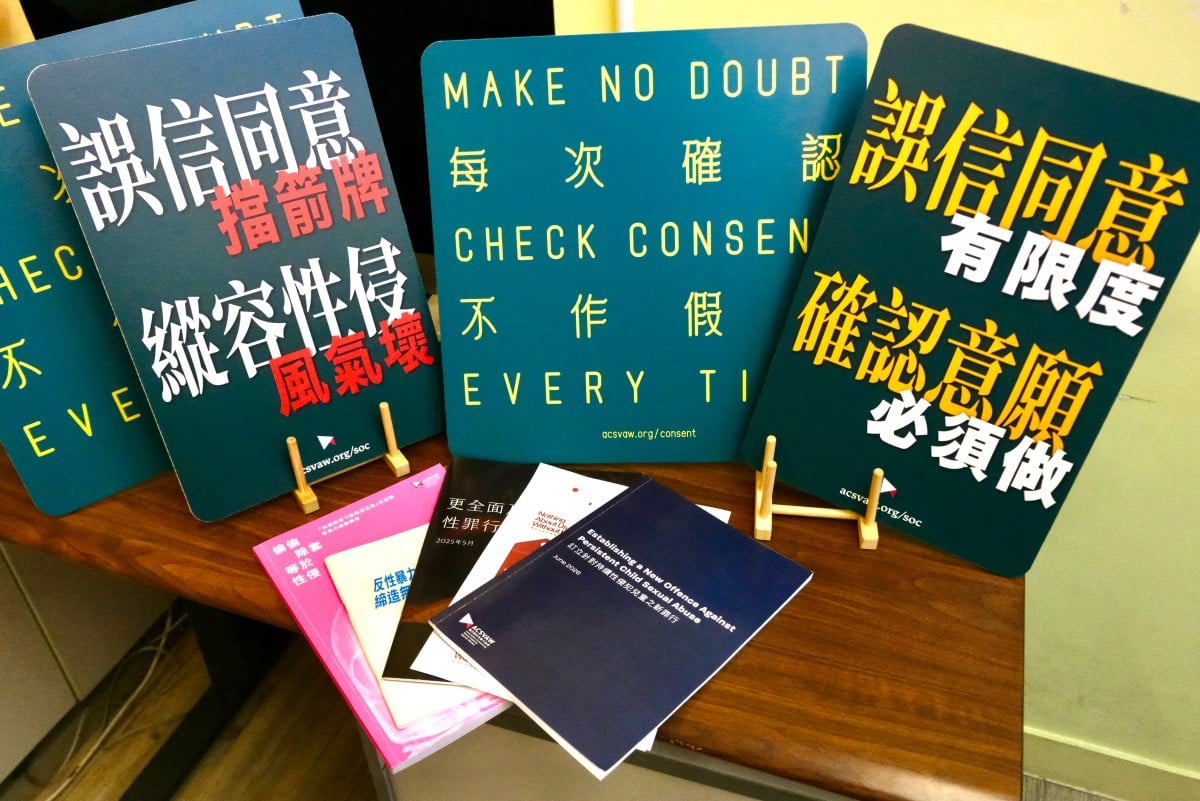
Sexual abuse-related documents and signages are displayed at the Association Concerning Sexual Violence Against Women (ACSVAW) office in Hong Kong on July 8, 2026. Victims of sexual violence and advocacy groups in Hong Kong said July 8 the government’s proposed amendment of its decades-old sexual offences legislation remained seriously flawed in several areas, including that of consent. (Photo by Tommy WANG / AFP)


Survivors of sexual violence and advocacy groups in Hong Kong said Wednesday the government’s proposed amendment of its decades-old sexual offences legislation contained “glaring flaws” in several areas, including that of consent.
The government opened a one-month public consultation on its proposals this week, seeking to reform laws that remain rooted in the city’s British colonial era and are similar to those enacted in England in 1956.
Authorities have admitted current laws are “outdated”, and have vowed to “modernise” them and strengthen protection for victims.
The city’s Association Concerning Sexual Violence Against Women (ACSVAW) told a news conference on Wednesday that the proposals “contain glaring flaws”.
The draft reforms include the introduction of three new non-consensual sexual offences to the criminal code, and stricter penalties for rape convictions.
A statutory definition of consent would be established, including a “non-exhaustive list” of situations where a victim is deemed not to have consented.
The proposed changes still allow for defendants to invoke “mistaken belief”, under which they can argue they believed they had obtained consent, ACSVAW’s executive director Doris Chong said.
“This may perpetuate the current system, under which defendants can avoid conviction simply by claiming a ‘misunderstanding’,” said Chong.
ACSVAW recommends that Hong Kong instead introduce statutory restrictions on “mistaken belief”, for example if a defendant did not take active steps to ascertain consent.
Chelsea Ma, a former practising barrister now with ACSVAW, said that if there were “no truly effective restrictions… in the end, all efforts could come to naught”.
Security secretary Chris Tang told lawmakers on Tuesday the proposed laws require that “the defendant must bear an active responsibility to ensure that consent was obtained”.
The Security Bureau, which oversees the amendment process, told AFP it would “compile and analyse the comments received and take them into account when formulating proposals for legislative amendments”.
‘Unreasonable burden of proof’
We Are X, a survivors’ group, said in a statement to AFP that it believed the draft legislation still has room for improvement.
It highlighted the fact Hong Kong lacks a discrete offence for persistent child sexual abuse.
This means prosecutions usually focus on a few isolated incidents out of dozens or hundreds instances in long-term abuse.
The group urged the government to establish “persistent child sexual abuse” as a separate offence, “thereby reducing the unreasonable burden of proof that victims face when filing separate charges for each incident”.
“The longer the abuse continues, the harder it is for victims to recount the specific details of each incident, making it more difficult to convict the perpetrator,” it said.
We Are X also highlighted loopholes related to the creation or possession of intimate images, including AI-made ones — actions which are not criminalised, while distribution of such images is.
“We believe that the role of the law extends beyond the courtroom, profoundly shaping how society understands sexual violence,” the group said.
“The judicial system should not be yet another, even longer trauma, but should be worthy of trust.”
Only about 20 percent of prosecutions related to rape or sexual assault in Hong Kong resulted in a conviction in recent years, the government’s data shows.