


Government's habit of scoring own goals and not showing up would see us be a laughing stock at the World Cup.
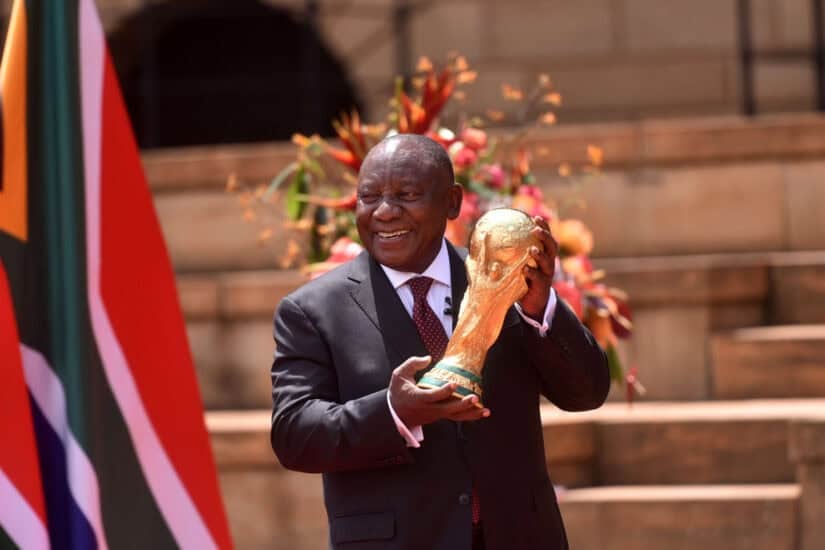
President Cyril Ramaphosa poses for a picture with the FIFA World Cup trophy at the FIFA World Cup Original Trophy Tour at the Union Buildings in Pretoria, 30 January 2026. Picture; Nigel Sibanda/ The Citizen


We are less than a week away from the biggest sporting event on the globe, and FIFA World Cup hype is everywhere. Not as strong as when it was on our shores in 2010, there are still flags being flown and soccer balls being handed out at retailers (if you spend more than a certain amount).
Bafana Bafana take on Mexico next week, with the whole of Mzansi behind it. But the road to Mexico over the past week has been filled with moemishes. Not only did the team fail to board the plane as planned, but they were also found to have broken FIFA rules by fielding 12 players for a short period during a recent warm-up friendly against Nicaragua. The result could be hefty financial penalties and suspensions.
It is the type of incompetence that rears its ugly head every now and then at SAFA House. Their inability to simply do their job has made them the butt of so many jokes, caused them to miss a major tournament in the past, and nearly cost them qualification for this one.
Yet for all the administrators’ failings, we are sadly still better off with them at the helm than government officials.
Government’s habit of scoring own goals and not showing up would see us become a laughing stock at the World Cup.
What do presidents actually do?
I was reminded of this during President Cyril Ramaphosa’s Presidency Budget Vote speech on Tuesday, when he repeated his favourite script: some successes, a handful of excuses, and a lot of promises.
Out of the gate, he noted that the presidency is “not a service delivery department” but a “strategic centre” for implementation, networking and fixing “blockages”.
He then used his best LinkedIn Luke vocab to dazzle MPs with buzzwords describing his key role: inclusive growth and job creation, reducing poverty and tackling the high cost of living, and building a capable, ethical, and developmental state.
And while there have been some successes over the period of his presidency, including a general increase in services and relief to impoverished areas, unemployment, the cost of living, and trust in “ethical” leadership are approaching rock bottom.
Even a recent Stats SA report has noted that while services have been delivered and the state is “developing”, the lived reality is that many still rely on wood, paraffin, community taps, and pit toilets to survive.
They are still in a state of poverty that no fancy speech or “strategy” can fix.
So where are the jobs?
The promise of job creation has been a horse Ramaphosa has ridden since 2018, but the latest employment figures from Stats SA show a decline in employment in the last quarter.
Since the president took over, about 466 000 more people are employed. But there are also more people looking for work, and so there are around two million more people unemployed than in 2018.
Both official unemployment and expanded unemployment rates are higher than they were during Ramaphosa’s first quarter in charge.
Ramaphosa’s presidency has created jobs, just not enough. A failure of his key role.
It is understandable that South Africa does not live in a silo, and that external factors like the Middle Eastern conflict and Covid-19 had an impact, but Ramaphosa’s speech was filled with these and other excuses for why he hadn’t failed. Everyone got the blame, from local governments to broken programmes and even Father Time.
His message: if you give us enough time, we may be able to fix it. The very same reassurance he has been giving desperate youth and the poor for eight years.
Cost of living hand to mouth
Meanwhile, most South Africans are crippled under the weight of another key presidential role: tackling the cost of living.
Inflation rose from 3.1% in March to 4.0 % in April, with food prices increasing sharply year-on-year.
The only upside to this is that now basic groceries cost so much that they get you a free soccer ball at the shops.
South Africans may be broke and unemployed, but at least we have World Cup fever, hey, Mr President?



