Local government elections had everything big losers unexpected winners and reminder theatre cannot substitute for trust.
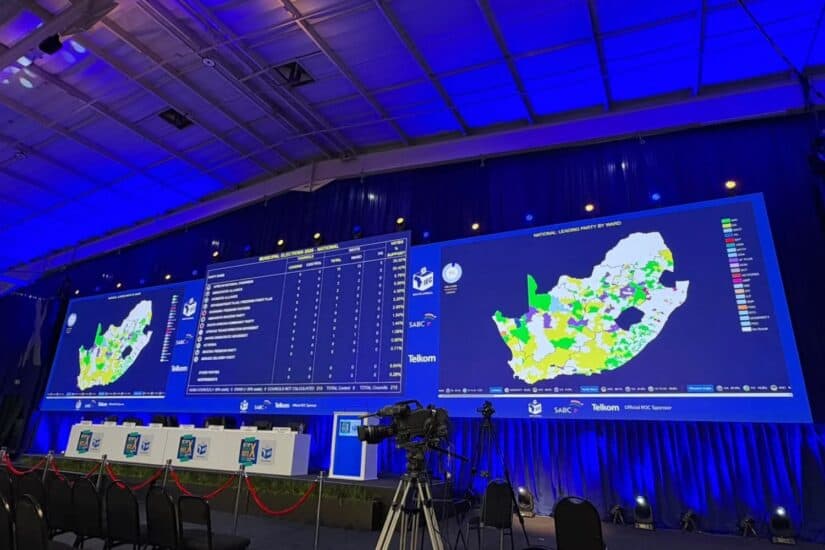
The IEC results board at Gallagher Convention Centre in Midrand. Picture: The Citizen/Faizel Patel


These local government elections had everything: big losers, unexpected winners and an uncomfortable reminder that political theatre cannot substitute for public trust.
The polls have introduced a new player and given final written warnings to some old players. The ANC and EFF have retreated, ActionSA has advanced, and the DA has strengthened its position nationally.
But the real verdict is not about party colours, but whether electoral change can produce functioning government.
For the ANC, the numbers are brutal. Its national support stands at 30.76%, compared with 45.59% in 2021. It has failed to secure an outright majority in any metro.
This is no ordinary setback to be explained away by campaign mistakes as Gwede Mantashe has attempted to.
It is evidence of a party whose historical authority increasingly exceeds its appeal to voters in the present. Liberation credentials cannot indefinitely purchase forgiveness for present disappointments.
Does this prove that the ANC’s downward spiral is irredeemable? Not quite. Elections reveal choices, not destiny. Nevertheless, another promise of renewal will be worthless without visible change.
The party must stop treating public confidence as an inheritance. Its own leadership now acknowledges that municipal failures have alienated voters.
Introspection is necessary; reliable services, accountable appointments and consequences for wrongdoing would be considerably more persuasive.
The EFF faces its own reckoning. They fell from 10.31% to 6.22% nationally. Anger alone is not an electoral programme.
The result should force the party to ask whether its confrontational identity offers enough reassurance to residents seeking competent municipal administration. Opposition politics must provide more than an explanation of what is broken.
ActionSA has a stronger claim to the Biggest Winners’ title. Its national share rose from 2.33% to 5.67%, with substantial gains in Tshwane and Ekurhuleni. It is now a major player in Gauteng’s metropolitan contests.
Herman Mashaba’s television-personality candidate strategy raises an interesting question: when does a gimmick become serious politics? Celebrity candidacies should not be dismissed as frivolous.
DStv’s Sizokthola host Xolani Khumalo seemed like just a celebrity gimmick when he appeared on election posters but has helped ActionSA claim some tough territories especially in Ekurhuleni’s Tembisa.
The DA, meanwhile, needs less of a “maybe” beside its victory. It reached 24.64% nationally and led five metros, although Cape Town alone delivered an outright majority.
These are meaningful gains. Leading a fragmented council is different from controlling it, and negotiating power is different from using it well. Its strongest argument must now be practical delivery.
The Patriotic Alliance’s limitations also deserve attention. Its national support increased to 1.98%, yet the dashboard records no outright council control.
The fair criticism is that increased support has not established broad governing dominance. A growing party can still fall short of the stature its leaders claim.
Nor should this story overlook uMkhonto weSizwe’s emergence as the leading party in eThekwini. The electorate has distributed power, and with that distribution comes responsibility.
Coalition agreements should be public, appointments defensible and service commitments measurable.
The biggest losers must learn humility; the biggest winners must resist entitlement. South Africans have changed the political cast. They deserve more than another season of the same municipal drama.