


The killing of DJ Warras during a building audit reveals how lawlessness and state failure have hollowed out Johannesburg’s CBD.
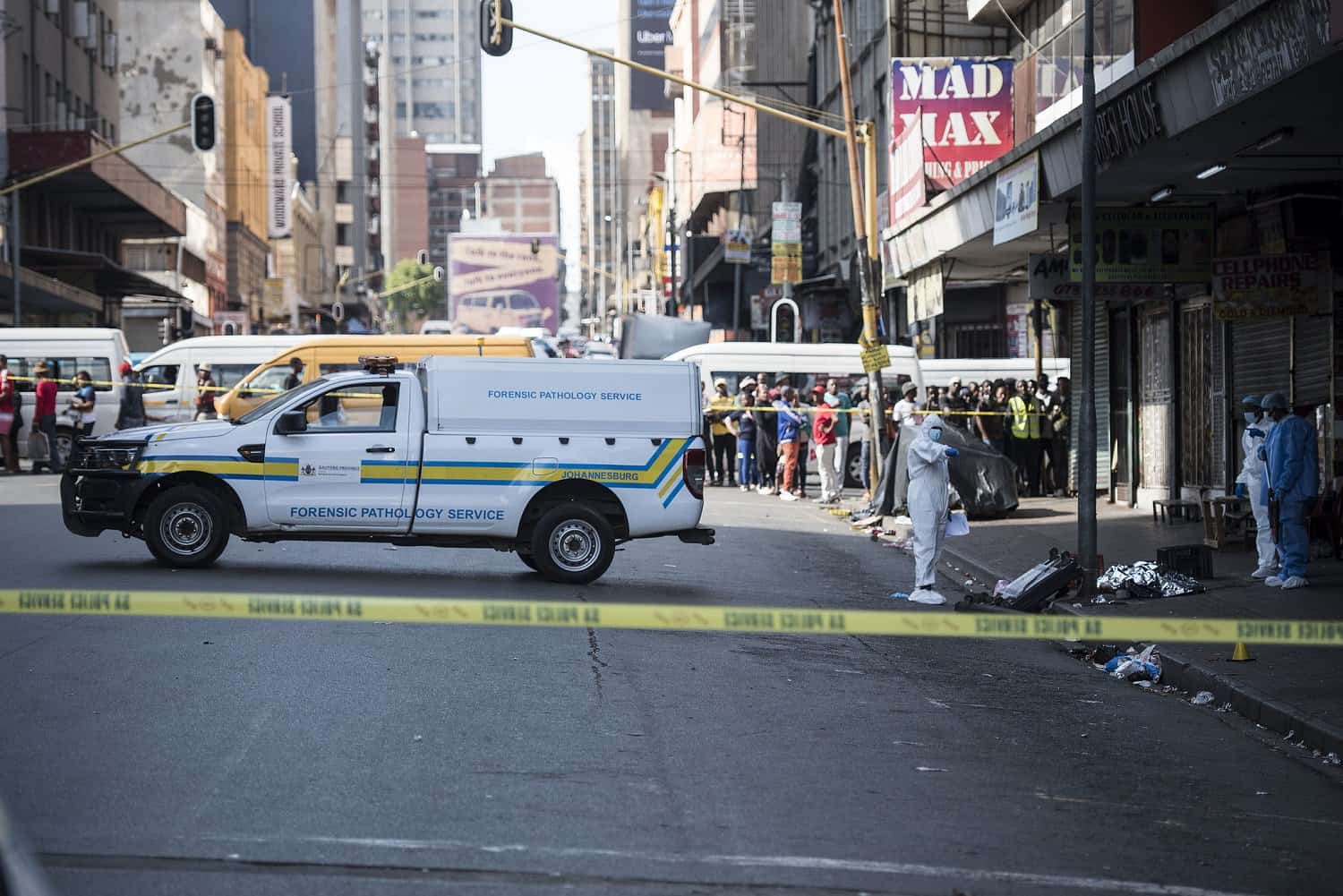
A forensic pathology van removes the body as police investigate the scene where radio and club DJ Warrick Stock, popularly known as DJ Warras, was shot and killed on Von Weilligh Street, 16 December 2025, in the Johannesburg CBD. Picture: Michel Bega/The Citizen


There is something profoundly wrong in the story we keep being told about “reclaiming our cities”, especially Johannesburg’s CBD and its hijacked buildings.
The death of former 5FM presenter and Cliff Central host Warrick “DJ Warras” Stock exposes that contradiction with brutal clarity.
He died while conducting an audit at Zambezi House – a building he allegedly co‑owned, yet one that had been overtaken by unauthorised occupants.
He went to work on Tuesday and never returned home. This cannot be normalised.
For years, the government has promised a revitalised Johannesburg CBD. Citizens, already exhausted by broken promises, warned that the sudden burst of activity ahead of the G20 was political theatre, rather than genuine renewal.
ALSO READ: ‘Struggling to imagine a world without him’: Family of DJ Warras mourns tragic death
The summit came and went. The hijacked buildings remain. The decay deepens. And now, DJ Warras’ death stands as a devastating symbol of service‑delivery failure – a reminder the state’s absence has real human consequences.
How did our cities become so lawless that property owners risk their lives simply by entering their own buildings? Why is decisive action against building hijackers so slow, so inconsistent, so invisible?
The truth is that years of neglect have created a dangerous ecosystem where criminal networks thrive, enforcement is sporadic and ordinary people are left exposed.
Citizens now navigate a maze of hijacked, dilapidated structures, while the state issues slogans, instead of solutions.
For three decades, South Africans have been told to trust a system that increasingly cannot enforce its own laws – from immigration to property rights to basic public safety.
ALSO READ: DJ Warras gunned down in Johannesburg CBD, suspect caught on CCTV
The issue is not only the presence of undocumented individuals, it is the collapse of governance itself.
When laws are ignored without consequence, when enforcement is selective or absent, when the state’s authority is eroded, people are left to fend for them‑ selves in spaces where the rule of law should be non‑negotiable.
We are governed by posters that proclaim Batho Pele, while the people are placed last. The irony is painful.
The very principles meant to protect citizens have become decorative, not directive. And so private individuals – like DJ Warras – step into roles that should belong to the state.
His death is not an isolated tragedy. It is an indictment. It is the cost of a government that has allowed its cities to decay.
NOW READ: PICTURES: This is where DJ Warras was murdered
Support Local Journalism
Add The Citizen as a Preferred Source on Google and follow us on Google News to see more of our trusted reporting in Google News and Top Stories.

