The current South African National Defence Force is a pathetic shadow of what it could be.
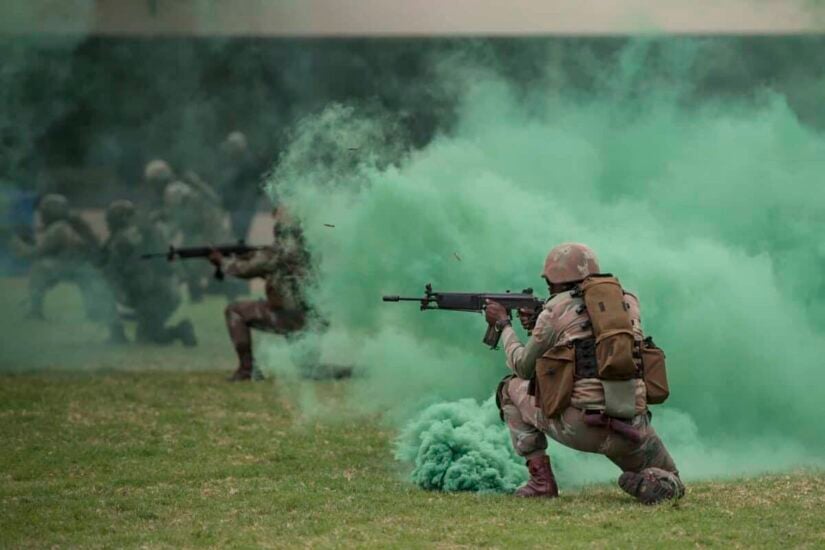
Members of the South African National Defence Force (SANDF) take part in a capability demonstration, 19 April 2025, at the Rand Show, at the Johannesburg Expo Centre in Nasrec. The display featured a combat simulation and static displays of military assets. Picture: Michel Bega/The Citizen


Not long before the 1994 elections, I stood in the dimly lit Kentron control room in Irene, Centurion, watching on a TV monitor as one of the company’s UAVs (unmanned aerial vehicles, or drones as we call them today) tracked an SAA Boeing 747 taking off from the then Jan Smuts Airport, 25km away in Kempton Park.
Almost 30 years ago, the clarity of the image in the demonstration proved eloquently that South Africa’s defence industry was among the world’s frontrunners when it came to drone technology.
And, it was nothing new, even then, because the military had used drones on the Angolan battlefields in the late 1980s.
Little less known was how good the country was at electronic warfare: having developed one of the world’s first uncrackable frequency-hopping radios in the early 1980s; its comms geniuses were turning out products sold all over the world, even under the tight arms embargo.
I once met an executive who boasted about his Joburg company making electronic components for the US Navy for use in its F-14 Tomcat fighters. Top Guns indeed…
Sometimes, it was the more mundane but equally vital bits which were in demand – as in the 1990 Gulf War, when the Allied military came knocking at South Africa’s door in search of the advanced sand filters we used on our helicopters… something they were going to appreciate in the Desert Storm war against Iraq.
There were plenty of other innovations in the defence realm, often birthed because of the difficulty in buying front-line systems.
I was reminded of this the other day when Siphiwe Dlamini, head of communications in the department of defence, wrote for us about the upcoming defence lekgotla.
He noted that in 1990, as the Cold War drew to a close, the industry employed about 130 000 people directly, while the research and development spend was about R6 billion.
Today that has declined to R1 billion a year. Over the same time, defence procurement has dropped from about R26 billion to less than R5 billion.
Today, the South African defence ecosystem directly employs 20 000 people and indirectly supports another 80 000 jobs – and yet the sector generates an annual turnover of just under R25 billion, of which almost 40% is exports.
The reason for that, sadly, is that many of the brightest brains in the defence business left the country, feeling they and their families had no future here under the ANC’s aggressive broad-based black economic empowerment and affirmative action policies.
Almost without fail, those top scientists and engineers have ended up in their new countries, helping build formidable arms-making entities.
Despite the country having blown billions on the arms deal in the 1990s (it was actually the second, because the first was torpedoed shortly after the ANC took over in 1994), the government did not commit enough money to support the new weapons systems, or replace and overhaul them.
The result is that the current South African National Defence Force is a pathetic shadow of what it could be.
This country needs serious defence spending, which will sustain a defence industry which will create and sustain thousands of jobs, earn billions in exports and ensure that South Africa is never in a place where its weapons suppliers can cut it off without notice because they don’t like our diplomatic ties.
As Dlamini pointed out, there is so much potential in our arms industry… but it needs to be nurtured and encouraged, not ignored and left to fend for itself.