


In coalitions, the DA, and Zille particularly, have proven to be impossible to work with and residents have paid the price for it repeatedly.
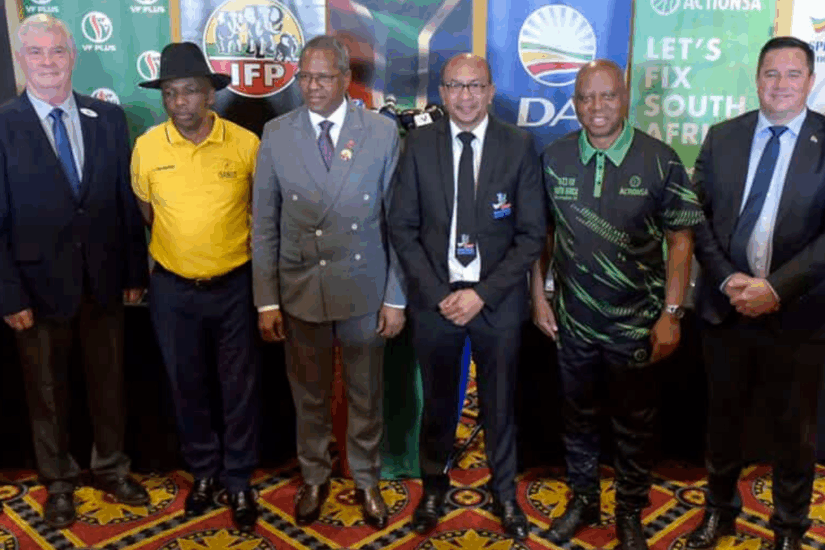
Leaders of political parties involved during the media briefing on the first day of the National Convention for 2024, on16 August 2023. The convention brought a group of political parties together to iron out their coalition agreements ahead of the 2024 elections. Picture: Neil McCartney/The Citizen


Every political party wants to govern with an outright majority to showcase an unadulterated brand of government.
The reality, however, is that coalitions look set to remain part of our political landscape for a long time to come, especially in hotly contested hung councils like Joburg.
Voters need to consider their political choices within the context of the team sport that is coalitions and, most critically, which candidates parties put forward to lead them. You wouldn’t want to bet on a striker to score if you knew that nobody trusted them enough to pass them the ball, right?
Let me clarify from the outset that ActionSA is amenable to working with any party that can produce a credible plan that will provide reliable services to all residents, that will fight corruption and that will address the crisis of illegal immigration.
It is precisely why Helen Zille’s announcement of her intention to coalesce with ActionSA, Inkatha Freedom Party (IFP), African Christian Democratic Party (ACDP) and Freedom Front Plus (FF+) requires careful examination against her track record in coalitions in Joburg.
Even though she has only recently moved to Joburg for the first time since democracy, as Federal Council chair, Zille has been the final say on coalitions in the DA since 2021. It therefore follows that her impact on coalitions has been considerable and measurable and warrants assessment by any serious Johannesburg voter.
On the eve of the inaugural council meetings to elect mayors after the 2021 local government elections, the DA negotiating teams (reporting to Zille) collapsed coalition talks with all other parties.
This followed a fraught negotiation process in which the DA dictated a take-it-or-leave-it structure of a coalition that no party was willing to accept. With the reality of this collapse returning the ANC to governments across Gauteng, political parties came together to teach the DA a lesson, including the EFF, and put the DA into mayoralties without coalition partners, agreements or majorities.
A year later, parties in the coalition expressed their frustration at the DA’s take-it-or-leave-it approach, which was exacerbated by the fact that they held every senior position in the government because of how they were elected against their will at those first council meetings.
Rather than accommodating the Patriotic Alliance (PA) and IFP, who were aggrieved, Zille refused to let the DA budge. After this collapse, no fewer than four attempts were made to restore the coalition behind DA mayoral candidate Mpho Phalatse.
On the final attempt, the PA had agreed to terms which saw ActionSA give away two of its three MMC positions to the PA in order to bring them back. Why wouldn’t the DA, when ActionSA had made all the sacrifices necessary for Phalatse to return as mayor?
Despite this, Zille cancelled the agreement over the heads of her own structures in Gauteng. In the wake of the establishment of the government of national unity (GNU) in June 2024, when a coalition between the DA, ActionSA, ACDP, IFP and FF+ was still in place in Tshwane, it emerged the DA was in talks with the ANC to translate the GNU into the province and the metros.
Nearly three years after supporting DA-led coalitions in Tshwane, which have produced regressing adverse audit findings, cholera outbreaks killing over 30 people and one failure after the next, Zille’s approach was to use the GNU to displace their coalition partners.
Of course, who can forget the DA announcing the moonshot pact, which became the Multi-Party Charter, with the stated intention to create a pre-election agreement between parties to provide an alternative to the ANC.
Throughout the duration of the charter, DA leaders, including Zille, spoke of plans to coalesce with the ANC while using the charter and its partners to campaign on a change mandate. Perhaps Zille’s announcement that she will consider coalitions only with ActionSA, IFP, ACDP and FF+ has to be viewed within a particular context.
This context is that Zille and the DA like to associate with these parties during campaigns while planning coalitions with the ANC. In coalitions, the DA, and Zille particularly, have proven to be impossible to work with and residents have paid the price for it repeatedly.
Compare this to Herman Mashaba‘s record in running coalitions in Joburg. In 2016, the DA’s fedex, a body on which Mashaba did not even serve but Zille did, agreed to set up a minority coalition with the EFF in Joburg.
Mashaba ran that coalition for three years, the greatest period of stability that the city has yet seen under a coalition government, an era where service delivery and the fight against corruption saw progress.
Coalition partners were treated with respect, meaningful power-sharing was implemented and every budget was a multiparty expression of solutions to address the complex challenges in Joburg.



