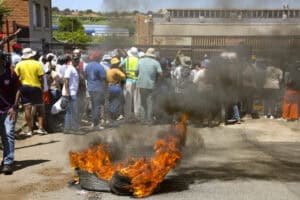
Protests aren't taken as seriously as they should because they're short-term addresses of long-term problems

Picture: iStock


Remember when students needed a new excuse not to write exams and they found it in their ability to protest the outsourcing of labour? Solidarity with workers they called it. Once they got their reprieve from those exams, the solidarity didn’t seem to travel a road of philosophical consistency because insignificantly few of them appear to be protesting against outsourcing in other spheres in the realms of the working class.
Why else would water tankers be filling our potholes so generously? Were the work of providing water actually done directly by the state, there could be marginally more accountability. There would certainly be less incentive to fill a tanker and drive around, unannounced at 3am, claim that nobody was around to pick up water so it had to be dumped because it was time to collect the next load.
This is why protests aren’t taken as seriously as they could. They’re short-term addresses of long-term problems to push short-term fixes.
The anti-migrant protests may have propelled some migrants to the border but to what end? So we have fewer migrants. Are the lives of the protesters any better? Probably not. The electricity protests, service delivery protests, water protests… without follow through, what good have they served?
This isn’t new and it’s demonstrable. There was a wave of protest for free higher education and once that was granted on paper, everything around it fell as though it was an engineering project entrusted to a Bachelor of Arts in philosophy. Nsfas was reasonably functional, until…
Now if you’re lucky, you can get your university degree paid, late and face eviction three or so times a year to join the rest of half of the country in the job market. There’s no protest for a better life, no protest for improvements to the national debt, no protest for anything that will actually make a sustainable difference.
Of course, there aren’t any protests to deliver long-term change because if that was the goal, that would have been the announced aspiration.
Instead, we had graduates in waiting chanting for insourcing. Why? It sounded cool and seemed like the right thing to do. Coupled with the typical South African protest anger, sprinkled with a dash of ignorance and bolstered by some hop-on-one-foot jargon, it did the trick.
What trick though? It got some workers insourced. Hot dang, good job, pat on back and forget about everything else; mission accomplished.
As I was typing this, I got a message from a local ward councilor: “…pump station has been restored. The city has paid over some of the money owing and will develop a payment plan to pay the contractor what is owed. We hope to see supply restored over the course of the weekend.”
A contractor is owed money? Not a shocking occurrence in good ol’ Mzanzi these days but the question must be asked, why is there even a contractor to owe money to? Why does the city not have somebody internally to fix the things that break? Things seem to break all the time so one can’t say that there isn’t a demand for people to fix them.
And if contractors can exist on the state teat then why can’t the state suckle its own teat to deliver?
If there’s something to protest about, it should be that we easily forget why we protested in the first place. There isn’t a single protest in recent memory that has yielded a positive result which didn’t include the need to protest again later down the line.
If outsourcing was such a bad thing, why did those who protest it stop when they could claim but a single victory even if it wasn’t the victory of the real cause?
Had they made a real dent in the idea of outsourcing, we wouldn’t be waiting for the water mafia to deliver today.