While billions disappeared, the consequences for those responsible have been negligible compared to the financial destruction they caused.
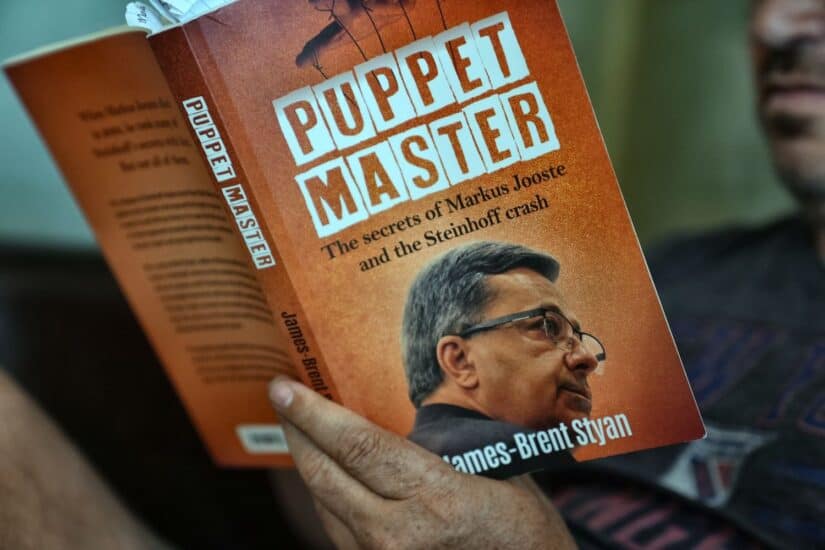
‘Puppet Master’. Investigative journalist James Styan revisits the Steinhoff scandal. Pictures: Hein Kaiser


The end is nigh, or was Steinhoff just a waypoint in South Africa’s seemingly endless cycle of crime? It’s been almost a decade since Markus Jooste’s complex ecosystem of corporate and personal interests collapsed.
And, said author James Styan, South Africa’s justice system remains ill-equipped to stop it from happening again. Investigative journalist Styan, whose sixth book. Puppet Master, revisits the Steinhoff scandal, said the country failed to learn from the disaster.
And while billions disappeared, the consequences for those responsible have been negligible compared to the financial destruction they caused.
“The sharks are still in the water and we still don’t have safety nets,” he said. Steinhoff’s collapse in December 2017 wiped approximately R200 billion from its market value within two weeks. More than 1 000 pension funds were invested in the company, while the Public Investment Corporation lost an estimated R21 billion.
“That’s blue-collar workers, nurses, teachers, policemen. That’s how it affects everybody, and the scale of it is enormous,” Styan said.
Styan’s book draws on approximately 20 000 pages of a PwC forensic investigation into Steinhoff. The complete report has never been publicly released, although a summary identified approximately R106 billion in irregular transactions. Styan obtained the full report, including e-mails, WhatsApp messages and interviews with people involved in the business. He wondered about governance.
“How was it possible the board didn’t see anything? What did they do about things they thought were weird?” he asked.
Steinhoff scandal
Communications allegedly show Jooste instructing associates to delete correspondence, manipulate financial records and avoid discussing sensitive matters electronically. Styan asked what has happened since the scandal. He questioned the accountability of auditors, the Johannesburg Stock Exchange, and law enforcement’s ability to investigate corporate fraud.
“What measures has the JSE put in place? What measures have auditors put in place?” he asked, the latter still unpunished, it appears, for the role that it played in legitimising Steinhoff’s annual reporting.
He was also critical of the Hawks, saying sophisticated financial crime required specialist investigators who understood complex accounting structures.
“The Hawks have this commercial crimes unit that’s supposed to be so incredibly well resourced. It’s not, by my understanding,” he said. “How the hell do you investigate crime like this? You need experts. We don’t have the experts.”
Styan said the problem extended beyond resources to political willingness to strengthen the justice system. He suggested politicians implicated or involved in corruption had little incentive to create investigative structures capable of holding powerful individuals accountable.
“The political will has, to date, simply not been there,” he said and asked why South Africans continued to accept a justice system where investigations took years to probe matters and prosecutions frequently stalled.
“Why wouldn’t you try to steal a hundred billion rand if your penalty is going to be five years in jail?” he said and added that it reads like an incentive for sustained perpetration. But it’s the human cost that puts the social balance sheet deeply in the red.
‘Catastrophic losses’
The families of people who died by suicide after suffering catastrophic losses, thanks to people like Jooste, had approached him seeking answers.
“People lost everything,” he said. Styan said Jooste was an exceptionally capable businessman who managed an international empire spanning 33 countries. Beneath it, he operated his fraudulent structure.
“How do you manage all of those complexities for so long and very few people suspect anything?” he asked.
The same goes for other entities, said Styan, particularly state-run companies. He cited SAA, Airports Company SA, Transnet and Prasa on his watch list. He questioned how many organisations like these, controlling billions of rands, could withstand thorough forensic investigations.
“We’ve got to come up with new ways of doing things. We’ve got to change things,” he said. “The next Steinhoff is around the corner. There’s no question about that in my mind.”