Residents of Slovoville in Roodepoort are at risk of exposure to hazardous substances if tailings facility is not rehabilitated.
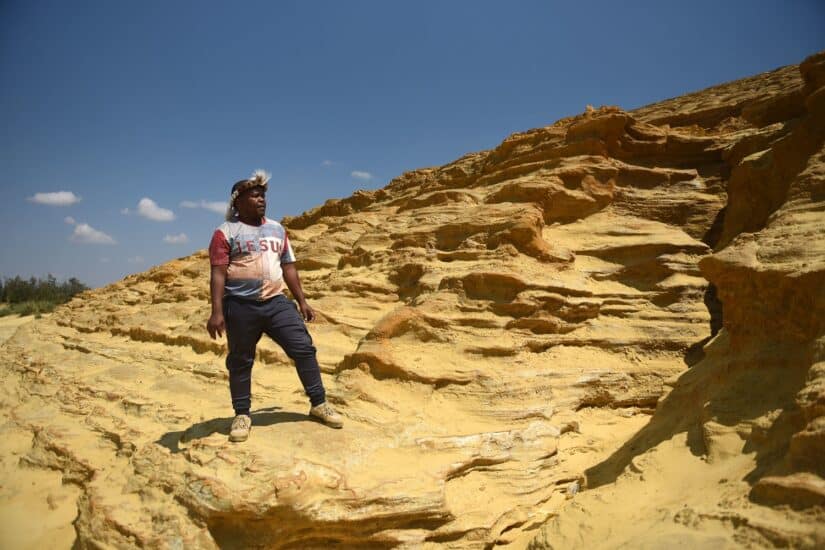
Bongumusa Mbatha, a community activist and founder of Eyesizwe Mining Communities, on the Simmer Deep Gold Mining property in Slovoville, Roodepoort, which specialises in the reclamation of gold from old mining dumps. Picture: Nigel Sibanda


Residents of Slovoville in Roodepoort on Gauteng’s West Rand are at risk of exposure to potentially hazardous substances if a mining tailings storage facility in the area is not rehabilitated.
The tailings were created by the South Roodepoort Main Reef Mining Company before the introduction of the 2004 mining legislation.
Residents at risk of exposure to hazardous substances
The company was later liquidated and entrepreneur Omphemetse Wilson Masilo acquired the tailings facility and the land through the liquidation process in 2008.
Masilo is the owner of Simmer Deep Gold Mining, a company specialising in the reclamation of gold from old mining dumps.
According to a document seen by The Citizen, Simmer Deep Gold Mining was granted a mining right on December 3, 2015, under the Mineral and Petroleum Resources Development Act.
“The right was granted for 30 years to reclaim gold from the tailings. However, the mining right has not been executed because the company has not yet paid the required financial provision,” the document says.
The tailings straddle the boundaries of Mogale City local municipality and the City of Johannesburg metropolitan municipality.
Potential dangers posed by tailings
It is situated between Zwaneville, Slovoville and Tshepisong, with the three communities located within about 1km of the tailings.
Following complaints from residents about the potential dangers posed by the tailings, the department of minerals and petroleum resources investigated the site.
According to the department’s report, the testing found elevated levels of potentially hazardous metals.
“The leach test results from samples taken from the tailings showed levels of lead, zinc and arsenic that were considered unacceptable and way beyond safety levels. These substances pose potential health risks and a danger to surrounding communities,” the report says.
The department subsequently issued a directive requiring Masilo to appoint an accredited specialist within 60 working days to prepare a rehabilitation plan and submit it for approval.
Department issued directive requiring owner to appoint specialist
The plan must detail how rehabilitation would be conducted, potential impacts of the work, measures to address negative impacts, proposed timeframes and recommendations to remediate affected areas and prevent further pollution.
The directive further states that within 30 days of the department approving the rehabilitation plan, the proposed remediation measures must be implemented.
Bongumusa Mbatha of Eyesizwe Mining Communities said residents had repeatedly raised concerns about the condition of the tailings.
“We have raised concerns about these tailings that they have been poorly maintained and managed since 2009.
“We are concerned that the tailings contain hazardous metals and produce dangerous dust that could pose health risks to nearby residents,” Mbatha said.
Residents report respiratory problems
Residents had reported respiratory problems, including asthma and sinus-related conditions, although these claims have not been independently verified.
Mbatha also accused authorities of failing to adequately enforce the directive against the mine owner.
He said the 60-day period provided for remedial measures lapsed on 17 July.
But Masilo disputed the residents’ concerns.
“The dump was created by South Roodepoort mine. The people residing in its vicinity found the dump there. They are occupying the land illegally,” he said.