The two former presidents had raised concerns about Judge Sisi Khampepe's alleged bias.
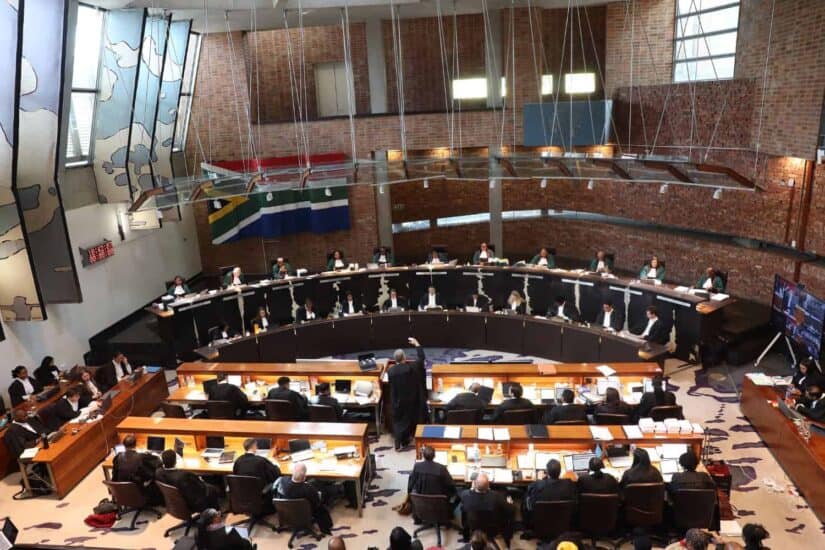
A legal representative speaks during the hearing of the National Health Insurance (NHI) case at the Constitutional Court (ConCourt) in Johannesburg on 5 May 2026. Picture: Gallo Images/Sharon Seretlo


Former presidents Jacob Zuma and Thabo Mbeki have failed in their latest attempt to have retired judge Sisi Khampepe removed as chairperson of the Truth and Reconciliation Commission (TRC) cases inquiry after the Constitutional Court (ConCourt) dismissed their review application.
The ConCourt delivered its judgment on Monday, 31 August 2026, granting the former presidents’ urgent application for leave to appeal.
The legal challenge followed a ruling by the Gauteng High Court in Johannesburg that dismissed Zuma and Mbeki’s bid to have Khampepe recused from a commission of inquiry established to probe the political suppression of investigations and prosecutions of apartheid-era crimes outlined in the TRC report.
The two former presidents had raised concerns about Khampepe’s past involvement in the TRC Amnesty Committee, as well as her previous position as deputy director of the National Prosecuting Authority (NPA) during the 1990s.
They maintained that her earlier roles created a reasonable perception that she could be biased in dealing with matters before the TRC cases inquiry.
However, the High Court found that the application had failed to meet a procedural requirement under Section 47(1) of the Superior Courts Act.
The provision requires the Chief Justice’s consent before civil proceedings can be brought against a judge.
ConCourt judgments on Khampepe recusal
ConCourt Judge Leona Theron indicated that three judgments were penned on the matter.
The first judgment, supported by four judges including Theron, noted that Khampepe had rejected Zuma and Mbeki’s initial application for her recusal on the basis that the two former presidents failed to demonstrate a connection between her past work and the inquiry.
“She emphasised that the commission’s mandate was to enquire into alleged efforts to suppress the TRC cases for the period since 2003.
“Commissioner Khampepe found that a temporal boundary existed between this period and her tenure at the TRC and the NPA, which ended on or before 2001,” Theron remarked.
The apex court also considered President Cyril Ramaphosa’s admission that he wouldn’t have appointed Khampepe as the chairperson if he had known of her previous roles.
Theron indicated that “a reasonable, objective and informed observer” would conclude that Khampepe “might not be able to bring an impartial mind” to bear on her responsibilities as the chairperson.
“The first judgment, thus, would have had her recused from the commission.
Zuma and Mbeki review application dismissed
The second judgment, which saw four other judges concurring, partially backed the first ruling.
However, it found that the first judgment approached the inquiry from an “incorrect premise”, focusing on the roles Khampepe played without attempting to assess the basis of the evidence.
Furthermore, it was concluded that Zuma and Mbeki “fell short” in proving Khampepe’s bias, therefore dismissing the review application.
“The second judgment finds that it would be insufficient to ground a reasonable apprehension of bias on mere institutional associations. More is required.
“The applicants made generalised averments that Commissioner Khampepe occupied positions in the TRC Amnesty Committee and the NPA.”
The last judgment agreed with the dismissal of Zuma and Mbeki’s review case, however, on different grounds.
Although the appeal was upheld as the High Court’s order was set aside, the review application challenging Khampepe’s 30 January 2026 ruling regarding her recusal was rejected.
Each party was ordered to pay its own costs in both the High Court and the ConCourt.