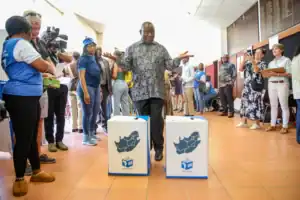



As of 5pm on election day, 188 000 election staff had scanned over 12 million voters at polling stations across the country.
 Elections 2026
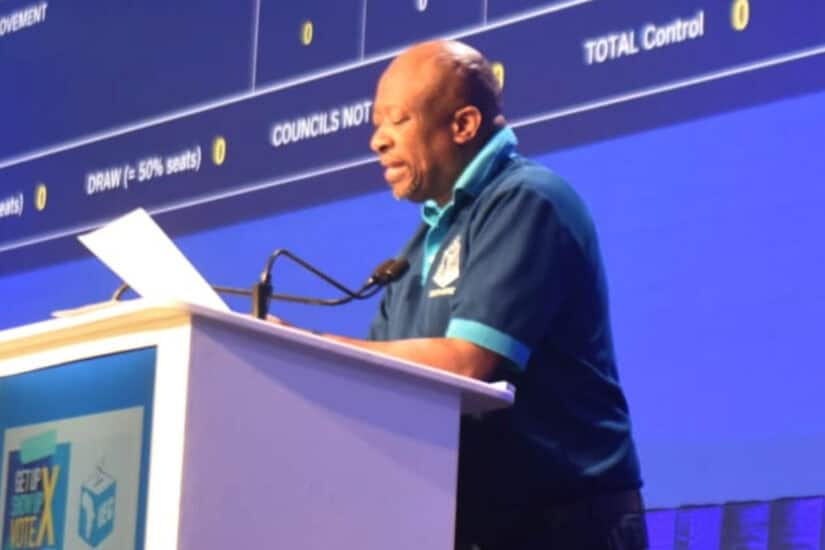
IEC Chief Electoral Officer Electoral Commission Sy Mamabolo. Picture: Nigel Sibanda / The Citizen


The Electoral Commission of South Africa (IEC) has dismissed claims that its staff were not adequately prepared for election week.
IEC officials fielded questions about staff conduct, voter management devises (VMD) and counting procedures, and provided an update regarding the ballots stolen in eThekwini during its evening briefing on election day.
‘Training like never before’
IEC CEO Sy Mamabolo stated that as of 5pm, 12 million votes had been recorded, with at least seven million coming from Gauteng, KwaZulu-Natal and Western Cape.

LIVE interactive map, latest news, multimedia and more!
View MapMamabolo reiterated that the commission had enlisted 188 000 citizens to handle the expected volume of voters, stressing it was a massive undertaking.
He said given the scale of the operation, the number of complaints around the speed and efficiency of staff, and the preparedness of presiding officers, was fractional.
“We have done training like never before. We have e-learning modules – four of them – and those e-learning modules have been made data free so that our staff can use them at leisure.
“We also did direct physical learning with presiding officers. To expect that when you deal with a programme of that size, of that magnitude, that there would not be out of line situations, I think it is really expecting behaviour that is outside the boundary of human reality,” said Mamabolo.
On the handling of VMDs and reported failures of the scanners, Mamabolo said the 53 000 VMDs were test and audited independently.
“From Monday, those devices have been in use at the voting stations and we have no reports of widespread malfunctions of the VMDs,” he said.
When asked if stations that opened late would be given extra time, Mamabolo said because there was “no widespread situation where voting stations opened late”, it did not warrant such action.
Mamabolo relayed that “several” voting stations had experienced power outages, and that generators and alternative lighting were being sourced to assist with the final voting hours and counting process.
‘Matrix of safeguards’
The IEC CEO maintained that anyone still in the queue at 9pm would be accommodated, but asked voters not to leave it to the last minute.
When the final voter leaves a station, the doors will be closed and the counting will begin.
Ballot papers are to be counted at the voting stations where they were cast, and counting may be observed by party agents and accredited observers.
Mamabolo said all ballots would be checked for the security stamp, before being separated into their ward and proportional representation piles, with all ballots sent to the voting station needing to be reconciled before results were considered.
“Results are subsequently scanned and captured at the local office of the commission and subjected to verification and independent external auditing,” said Mamabolo.
IEC officials were asked for an update on the ballots stolen in Ward 2 in eThekwini, with chairperson Mosotho Moepya stating that the matter was still being investigated.
However, he assured voters that the stolen ballots would not find their way into the counted ballots.
“This commission has put in place a matrix of safeguards to ensure the credibility of these elections.
“In an instance where we know which ballots have been stolen, where we know which area they relate, they will simply not be able to find a way,” Moepya declared.