



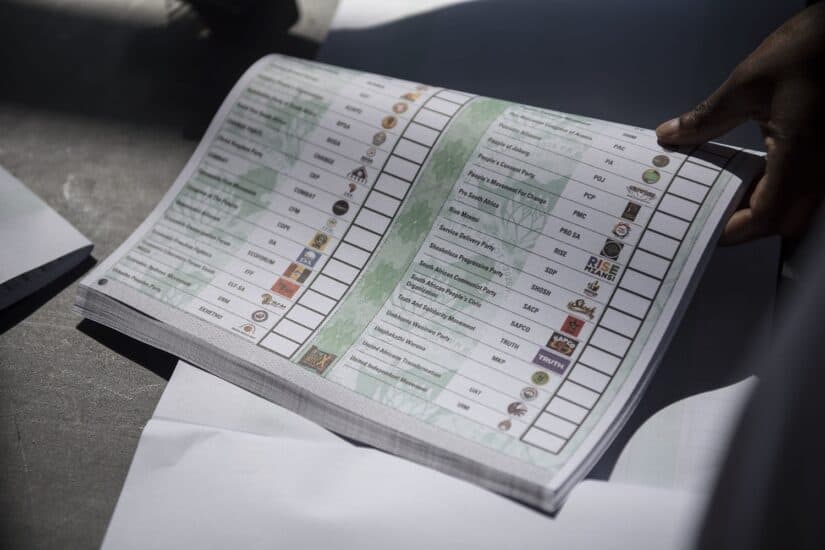
South Africa's enormous ballot papers have again ignited debate about whether smaller parties are important part of democracy.
 Elections 2026
Are smaller political parties an important part of democracy, or simply cluttering elections, fragmenting votes and making coalition governments difficult to manage? Picture: Michel Bega


South Africa’s enormous ballot papers have again ignited debate about whether smaller political parties are an important part of democracy, or simply cluttering elections, fragmenting votes and making coalition governments difficult to manage.
With dozens of parties contesting the local government elections this week, political analysts and politicians are divided over whether tougher entry requirements and electoral thresholds could simplify elections without undermining democratic rights.
Huge ballot papers ignite debate over smaller parties
Political analyst Theo Neethling said South Africa has reached a point where electoral reform deserves serious consideration.

Get your results on
our Election Hub
Live results
“I would personally support a five percent threshold. We have so many political parties and candidates that the system has become unnecessarily complicated,” he said.
He added that crowded ballot papers may confuse voters, while the number of participating parties place additional pressure on election administration.
“The more parties you have, the greater the possibility of mistakes. It complicates the entire process, from voting to counting, and creates additional problems for the IEC,” he said.
He asked whether parties attracting less than one percent of the vote justified the additional complexity.
“People can argue this is democracy, but even democracy needs certain parameters. We could simplify the process without making any real difference to the outcome,” he said.
Reform needed to reduce number of parties contesting
DA member of the Gauteng provincial legislature and Ekurhuleni election campaign manager Mike Waters said reform is necessary.
“The size of those ballot papers was ridiculous. We need electoral reform that reduces the number of parties contesting elections and, ultimately, winning seats,” he said.
Waters favours a threshold which, he said, would discourage parties with little prospect of securing representation.
“If there were a threshold of one or two percent, many of these parties would simply not contest because they know they have little chance of winning a seat,” he said.
Waters cited Ekurhuleni, where he said seven parties each secured a single council seat in the previous election.
“Together they held the council hostage. Voters want stability and we need an electoral system that allows serious parties to govern without being held hostage by smaller parties,” he said.
Electoral thresholds determine whether parties qualify
Electoral thresholds determine whether parties qualify for representation, while deposits and registration requirements affect their ability to contest elections.
Germany uses a 5% threshold in federal elections, although exceptions apply.
Though thresholds could discourage smaller parties from contesting elections, they would not automatically shorten ballot papers.
Only stricter nomination requirements or higher deposits would directly raise barriers to entry.
However, ActionSA’s Michael Basch said that restricting smaller parties could come at a democratic cost.
“The strength of our democracy is that we are open to independent candidates and smaller parties. It gives voters a wider choice and prevents us from becoming a political system dominated by just two parties,” he said.
Smaller parties disappear naturally
Basch said many smaller parties would disappear naturally after failing to secure seats, particularly once the financial realities of running a political organisation became apparent.
“Campaigning is difficult and expensive. Many of these smaller parties will disappear once they realise what it takes to sustain a political organisation. Over time, the system will naturally settle,” he said.
Basch said declining voter turnout presented a greater danger than the number of parties contesting elections.
“Even if a smaller party attracts only 10, 20 or 30 votes, those could be people who would otherwise never have voted. The real danger is when people stop participating, because that makes it easier for a different party to secure a majority,” he said.
Another political analyst, who consults to a major political party, proposes a 2% threshold with higher election deposits.
“There should be a threshold for political parties contesting a municipality. If they fail to reach that threshold, they should forfeit their deposit. Independent ward candidates should be treated differently, because they are true neighbourhood representatives and not party animals” he said.