He expressed "disappointment" in President Cyril Ramaphosa's handling of relations, saying Washington had "run out of patience".
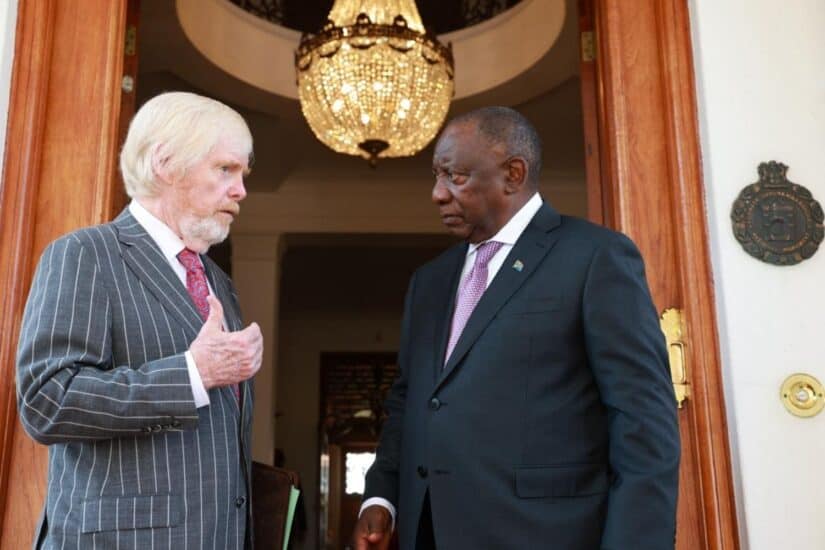
President Cyril Ramaphosa and United States Ambassador to South Africa, Leo Brent Bozell III. Picture: GCIS.


United States (US) Ambassador to South Africa Leo Brent Bozell III says the State Department will not disclose the names of the South Africans affected by the recently announced visa restrictions, adding that former president Thabo Mbeki is the best person to break the impasse
US Secretary of State Marco Rubio last week announced new visa restrictions targeting foreign nationals accused of involvement in race‑based discrimination and uncompensated land seizures in South Africa.
Rebuke
The policy, unveiled by Rubio, marks Washington’s sharpest rebuke yet of Pretoria’s handling of minority rights.
It is the latest action by the Trump administration to target the South African government for allegations that it is mistreating White South Africans, which the government has denied.
Warning
Bozell III warned Pretoria that the new visa restrictions are just the beginning to show “America’s firm resolve in this matter.”
He said the visa restrictions announced by Washington are part of a broader process that began with President Donald Trump’s executive order in January 2025.
“President Trump, in January of 2025, put forward the executive order, laying out what the issues were, in broad terms. It was the Afrikaner issue, and the attacks overall on rural farmers.
“It was the growing hostility toward investments from the United States. And thirdly, it was the geostrategic issues, and the military issues, and the like,” Bozell said
‘Simple process’
He said the order was followed by months of dialogue throughout 2025, culminating in December with five specific asks from Washington.
“In my meeting with President Ramaphosa, I tried to emphasise just how simple this process was.
“The first ask was for government to leave the US refugee programme alone after a dispute in December. Asked and answered, done,” Bozell said.
Land expropriation
Bozell said the second dealt with expropriation without compensation.
“To us, it would be a direct threat to investment in your country. In our country, you’ve got to have a justified expropriation, and then fair market compensation for it. Now, this one’s in the courts. People believe the courts are going to rule it unconstitutional, and that’s going to be the end of it.”
The third ask was for President Ramaphosa to condemn the “kill the boer” chant.
“Kill the boer, kill the farmer” as incitement to violence. This is a concept that is endorsed by three‑quarters of the South African people. I’ve seen the polling data,” Bozell said.
Bozell stressed that the demands were straightforward and aimed at addressing Trump’s concerns over rural safety, investment security, and broader strategic issues.
Thabo Mbeki best person
He described former president Thabo Mbeki as the “best person” to resolve the diplomatic impasse between Washington and Pretoria, citing his stature and experience in global diplomacy.
Bozell argued that Mbeki’s credibility makes him uniquely suited to mediate.
“Mbeki is the best person to break this impasse. He understands the mechanics of global diplomacy better than anyone else in South Africa,” he said. “He has the gravitas to sit across the table and get both sides talking again,” he told Business Day.
Disappointed with Ramaphosa
Last week he expressed “disappointment” in President Cyril Ramaphosa’s handling of relations, saying Washington has “run out of patience”.
“As has been made absolutely clear, the time for endless dialogue has run its course. No more. America has just so much patience. We want strong, and lasting relations with the South African government. It needs to show it wants the same.
“So far it has shown it cares for neither. As a result, the consequences, as I’ve attempted time and again to express, are necessarily going to be severe. This visa restriction policy is only the first step in a series of escalatory measures that will show America’s firm resolve in this matter,” Bozell said.
Debate
The appointment of Roelf Meyer as South Africa’s new ambassador to the US reignited debate about representation, symbolism, and political alignment in South Africa’s evolving democracy.
Ramaphosa appointed Meyer as Pretoria’s ambassador to the US in April.
South Africa has not had an ambassador in Washington since the Donald Trump administration expelled Ebrahim Rasool in March 2025, declaring him persona non grata and giving him just a week to leave the US over his comments about the administration.
Trump on SA
Trump has singled out South Africa for harsh treatment on several issues since he returned to the White House in January, notably making debunked claims of white Afrikaners being systematically “killed and slaughtered” in the country.
He ambushed Ramaphosa in the Oval Office earlier last year, playing a video in which he alleged a campaign against white farmers by the post-apartheid government.
During the bilateral talks, which played out before the media, Trump showed videos of EFF leader Julius Malema to support his false belief in genocide against whites in the country, asking why Malema has not been arrested.
The videos also showed MK party leader Jacob Zuma singing similar, apparently anti-white, songs from the struggle years.
FF Plus
The Freedom Front Plus (FF Plus) accused Ramaphosa and his administration of contempt for ignoring US conditions for normalising relations, triggering “serious and direct consequences”.
FF Plus leader Dr Corné Mulder said the announcement makes it “abundantly clear that there are no more delays in addressing the US’ conditions”.
“Just two days ago, the Freedom Front Plus warned that South Africa is dragging its feet in addressing the five conditions. The response by Vincent Magwenya, the president’s spokesperson, that there is no rush to respond seeing as there is no deadline further demonstrates government’s contempt.”
US-SA RELATIONS | United States Ambassador to South Africa Leo Brent Bozell says the State Department will not disclose the names of South Africans who will be affected by the recently announced visa restrictions. pic.twitter.com/jdnpVT9RhD
– SABC News (@SABCNews) September 21, 2026
Allegations
The ANC‑led government has denied allegations of systemic discrimination against white citizens.
Ramaphosa has previously said there is “no evidence of persecution against white people”, and warned that such claims threaten national unity.
Racial injustice
International Relations Minister Ronald Lamola said it is “our sovereign right to put in place laws that address centuries of racial injustice”.
He added that legislation in the democratic era is designed to redress exclusion and uplift historically disadvantaged communities.
“The announcement once again aligns with the mischaracterisation of South Africa’s domestic policies by fringe groups who wrongly portray themselves as representatives of minorities, and Afrikaners in general.”
Last week, North West University Professor and political analyst Andre Duvenhage told The Citizen that the US’ decision to impose visa restrictions on South African officials should not surprise anyone, but is a red flag for the ANC and a historic low in bilateral relations.