
Trump may have changed the tone, but America's interests will not disappear when a new president is elected.
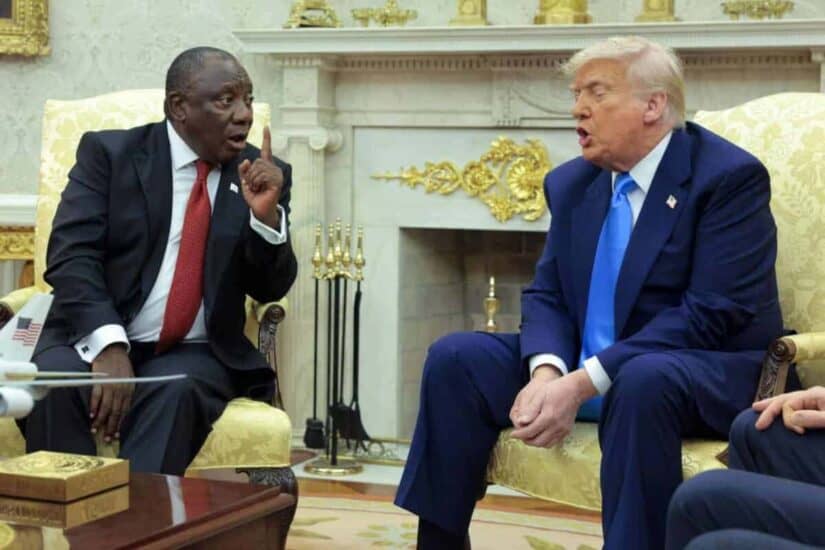
President of South Africa Cyril Ramaphosa and US President Donald Trump. Picture: Getty Images


Many in South Africa cling to the tempting belief that the country’s rocky ties with the US are merely a Donald Trump problem. Some believe that when Trump leaves office in January 2029, tensions will ease and Pretoria and Washington can get back to business.
But what if Trump is not the real problem? What if the bigger issue is American foreign policy itself? Trump may have changed the tone, but America’s interests will not disappear when a new president is elected.
South Africa has increasingly found itself caught in a geopolitical tug-of-war. On one side is the US and its traditional Western partners. On the other are rising powers such as China and Russia. Pretoria insists it does not want to choose.
Its position is clear: South Africa should be able to maintain relations with everyone and decide for itself where its interests lie. Washington “had run out of patience” with President Cyril Ramaphosa, warning visa restrictions are only the first step in escalating measures against Pretoria, according to US ambassador Leo Brent Bozell III.
Bozell said Afrikaner safety, land expropriation, investment security and condemning the “Kill the Boer” chant were among Washington’s top “asks” – all of which Ramaphosa has ignored. But these “asks” mask real concerns.
The real issue is Pretoria’s closeness to Beijing, Moscow, and its stance on Israel. Here is where things become interesting. Trump has himself shown that America can engage with countries it considers rivals. He has spoken directly with Chinese President Xi Jinping and Russian President Vladimir Putin.
So why should South Africa be expected to choose? The answer may lie less in personalities and more in power. The US wants a South Africa that remains an important economic and strategic partner. It wants American businesses to have opportunities here, and it wants Pretoria to consider American interests when making major foreign-policy decisions.
South Africa, meanwhile, wants investment, trade, technology and access to global markets – without surrendering the freedom to build relationships elsewhere. That is the real balancing act.
It also explains why two very different South Africans, former president Thabo Mbeki and South African ambassador to the US Roelf Meyer, have become interesting figures in this matter. Mbeki has spent decades operating at the highest levels of international diplomacy. He understands Washington, but he also understands Africa’s determination to speak with its own voice.
Perhaps that is why America insists he can ease tensions; however, this is uncalled for considering that South Africa has a sitting government. Therefore, this smells like an attempt at regime change.
Meyer brings something different. He is the ambassador to the US and America should engage him productively. He was one of the key negotiators during SA’s transition into democracy. His political legacy is associated with the difficult task of getting opposing sides around the same table. That experience could prove valuable.
Pretoria and Washington do not necessarily need another argument, but they do need to talk about what each side actually wants. South Africa should not have to choose between Washington and Beijing. Nor should it assume that ties with China or Russia automatically require hostility towards America.
The challenge is to prove that non-alignment means independence. That’s why waiting for Trump to leave office could be a dangerous belief. A new president may speak differently. The relationship may become warmer. Some disputes may disappear. But America’s and South Africa’s interests will remain.
The real question is not what happens when Trump leaves, but whether the relationship with America can withstand change without affecting Pretoria’s freedom to choose its own partners.