


The defence manufacturer says its Mbombe 8 infantry fighting vehicle proves South Africa can compete with global military technology producers.
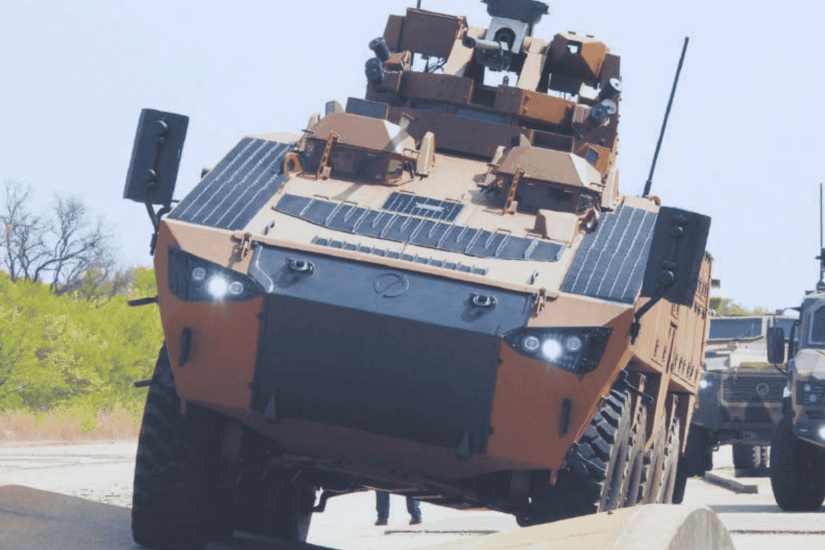
The 11 crew Mbombe 8 shows off its stability on the Gerotek testing range outside Pretoria. Picture: Kevin Ritchie


South Africans should not look overseas for their defence needs to be met because the country has more than enough home-grown talent, says Paramount South Africa chair Mathews Phosa.
Speaking at the company’s media day at the Gerotek test range outside Pretoria on Wednesday, Phosa said the group’s Mbombe 8 Infantry Fighting Vehicle (IFV) showed “the art of the possible”.
“South Africa does not have a defence technology problem, but a defence policy procurement challenge,” he said.
Paramount says South Africa can build world-class defence vehicles
SA’s two-decade-long delayed Project Hoefyster, set up in 2007 to replace the army’s ageing Ratel IFV fleet, has yet to put a single Badger IFV in the field and is now estimated to cost R16 billion more than the initial R1 billion budget to complete.
Paramount, which designed the all-new Mbombe 6 in 2007 as a six-wheeled IFV to replace the surplus Ratels it was selling to African markets, produced the eight-wheeled multiplatform and multi-use Mbombe 8 in 2016.
The Mbombe 8 meets all the Hoefyster specifications. The company also designed the Mbombe 4, as a four-by-four variant in the Mbombe family.
Established 30 years ago, Paramount is the largest privately owned defence and aerospace company in Africa, designing and building land systems and the Mwari aircraft in South Africa.
Procurement delays remain a major challenge
With the exception of the acquisition of 12 Marshall internal security vehicles by the police, the company has never been able to supply its vehicles to the SA National Defence Force (SANDF), despite the South African-designed Mbombe family being acquired, built and deployed operationally in Africa, Europe and Asia.
This year, Paramount’s lightweight armoured vehicle, the Maatla, was short-listed by Armscor, along with vehicles by SVI and DCD Mobility, for live field evaluations and trials for the SANDF’s border security needs.
But the tests were cancelled at the last minute and the more than R500 million tender for the 500 armoured personnel carriers went to rival firm Milkor SA instead.
This despite the company not having a proven track record in military vehicle development and assembly.
“There is sometimes an assumption if South Africa needs a modern defence capability solution, it must look overseas to China, to Türkiye, to Europe or elsewhere,” said Phosa.
“SA can compete. Our engineers, our technology, our manufacturing capability can compete successfully in some of the most demanding countries in the world. The Mbombe 8 demonstrates what is possible.”
The question, he said, was whether the government would give the industry the opportunity to compete at home, warning that without it, SA’s defence industrial capabilities could disappear and with that, jobs and factories.
“Government needs to do its part. Give SA engineers the opportunity. Give SA soldiers the equipment they deserve. And let us once again make South Africa a country that does not simply buy defence technology from the world, but builds the technology that the world wants to buy from us.”
Mbombe targets new international markets
Deon Grobler, Paramount’s head of international vehicle business, said the Mbombe had been tested extensively overseas, performing very well in the deserts of the Middle East, the snow of Kazakhstan and the jungle environment in KwaZulu-Natal.
Part of these tests included being able to strip out and replace the entire engine and gearbox in under 90 minutes.
Geopolitical tensions, too, had meant a shift in potential markets. Whereas, Africa had always been Paramount’s primary market and latterly Southeast Asia and Eastern Europe, now Nato countries are reaching out to Paramount, he said.
Next month, Paramount is launching a light-armoured military vehicle it developed with the Indian Army at the biennial African Aerospace and Defence expo at Waterkloof Air Force Base.



