The deputy national police commissioner's dramatic unravelling was triggered on 6 July.
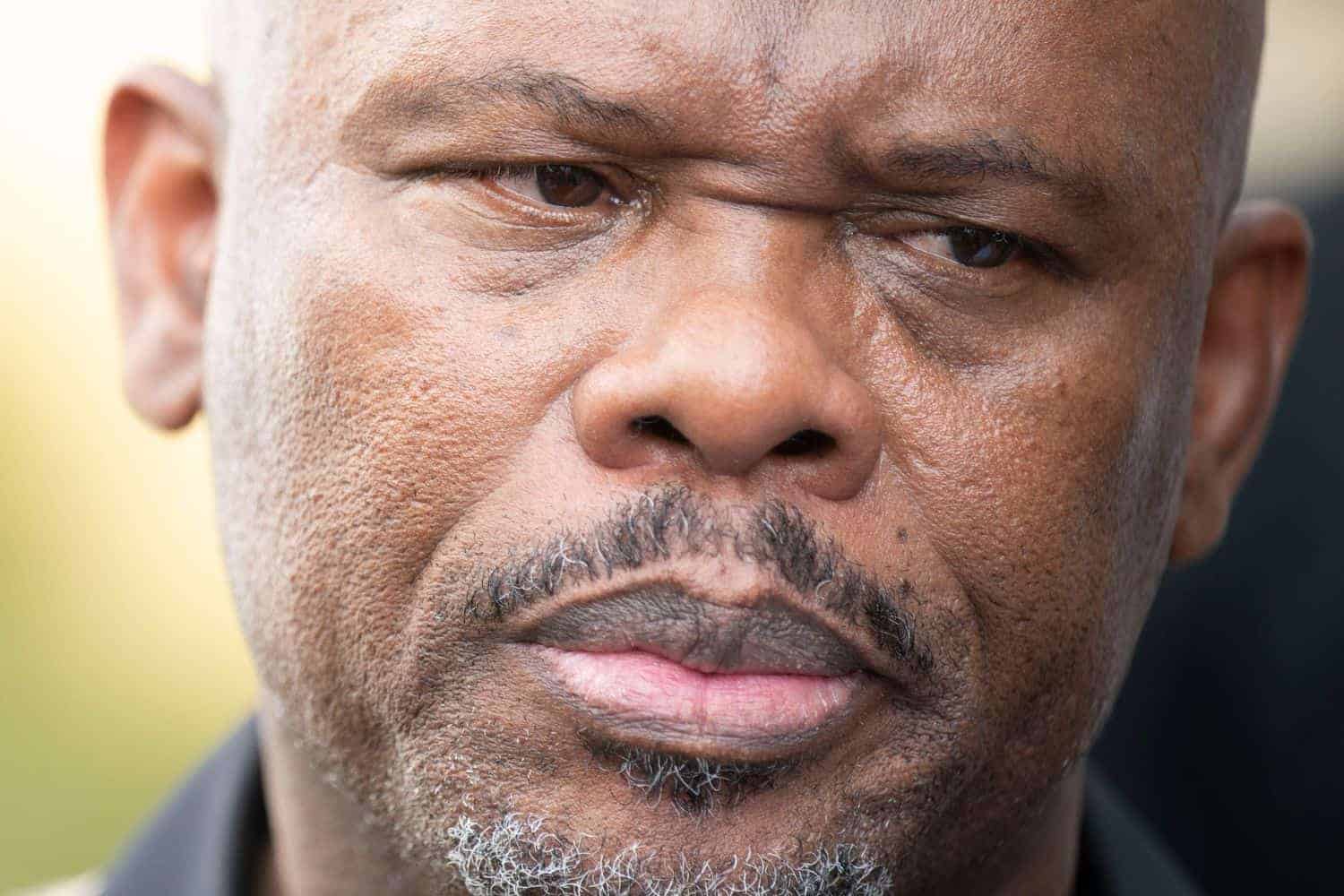
Deputy National Police Commissioner Shadrack Sibiya outside his home in Centurion during a raid on 9 October 2025. Picture: Gallo Images/Deaan Vivier


Shadrack Sibiya’s career once traced the classic arc of a hardened crime fighter rising through the ranks of South Africa’s police service.
Now in 2025, this arc has bent sharply downward, leaving the suspended deputy national police commissioner at the centre of one of the most explosive law enforcement controversies in democratic South Africa.
Sibiya’s dramatic unravelling was triggered on 6 July, when KwaZulu-Natal (KZN) Police Commissioner Nhlanhla Mkhwanazi made a stunning public allegation during a media briefing.
Mkhwanazi accused Sibiya of colluding with Police Minister Senzo Mchunu to disband the political killings task team (PKTT), allegedly to shield organised crime syndicates from investigation, among other allegations.
The claim ran across the policing landscape, immediately placing Sibiya under intense scrutiny.
Shadrack Sibiya suspended
National Police Commissioner General Fannie Masemola subsequently placed Sibiya on suspension, pending an internal disciplinary inquiry.
What began as a leave of absence swiftly escalated into a full-blown investigation.
In early October, law enforcement officers raided Sibiya’s Centurion home, seizing electronic devices in a development widely anticipated to precede his arrest.
At the heart of the controversy is Sibiya’s alleged relationship with Vusimuzi “Cat” Matlala, a businessman widely described as an underworld figure and currently facing attempted murder charges.
ALSO READ: ‘He loves money a lot’ – Inside Matlala’s relationship with Shadrack Sibiya
Testimony before the Madlanga commission of inquiry – including that of Mkhwanazi and Masemola – painted Sibiya as having close ties to Matlala.
The most damaging moment came when audio recordings were played in which Matlala allegedly told police, on the day of his arrest on 14 May, that he had made substantial cash payments to Sibiya.
These included R300 000 for Sibiya’s son’s wedding and R2 million for a plot of land.
Sibiya slams Mkhwanazi
Sibiya has yet to testify fully before the commission, where he is expected to respond directly to the allegations.
However, he has already appeared before Parliament’s ad hoc committee investigating criminality, political interference and corruption within the justice system.
There, Sibiya struck back at Mkhwanazi.
READ MORE: ‘I didn’t see it coming’: Sibiya on how his relationship with Mkhwanazi deteriorated
He accused the KZN police commissioner of using his “very powerful” social media presence, particularly on TikTok, to shape public opinion and shield himself from scrutiny.
“This wins all South Africans. You touch Mkhwanazi, you touch us – but he is a policeman,” Sibiya said.
He warned that such popularity could erode accountability within the police service, describing it as “a monster that no one is able to control“.
Sibiya also rejected the suggestion that he had ever operated outside the law.
“I have never been a rogue officer in my 37 years in the police,” he insisted.
Career
His career has long been marked by controversy.
He rose through the ranks of the South African Police Service (Saps) to become Gauteng provincial head of the Directorate for Priority Crime Investigation (DPCI) – the Hawks.
In 2015, he was dismissed from the elite unit following allegations linked to the illegal rendition of Zimbabwean nationals during his tenure.
Four years later, he resurfaced in local government as head of the City of Johannesburg’s anti-corruption unit, Group Forensics and Investigation Services (GFIS).
That appointment, too, proved turbulent.
Sibiya later faced investigations involving R3.5 million in alleged unlawful gratification and R580 000 in irregular expenditure linked to his time at the metro.
READ MORE: Court dismisses Shadrack Sibiya’s application to go back to work
He denied the allegations.
In an unexpected twist, the Labour Appeal Court overturned his Hawks dismissal in May 2022, ordering his reinstatement.
Two months later, Sibiya returned to Saps.
By July 2023, he had climbed back to the top echelons of power, promoted to deputy national commissioner for crime detection – one of the most influential policing posts in the country.
That comeback has now collapsed with equal force.
As 2025 draws to a close, Sibiya now stands under multiple investigations – a once-powerful police officer reduced to defending his integrity amid a rising tide of evidence and testimony.
Whether the commission ultimately clears him or confirms the worst, the spectacle already marks one of the most dramatic falls from grace in South African policing history.
Support Local Journalism
Add The Citizen as a Preferred Source on Google and follow us on Google News to see more of our trusted reporting in Google News and Top Stories.