Analysts say push-and-pull factors and the 30-year rule fuel exodus to South Africa, Europe, and the US.
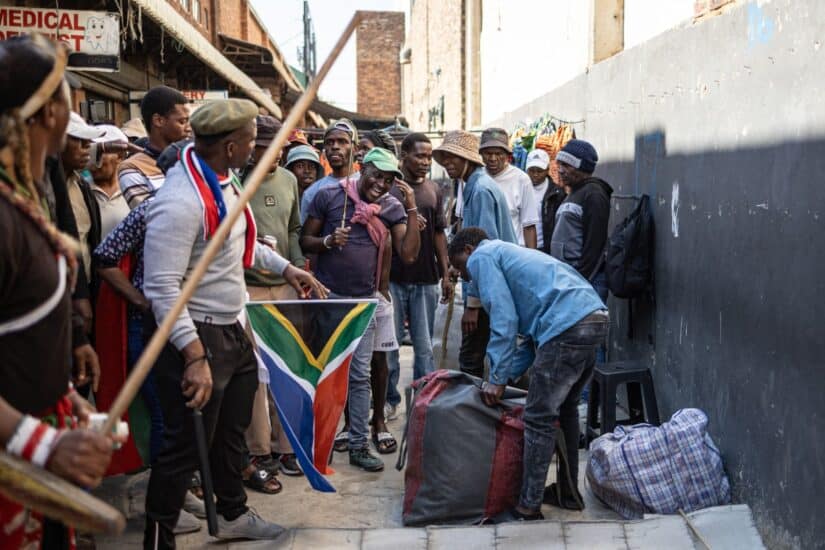
A crowd surrounds a foreign national street vendor as he packs his bags during a protest yesterday calling for the removal of undocumented migrants in Alexandra township. Picture: AFP


The ongoing movement of migrants from Africa to other countries, including Europe, is due to governance failure and “sit-tight” leaders who refuse to vacate their cushy seats of power, say political analysts.
One analyst cited the “push-and-pull” factors that are at play in international migration, particularly in Europe.
Migration a global phenomenon
Political analyst Ntsikelelo Breakfast said migration is a global phenomenon, not limited to the African continent.
“If we frame it as an African issue, it means then we are targeting Africans because there are foreign nationals from Europe who are also here in South Africa who might be here to make ends meet, or for other reasons,” said Breakfast.
But there is growing tension between South Africa and the west African states of Nigeria and Ghana over the eviction of the latter’s nationals in South Africa.
Whether migrants are from Africa or other continents, they will always have an impact on the host nation, added Breakfast.
“You will find locals may struggle to access economic and public resources like water, health and education facilities because they compete for them with foreigners. This generates conflicts, hence the birth of organisations like March and March in South Africa,” he said.
Breakfast said it’s not only an African issue. In the US, President Donald Trump has tightened border control to prevent migrants coming in from Mexico.
Not only an African issue
African and Middle East migrants flee from their countries in search of a better life in Europe.
“However, it is an indicator of failed states on the African continent,” said Breakfast.
“It is important this matter be addressed at multilateral level, such as by the Southern African Development Community, the Economic Community of West African States and the African Union, so affected countries are held accountable for democratic values, such as holding regular elections and ensuring political stability.”
But analysts say Africa is not alone in the immigration crisis. It is the worst affected because most of the continent’s leaders refuse to open up and democratise, while their economies suffer under bad governance systems.
Another political analyst, Lesiba Teffo said most of the movements globally in the past 29 years “are informed by poor political governance”.
“Remember good political governance is a necessary condition for socioeconomic development,” said Teffo.
Movements informed by ‘poor political governance’
“Where there is no socioeconomic development, there is bound to be discontent.
“Discontent yields conflict, and conflict leads to disaster that more often causes people to leave their countries to look for alternative safe bases.”
Teffo pointed to “sit-tight” presidents, including the late Zimbabwean president Robert Mugabe, Uganda’s Yoweri Museveni, Paul Biya of Cameroon and others, who overstayed their welcomes, as the basis of political instability in their countries.
“There is no way you can run a country for 30 to 40 years as a family or an individual and there is no discontent.
“When you reach that period, there is no way you are not going to misuse state power and suppress or kill people to stay in power,” added Teffo.
People flee dictators and where there is no democracy and poor political governance. However some migrants are just seeking a better life elsewhere.
Zimbabwe, Mozambique, and Lesotho economic migrants chase stability
In the SADC region, people in countries such as Zimbabwe, Mozambique, Lesotho, Swaziland and others are not running from political persecution, but are economic migrants facing “excruciating” economic conditions at home.
“These are not asylum seekers – there are no wars in these SADC countries – these are economic migrants,” said Teffo.
“Those from Pakistan, Bangladesh and other countries are not fleeing political persecution, but seeking greener pastures.
“SA is targeted by migrants, whether legal or illegal, because, just like Europe and the US, it is relatively stable and has a relatively strong economy.
“They are looking for alternative places of economic survival.
“If Mugabe, for instance, did not mess up Zimbabwe, many people from that country wouldn’t have crossed into South Africa because previously Zimbabwe was economically superior to South Africa,” added Teffo.