
Ramaphosa said South Africa could no longer afford to remain on the margins of innovation.
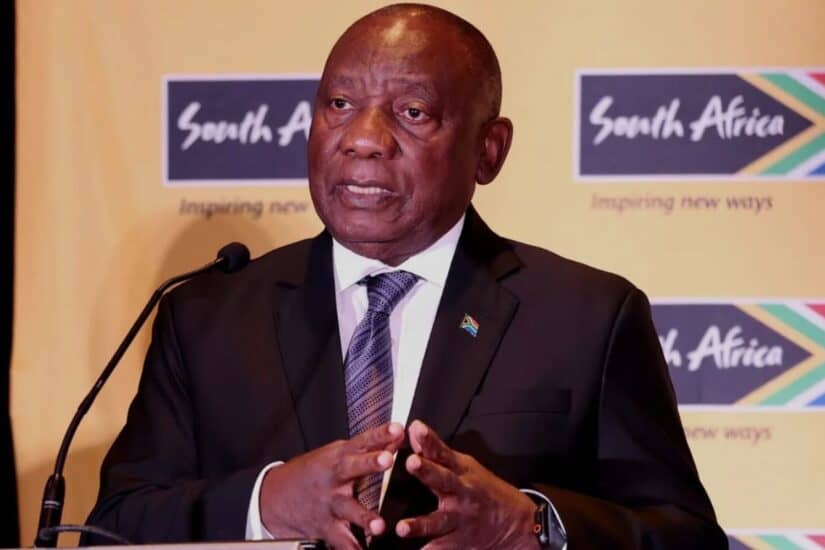
President Cyril Ramaphosa has thrown down the gauntlet in the global race for artificial intelligence. Picture: The Presidency.


President Cyril Ramaphosa has thrown down the gauntlet in the global race for artificial intelligence (AI), pitching South Africa as Africa’s future AI powerhouse and warning that the continent risks being left behind if it fails to seize the opportunities created by the next technological revolution.
Speaking to investors, technology executives, researchers and entrepreneurs in Silicon Valley, Ramaphosa made an aggressive case for South Africa to become a leading destination for AI investment, data centres, research and innovation, while urging global technology giants to view the country as a strategic partner rather than simply a market.
Technologies
He said South Africa could no longer afford to remain on the margins of innovation and must become a creator, owner and exporter of advanced technologies.
“We cannot be content to remain merely consumers of technologies developed by others. We must become developers, producers, innovators and owners of technologies.”
The president’s remarks come amid an unprecedented global race to dominate AI, with hundreds of billions of dollars flowing into AI infrastructure, data centres and advanced computing capabilities.
Ramaphosa said Africa faces a critical moment as countries that control computing infrastructure, advanced technologies and scientific capabilities stand to gain enormous advantages in the future global economy.
“The countries that control computing infrastructure, advanced technologies, data and scientific capabilities will enjoy considerable advantages in the emerging global economy. Those that fail to develop these capabilities risk becoming increasingly dependent on technologies, products and services developed elsewhere.”
Mistakes
While acknowledging that Africa has often exported raw materials while importing high-value finished products, Ramaphosa insisted the continent must not repeat the mistakes of previous industrial revolutions.
“We cannot allow the artificial intelligence revolution to reproduce these historical patterns of inequality and dependence.”
AI investment
Instead, he outlined a vision in which South Africa becomes a major destination for AI investment, research, innovation and data infrastructure.
“South Africa is already a leading location for data centre investment on the African continent. We should seek to make South Africa a preferred destination for investment in AI computing infrastructure serving both our domestic economy and the wider African market.”
SA advantages
Ramaphosa argued that South Africa possesses key advantages, including established financial institutions, strong universities, telecommunications networks, engineering expertise and access to African markets.
He also highlighted improvements in electricity supply, energy reforms and existing industrial infrastructure as major opportunities for attracting global technology companies.
“A large data centre can represent billions of rand in capital investment. It can generate substantial demand for construction, electrical engineering, cooling systems, transformers, switchgear, energy storage and specialised maintenance services.”
Builders of future
However, the president stressed that South Africa’s ambitions extend beyond merely hosting technology infrastructure.
“We want to be builders of the future, not merely recipients of it.”
He said artificial intelligence has the potential to transform nearly every aspect of the economy, from mining and agriculture to healthcare, education, energy and government services.
“There is no reason why South Africa should not produce globally competitive AI companies. There is no reason why our researchers should not make important contributions to advances in machine learning, robotics, language technologies and other fields.”
Silicon Valley
Ramaphosa also challenged Silicon Valley companies to deepen their presence in South Africa through investments, research partnerships and skills development initiatives.
“We invite you to make South Africa a strategic partner in the development of the artificial intelligence economy. We invite you to invest in our digital and computing infrastructure. We invite you to establish research and development facilities in our country.”
No handouts
In one of the strongest moments of his address, the president made it clear that South Africa was not seeking handouts.
“We are not asking for charity. We are presenting an investment and partnership opportunity.”
He said the country offers investors a sophisticated economy, advanced connectivity, significant energy resources and access to the African Continental Free Trade Area, making it an ideal base from which to serve the continent.
For Ramaphosa, the stakes could not be higher. As billions of dollars pour into artificial intelligence and the foundations of the future global economy are being laid, he believes South Africa faces a defining choice: become a builder of new technologies or risk becoming dependent on innovations developed elsewhere.
“We have not come to Silicon Valley to ask for a place in someone else’s future. We have come to build partnerships through which we can help shape a future of our own.”
Ambitions
With those words, Ramaphosa signalled that South Africa’s AI ambitions extend far beyond catching up with global trends.
The goal is to position the country as Africa’s technology powerhouse, attract billions in investment and help shape the technologies that will define the global economy for decades to come.