
Land invasion on The Bluff: Squatters refuse to budge
Transnet is taking legal action against the land invaders as they refuse to move from the private land until they are provided with basic services and accommodation.
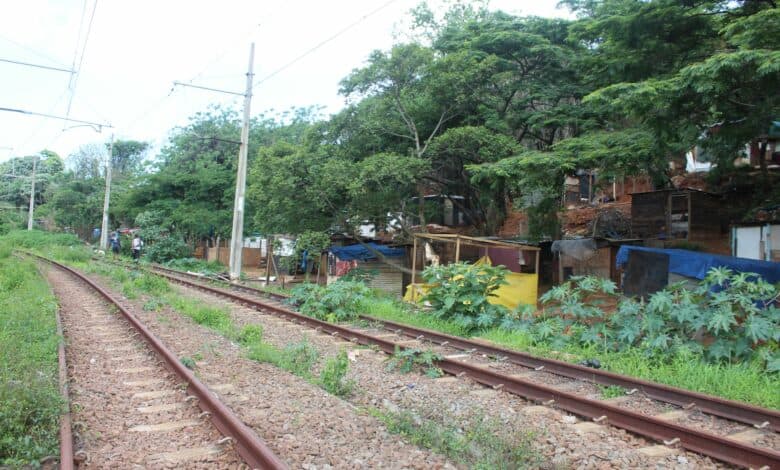
SHACK dwellers who have occupied a piece of land along the railway line to a section of private land in Fynnlands have vowed that they will not move to other areas if they are not provided with basic services.
Also read: Merebank home invasions: Families assaulted by gun-wielding thugs
The residents, many of whom have been living in these shacks for the past four years, said they occupied the land to be closer to places of employment.
More than 20 new shacks have been built on Transnet property in less than two weeks, and this prompted nearby residents to call for an urgent intervention from authorities as scores of land grabbers were seen clearing the bush to erect illegal structures. Residents raised safety concerns as the squatters were cutting bushes which could lead to soil erosion.
One of the residents, Zweli Mbhele, said that despite the challenges they face daily, they are unwilling to leave the area.
Also read: The Bluff Precinct Plan project gets green light
“We don’t have any other alternatives. Many of us come from previously disadvantaged communities. I came to The Bluff to look for work and was sleeping on verandas along the Brighton Beach Promenade until one of my friends told me about an unoccupied piece of land in Fynnlands. I relocated here because it is closer to my job,” said Mbhele.

Bulelani Gutshwa travelled from the Eastern Cape to look for greener pastures in Durban.
“I have been looking for a job for many years but have not been able to find one. I decided to come to Durban last year. But I did not have shelter since I am unemployed. Although the living conditions in these shacks are inhumane, we have no alternative.
“I am glad that a team from Transnet came to conduct a head count of all the dwellers who have occupied this land. We are hoping that the authorities will move us to a better place,” said Gutshwa.
Ratepayers’ association reacts to the land invasion issue on The Bluff
Chairperson of The Bluff Ratepayers’ and Residents’ Association Norman Gilbert said their association, The Bluff residents and Ward 66 councillor Zoë Solomon have been active in trying to resolve this issue.
“We did determine that some of the shacks had, in fact, been built on private property, and the residents met with the people who then removed their building materials only to move further down the railway line to a section of land that belongs to Transnet.
“Our ward councillor has engaged with Transnet who sent a delegation to inspect the land invasion, together with representatives from the Provincial Environmental Team due to the soil erosion, the fact that there is no bedrock there and the land can slip in rain, and that the houses are compromised,” said Gilbert.
Last week, Solomon conducted an oversight visit to the informal settlement. Following the recent meeting, Solomon was pleased that Transnet agreed to meet with her.
“It has been confirmed that the legal team of Transnet has begun their work on the legal action against the invaders of this private land. The security has been deployed to monitor this space at the dead end of Goutsburg Road to prevent further dropping of building materials,” said Solomon.
She said that during the lockdown, there was an outreach, through the Vulnerable Groups Committee, of people who had been locked down in service industry jobs and had an immediate loss of income.

“There was a list submitted of 17 households that were not in our ward. As the lack of income intensified, there was an influx of homeless and displaced people taking up shelter in the bush on The Bluff. It was dealt with according to municipal by-laws. Those who were chased took refuge in another area that belongs to Transnet along The Bluff Peninsula that borders the railway lines on the harbour side at the Cutler Area.
“I alerted Transnet about both invasions but was largely unsuccessful in receiving a response. I then escalated the issue to Parliament, where the minister addressed the CEO at the time, acknowledging that the problem had been reported by me and that the legal department had been notified.
“The invaded land of Transnet is neither in my jurisdiction nor – by geographic boundary – even in my ward,” she said.
Invasion of Transnet land has been going on for many years
The most populated space has always been the entrance to the bush from Station Road in Marlborough Park.
Solomon said, “In recent years, the mushrooming of illegal structures appearing after the land invasion was constantly controlled by me, and people inhabited another section below Benjamin and Goutsberg. They told Transnet that I had told them to [build illegal structures] there because it was not municipal land.
“In the eThekwini Municipality, I hold the whip of caucus position for the Safety and Emergency Services Committee under which land invasion falls. It is in this capacity that I was prepared to go to Solomon Mahlangu Drive in Ward 32 [to conduct an inspection] of 400 shacks.
“It has been reported this month, during the meeting of the Committee for Safety and Emergency Services, that the head of Land Invasion and the head of Human Settlements in eThekwini had approached the National Assembly to change some clauses in the PIE Act to allow the removal of informal dwelling, however, the proposal was rejected,” Solomon added.
Questions have been sent to Transnet, however, nothing was forthcoming until the time of going to press.
What does the law stipulate regarding the occupation of private land?
The Prevention of Illegal Eviction From and Unlawful Occupation of Land Act (the PIE Act) provides for the prohibition of unlawful eviction and the procedures for the eviction of unlawful occupiers.
The following procedures must be followed before a person can be lawfully evicted from a property:
- The lawful owner of the property or the person in charge of the land approaches the court for an eviction order against an unlawful occupier.
- At least 14 days before the hearing of the proceedings, the court must serve written and effective notice of the proceedings on the unlawful occupier and the municipality having jurisdiction – this means that should proceedings for an eviction order be instituted, the person against whom the eviction order is requested must be given notice to appear and/or defend such proceedings at least 14 court days before the date of the hearing.
- On the day of the proceedings and if the court is satisfied that all the requirements have been complied with, and that there is no valid defence that has been raised by the unlawful occupier, the court will grant an order for eviction.
For more Southlands Sun news, follow us on Facebook, Twitter and Instagram. You can also check out our videos on our YouTube channel or follow us on TikTok.
Subscribe to our free weekly newsletter and get news delivered straight to your inbox.