Continental Linen's Hillel Kahn shares how authenticity, persistence and practical thinking helped build a national retail brand.
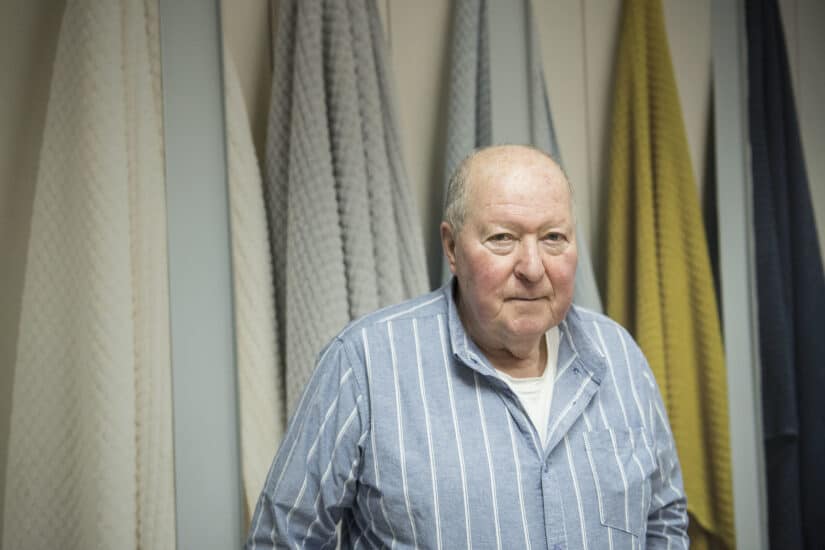
Hillel Kahn of Continental Linen at the company’s head office in Marlboro Gardens, Johannesburg. Picture: Michel Bega/The Citizen


In a marketing world increasingly dominated by artificial intelligence (AI), the algorithms would struggle to re-create Hillel Kahn… mainly because he doesn’t give a damn about the rules of advertising.
No AI bot would recommend that the boss of a company use his own, flat, Eastern Joburg boytjie voice on radio ads.
Building a brand by being authentic
Ad agency clevers would try to persuade him to do slick, all singing, all dancing, TV spots. But he voiced his own radio spots.
But Hilly – Hillel is his given name – dances to his own tune… and his Continental Linen and Whitehouse linen business is booming, becoming a household name in everything from table cloths to bedspreads, duvets and pillows.
While money was tight in the early days of the business, the idea of voicing his own ads wasn’t about saving a few rands.
“You see, the whole world these days is full of so many ads which sound the same, it’s just like wallpaper,” he says, before chuckling as he recalls an interaction with a customer.
“This guy said one of his relatives, who teaches English, said my radio ads were the worst she had ever heard… And yet, there he was – standing in my store.”
Today the combined Continental Linen/Whitehouse Group has 105 stores across the country, employs more than 1 200 people and has its own factory.
From Woolworths to retail success
Kahn’s old man would have probably been proud of him – although there must have been times when the elder Kahn despaired of his son ever making anything of his life.
“Dad was a bit of an electronics whizz – very clever guy – and he appreciated the value of an education, which is why he pushed me toward going to university. I wasn’t really cut out for that and I found a job as a trainee manager at Woolworths…”
That was a hard life – with many work days starting at 6am and finishing after 10pm – but there was no finer place to learn the art of selling which is, in reality, as Kahn notes, just the ability to get on with people.
Over the years, he worked in various roles in business involving textiles and fabrics and took to it, watching the local textile industry from its peaks as a world-beater to its decline in the ’90s, when cheap foreign imports, from China and India, decimated local factories.
Becoming involved as a buyer and importer of these overseas fabrics in the companies he was involved with, Kahn made more than 30 trips to India.
“It is a fascinating place and I really enjoyed going back there.”
Investing in local manufacturing
Once he acquired Continental Linen, in the early 2000s – and later absorbed the Whitehouse group – Kahn started looking seriously at the opportunity to grow his textile business.
“If you need to replenish imported stocks, there can be a significant lead time – and in this business, time really is money. If the stock is not there, customers can’t buy it.”
That insight led to the group improving a textile factory in Cape Town. It was one of the company’s most astute moves.
It has been expanded to cope with increased demand but also added flexibility in allowing new lines to be produced.
In the end, the move to better self-sufficiency was a logical step.
“I don’t think there is any special formula for success in business. Business is just common sense. If it doesn’t make sense, it won’t work…”
Still driven at 75
These days, Kahn’s son and daughter work in the business, although he still puts in full working weeks.
But, at age 75, should you put your feet up?
“I don’t think I would survive if I wasn’t involved in business. I can’t stop.”
The factory the group runs in Cape Town is a perfect example of how jobs can be created with the right incentive.
The government, says Kahn, does make a financial contribution in terms of rebates and reduced duties.
“But I worry sometimes about the politics and crime and unrest. That’s not good for business, it’s not good for anybody.”
He’s also aware of the responsibility the company has, with the growing family of workers who depend on it, many of whom had previously lost jobs in other textile factories.
Recently, the company took all its store managers to their retail conference in Sun City.
“It was amazing. Some people had never left the places they grew up in. Many had never been in a plane before. Few had seen Sun City.”