
Joe Public founder Pepe Marais says the secret to a thriving business comes down to a single word. Here's why.

Purpose and conscious leadership matters. Picture iStock


Pepe Marais has spent six years pursuing a doctorate, three decades building South Africa’s most recognised independent advertising group, Joe Public, and most of his adult life trying to answer a question.
It’s a simple question, but with a big whack: Why does your business or company exist in the first place?
The answer, he said, fits in a single word. There’s no paragraph, vision statement designed by committee and ponytailed into meaning and definitely not a mission statement that becomes wallpaper in a reception area nobody actually reads after day five. It cuts the bullshit.
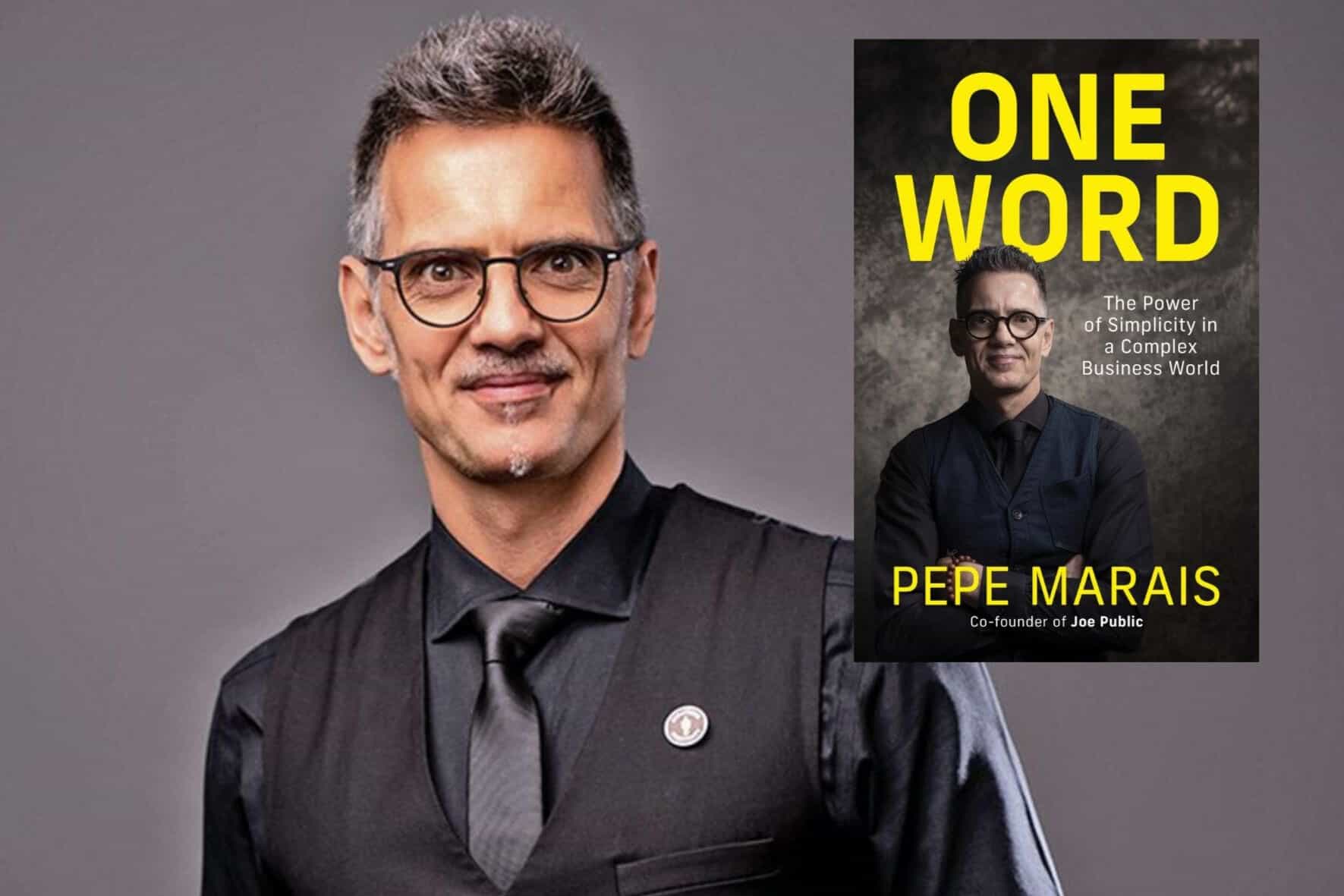
His book, One Word: The Power of Simplicity in a Complex Business World, unpacks this powerful notion and draws on his doctoral research into organisational purpose and conscious leadership.
“Purpose is the most talked about, yet least understood, business subject on the planet,” said Marais. “Statements are often consciously constructed, with little depth.”
Cutting the bullshit
And One Word is not a business book in the ra-ra sense of the word. It’s not another self-help aggrandising effort, but instead an exercise in blunt honesty.
The conventional thinking about it all goes back to Milton Friedman, who declared in the early 1970s that the purpose of business is to make money. Marais said that assumption has taken a serious knock.
“Over the course of the past two decades, this has been broadly challenged, with the opposing belief that businesses have greater roles to play within society, and that money is merely a by-product of this greater service.”
The destination, in other words, was never the money.
Most organisations hear the word purpose and reach for their Corporate Social Investment or CSI budget. Marais has little patience for that misreading.
“Organisational purpose is often wrongfully understood, with leaders assuming that it is CSI. It is not,” he said.
“Business purpose simply means that there is a greater why behind what the business does. And when this why is clarified, and everyone within an organisation focuses on this one objective, it is proven through multiple studies to yield exponential financial returns.”
Vision statements can also be a symptom of corporate nacissism.
“Vision is often constructed in the absence of purpose and is therefore mostly self-serving,” he said. “For example, to be the best. And when we are self-serving, the data shows that we are less sustainable.”
The average lifespan of a Western business has dropped from seventy years to fifteen over the last half century, a trajectory Marais said connects directly to that self-serving instinct.
Purpose is not CSI
Over more than two decades, working with upwards of sixty businesses, Marais developed a one-day process to help leaders find their word.
The single collection of letters that defines purpose. He used Joe Public as an example and said that it would be easy to assume that the one word that the agency stands for is creativity.
“But that would be the wrong assumption, as it is what we do as an organisation,” he said.
“When we asked why we do what we do, we arrived at our one word: growth, defined as serving the growth of our people, our clients, our country, and our world, through the greatness of our creativity. Since bringing purpose into the fabric of our business in 2010, this approach has seen Joe Public grow by over 3000%, which is an average compound rate of 30.8% per annum.”
“Every business I work with has a unique word at its essence that has been there since inception,” Marais said.
The word is never invented, but found.
“Finding an organisation’s purpose is totally achievable and, in fact, relatively simple. The complexity lies in implementing purpose.”
And this, he said, is where most efforts come unstuck.
“Ninety-three per cent of strategies factually fail at implementation,” he said, “and purpose is ultimately the deeper and more profound strategy of the business.”
“Due to this failure, we do not see enough examples of organisations that thrive based on their purpose. As a result, the narrative around purpose is slowly fading. Which is a great pity to me, as it is the most powerful tool for growing an abundant, thriving, and sustainable organisation.”
Purpose builds thriving organisations
The buck stops and starts with the leaders of an organisation, he said.
“An organisation can only ever be as conscious as its leaders,” said Marais. “Each leader must be aware of his or her own word, its meaning, and actively live their individual purpose before they can expect their organisation to behave in a purposeful manner.”
It’s an inconvenient truth to some.
“Leaders are not willing to do the depth of work needed to lead at this level first.”
And in a country where job creation is not an abstract policy goal but a daily lived reality for millions, unwillingness carries a cost that extends well beyond any balance sheet, he said.
Marais wrote the book specifically to serve the growth of entrepreneurial businesses in South Africa, because he believes that is the only real engine for the jobs the country desperately needs.
“Purpose is the most powerful tool for growing abundant, thriving, and sustainable organisations,” he said.