
The controversy has reignited debate around the commercial use of liberation history in South African advertising.

Dineo Langa starred in the now-deleted Glenlivet campaign, which drew widespread criticism for linking the 1956 Women’s March to alcohol advertising. Picture: Instagram, @dineomoeketsi


The Glenlivet South Africa and actress Dineo Langa have issued public apologies after a Women’s Month advertisement referencing the 1956 Women’s March and struggle icons was met with widespread condemnation online.
What the Glenlivet ad showed
The now-deleted 75-second black-and-white promotional video, which circulated widely via screen recordings after being pulled from official channels, featured Langa in a tailored light-coloured pantsuit, swirling a glass of Glenlivet whisky as she moved through interior spaces lined with portraits of Winnie Madikizela-Mandela, Lilian Ngoyi and Sophie Williams-de Bruyn.
On-screen text invoked “the great Mama Winnie Mandela” alongside the iconic anti-pass law slogan “Wathint’ abafazi, wathint’ imbokodo” (“You strike a woman, you strike a rock”), tying the courage of the 1956 marchers to what critics read as a celebratory toast with the product.
The backlash
The ANC was the first official organisation to release a statement titled “Statement on the Use of the Legacy of the 1956 Women’s March in Alcohol Advertising”, saying it had “noted with deep concern” an advert using the images of “some of South Africa’s most revered struggle icons… to promote an alcoholic product.”
The political party argued the campaign was “particularly insensitive” given how alcohol was historically used as “an instrument of exploitation and control” under apartheid, and called on Glenlivet to withdraw the ad, apologise, and explain how the campaign was approved.
ANC national spokesperson Mahlengi Bhengu-Motsiri echoed the call, saying the women’s “legacies and sacrifices are not marketing props”.
Social media users piled on.
Noxolo Madonsela questioned the link between “the courage of the women of 1956” and drinking alcohol, given the substance’s weaponisation under apartheid.
Khanyi Magubane described the ad as showing “a beautiful, well dressed, poised black woman” toasting struggle icons, quipping “So we fought to become men.”
X user, @NeoDinero, pointed out the irony that the featured generation of women had in fact protested at beer halls against men “drinking their salaries away”.
Thabiso Goba and Nthabeleng Likotsi called the campaign “tone deaf” and accused it of commodifying Black womanhood under the guise of “soft life” branding.
The apology
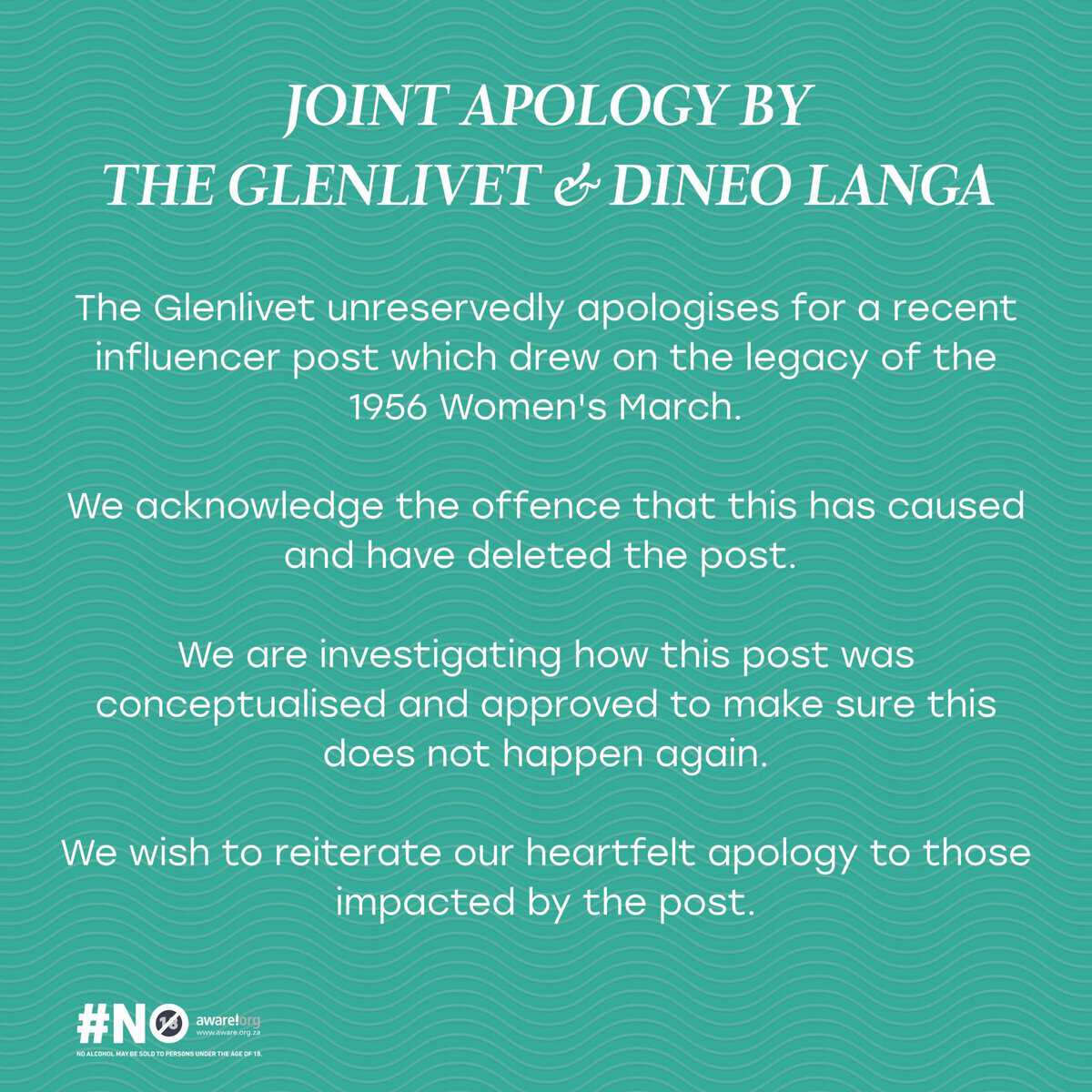
The Glenlivet SA responded on social media, confirming the post had been removed and offering a joint statement: “The Glenlivet unreservedly apologises for a recent influencer post which drew on the legacy of the 1956 Women’s March… We are investigating how this post was conceptualised and approved to make sure this does not happen again.”
Langa quoted the brand’s post, writing: “I am sorry for the harm I have caused. I understand the gravity of this mistake and will be more mindful in future.”
However, political analyst Tessa Dooms was sharpest on the apology itself, noting the ad involved “a budget, story boards, a script, production, editing and PR strategy,” dismissing claims it would be “investigated”.
The controversy has reignited debate around the commercial use of liberation history in South African advertising, and where the line sits between honouring struggle icons and exploiting them for brand equity.
The timing meant that the conversation occurred just before the close of Women’s Month, which marks the 9 August 1956 march of an estimated 20 000 women to the Union Buildings in Pretoria against pass laws.
At the time of writing, Glenlivet has not made public the findings of its internal review.