
Grade 9 students from across South Africa showcase their advanced Magic Marimba, Bead Bot and Indian puppet projects, which use technology to preserve culture.
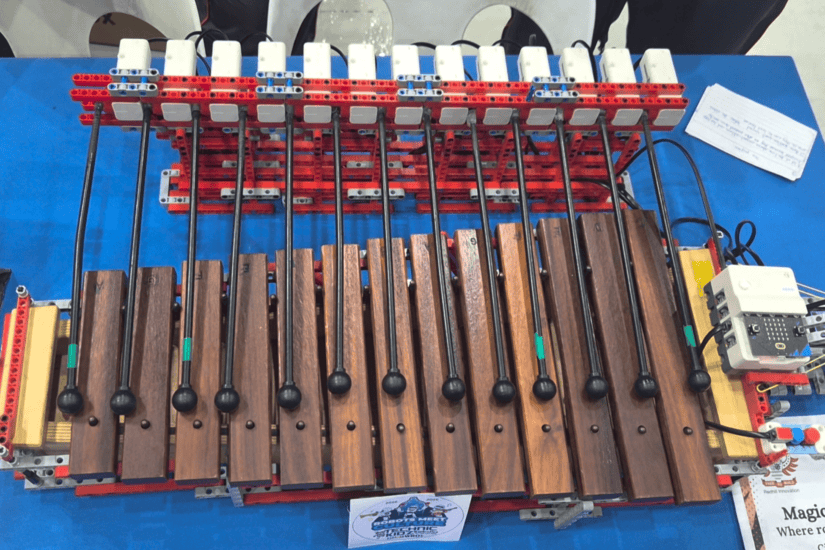
Picture: Caslian Scott- Inspired by Shona culture and their school’s national award-winning marimba band, Daneah, Miles and Matthew from Redhill School created a magic marimba that uses an artificial intelligent (AI) lens to read the image displayed, and play the desired song.


A group of young, eager robotics enthusiasts gathered at the Resolute Roboticon x World Robot Olympiad in Pretoria to showcase their inventions, as pupils from Grades 1 to 9 competed in various categories for a chance to win prizes.
Saturday’s event combined culture with technology, creativity, and brains to uplift the next generation of innovators, engineers, and technicians who are already mini experts in their craft.
The Magic Marimba
A group of grade nine coding and robotics students collaborated on an invention they call the Magic Marimba.
Inspired by Shona culture and their school’s national award-winning marimba band, Daneah, Miles and Matthew from Redhill School created a Magic Marimba that uses an artificial intelligence (AI) lens to read the image displayed and play the desired song.
An ode to Shona culture
“We created the Magic Marimba because we wanted to preserve Shona culture.”
Daneah explained that the Shona people are from Zimbabwe and noted that the instrument is an important part of their heritage.
“The Shona people usually sing songs related to the activities they are doing, so that is why we created four songs: a grinding song, a praising song, a threshing song and a weaving song.”
She said that she was mostly involved in the design and presentation of the invention.
3 000 lines of code
Miles, was the chief coder, project manager and quality controller, said they coded a total of 3 000 lines of code for three different micro: bits that allow the marimba to play on its own.
Miles explained that the micro: bits work together with radio signals to speak to each other and make sound.
“The micro: bits use the AI lens to recognise images depending on the song.”
Saving musical heritage
Meanwhile, Matthew, the researcher, material manager and builder, said that the point of the marimba was to save the musical heritage of the Shona.
“Because when the elders die, they usually have all the information and songs, that gets lost,” Matthew said.
“So we wanted to preserve that by having a marimba that can play it all without anybody having to do any physical work.”
Remembering forgotten culture
Matthew emphasised that the Magic Marimba can teach the next generation how to play it, while keeping the culture alive.
In an attempt to keep the verbal traditions alive, the team created a physical instrument using real marimba keys to reconstruct the self-playing Magic Marimba.
Daneah explained that they wanted to start with cultures and traditions that are easy to forget.
A butter chicken sensing robot
A pair of grade nine students from Greenside High School, Aaliah Amanjee and Salma Hoosen, chose to represent their Indian culture by creating a puppet-like robot that can identify butter chicken and foods related to the region.
“It is able to educate people who are ignorant about a lot of the minority groups, including the Gujarati people.”
“It can teach children and many communities about Indian culture.”
A taste of India
She explained that the puppet named Lakshmi Khan aims to break the stereotypes associated with Indians by providing a model that can do the traditional Indian dance, teach how to count in Gujarati, sense a hand waving and wave back, while also explaining the Taj Mahal.
The model can even sense butter chicken, a popular Indian dish in India, and jalebi, which is a popular spiral-shaped Indian dessert.
Once the food items reach the light sensor on the model, which stands in front of an image of the Taj Mahal, the robot tells the user the name of the dish and explains what it contains.
“We thought that this would be a good way to make learning about the Indian culture more interactive,” Salma noted.
The Bead Bot
Meanwhile, another pair of grade nine students from St. Dominic’s in Newcastle, KwaZulu-Natal, were inspired to create a Bead Robot that can create bracelets and necklaces.
The Bead Bot was coded and assembled by Yuvaan Singh and Jason Fan, who were inspired to innovate the bot after Yuvaan’s special bracelet broke and he did not know how to put it back.
“Since the bracelet was quite expensive, I didn’t want to go and buy a new one, because it also had sentimental value,” Singh said.
Robot solution
“So I tried to rethread it, but it was very difficult,” Singh reiterated.
After scouring the internet for answers without success, he decided to design and build the Bead Bot.
Jason explained the various buttons on the intricate bot that represent various bead colours.
How it works
The thread runs along the middle of the Bead Bot; each time one presses a button, a different-coloured bead will emerge from the top cup and line up perfectly with the thread, creating the desired necklace and bracelet.
The duo also created additional pieces for their Bead Bot, including a colour sorter and a pattern designer, using their knowledge in coding and design.
In the hopes that they would be the ones taking home the World Robot Olympiad Champion title in Puerto Rico, where the competition will be held this year, they explored the theme ‘Robots Meet Culture.’